The Technical Vault
By SOSCleanroom
TX3225 Sterile TexTra 10 12" x 12": sealed-border polyester knit for ISO 3–8 sterile wipe-downs with high sorption
Last reviewed: Jan. 4, 2026 | Audience: contamination control, cleanroom operations, EHS, quality
Texwipe TX3225 Sterile TexTra 10 is a sterile, gamma-irradiated, 100% continuous-filament polyester knit wiper built for controlled wipe-downs where
you need a sealed border (to reduce edge-driven debris) and a thicker knit that behaves like a two-ply in liquid hold-up—without the bulk and handling
variability that can show up with layered constructions.
In practice, TX3225 is selected when teams want repeatable wipe mechanics in ISO Class 3–8 environments: strong abrasion resistance, broad solvent
compatibility, and packaging controls that make sterile transfer easier to execute consistently across shifts. It is commonly written into SOPs for aseptic
suites, critical equipment wipe-downs, and solution application/removal steps tied to USP <797> and USP <800> cleaning workflows.
What it’s for
Sterile wiping and cleaning of environmental surfaces and production equipment; applying and removing cleaning/disinfecting solutions; spill control; and
solvent wiping (e.g., IPA, ethanol, acetone, degreasers) when validated for the surface and the process endpoint. TX3225 is also used as a tray/parts-lining
wipe to protect, dry, and stage items during aseptic handling, when allowed by the site’s material transfer and cleaning SOPs.
Decision drivers
TX3225 is most valuable when your risk is “sterile wipe-down drift” (inconsistent technique, inconsistent wiper construction, or inconsistent packaging control),
and you want to reduce variability while keeping a sealed-edge polyester platform.
- Sterile, validated SAL: Gamma irradiated and sterile validated to a Sterility Assurance Level (SAL) of 10-6 for sterile/aseptic environments.
- Sealed-border edge strategy: Sealed border helps reduce fraying and edge-shed during rigorous wiping on abrasive features.
- High sorption without “two-ply handling”: Thick single-layer knit designed to behave like a two-ply for liquid holding capacity, simplifying wipe technique.
- ISO room-class fit: Positioned for ISO Class 3–8 (Class 1–100,000; EU Grade A–D) programs; qualify to your acceptance limits and wipe method.
- Chemistry compatibility posture: Polyester knit with strong chemical resistance for common cleanroom solvents and disinfectant solutions (validate for your specific chemistry/contact time).
- Packaging + traceability controls: Case-level documentation and lot coding support investigations and change control; packaging supports wipe-down of the outer bag before sterile entry.
Materials and construction
TX3225 is a single-ply, double-knit, no-run interlock wiper made from 100% continuous-filament polyester, cleanroom laundered, with a thermally sealed border.
Operationally, the combination matters: continuous-filament polyester reduces “short fiber” breakage pathways, the no-run knit resists unraveling, and the sealed
border reduces edge-driven debris when the wipe is dragged across fasteners, welds, brushed stainless, or textured polymer guards.
Sterile lots are gamma irradiated and supported by lot-level controls. That reduces the need to autoclave in-house for many programs and helps keep sterile
wipe-down performance more consistent—especially when cleaning frequency and documentation burden are high.
Specifications in context
SKU: TX3225
Wiper family: TexTra 10
Size: 12" x 12" (31 cm x 31 cm) nominal
Material: 100% polyester (continuous filament knit)
Edge strategy: sealed border (thermally sealed)
Sterility: sterile; gamma irradiated; SAL 10-6
ISO range (positioning): ISO Class 3–8 (Class 1–100,000; EU Grade A–D)
Shelf life (sterile, dry): 3 years from date of manufacture
Packaging (case): 5 bags per case; 100 wipers per bag (5 inner bags of 20); 500 wipers per case total.
Physical typicals (TexTra 10 TDS): basis weight 233 g/m2; sorptive capacity 600 mL/m2; sorptive rate 0.3 second.
In context: TX3225 is usually the “high-contact sterile wipe-down” selection—strong enough to wipe aggressively without snagging easily, absorbent enough to apply/remove
larger volumes of solutions, and packaged to support disciplined sterile entry and traceability.
Cleanliness and performance metrics
Treat cleanliness values as a qualification framework: particles/fibers speak to shedding potential, NVR speaks to residue film risk, and ions speak to corrosion/ionic
contamination risk. Published values are typical analyses and should be confirmed under your chemistry, contact time, surface roughness, and inspection endpoint.
Typical contamination metrics (TexTra / TexTra 10 TDS):
• LPC (≥0.5 µm), TexTra 10: 4.2 x 10⁶ particles/m2
• Fibers (>100 µm), TexTra 10: 60 fibers/m2
Typical NVR (TexTra 10):
• IPA extractant: 0.04 g/m2
• DIW extractant: 0.01 g/m2
Typical ionic extractables (TexTra 10):
• Sodium: 0.15 ppm • Potassium: 0.15 ppm • Chloride: 0.10 ppm
Operational interpretation: the sealed border and knit structure are designed to keep wiping stable when contact pressure increases. If you see particle spikes in practice, it is
more often a technique or surface-condition problem (loaded faces, over-wetting, rough/snaggy fixtures) than a “bad wipe” problem.
Sterility, packaging transfer, and traceability control
TX3225 is supplied sterile (gamma irradiated) and is described as individually lot coded for traceability and quality control. From a controls standpoint, the packaging
architecture matters as much as the wipe: outer bag wipe-down, controlled presentation of the inner bags, and disciplined “touch points” reduce the probability that the wipe
becomes the contamination vector during a sterile cleaning event.
Rule of thumb: Treat the outer bag as “dirty,” the inner bag as “sterile-suite eligible,” and the wiper stack as “sterile only if you never back-track a glove.” If you touch a non-sterile surface, rotate gloves or re-gown per SOP before returning to the wipe stack.
Best-practice use
For sterile wipe-downs, consistency beats intensity. Your goal is to lift residues and remove solution films without re-depositing contamination or “polishing” a drying film back into the surface.
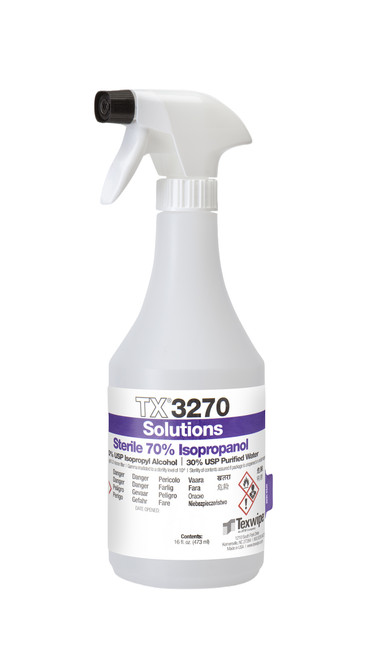
- Stage the transfer: Wipe down the exterior package per SOP (often sterile 70% IPA) before introducing the inner bag into the sterile area.
- Fold for face management: Quarter-fold and rotate faces early. Define a max surface area per face (or per pass) for critical equipment wipe-downs.
- Wet-clean then finish: Use a wet pass to dissolve/lift, then a fresh wipe/face for the final pass to reduce streaking and re-deposition.
- One-direction strokes with overlap: Clean-to-less-clean with consistent overlap. Avoid circular wiping unless your SOP requires an emulsification step followed by a controlled finish.
- Snag discipline: If the wipe snags on a sharp edge or fastener, discard immediately and treat the surface condition as a maintenance finding.
- Document the lot when it matters: If the cleaning event is tied to batch release or investigation risk, record the lot/case identifier in the cleaning record.
Common failure modes
Streaking or visible film: Usually caused by over-wetting, wiping too large an area with a single face, or finishing while the solvent is drying. Correct by reducing wetness, tightening face rotation, and using a fresh finishing pass.
Re-deposition events: Commonly driven by back-tracking a contaminated glove to the wipe stack or reusing a loaded face. Correct with explicit sterile touch-point discipline and “discard triggers.”
Particle spikes on rough fixtures: Often surface-condition driven (burrs, damaged coatings, rough welds) rather than wipe-driven. Correct by addressing the surface and standardizing pressure and stroke pattern.
Traceability gaps: Occur when sterile supplies are staged without recording lot/case identifiers for high-risk processes. Correct by defining when lot capture is required and making it easy at point-of-use.
Closest competitors
Berkshire Gamma Wipe®-VP (sterile sealed-edge 100% polyester knit): Competes on the same mechanism set (sterile + sealed edge + knit polyester) for ISO Class 3+ environments. Programs often compare these platforms based on packaging controls, sterility documentation posture, and how the wipe behaves under higher friction wipe-downs.
Contec Sterile Polynit Heatseal Wipes (laser-sealed edge 100% knit polyester): Another sealed-edge knit polyester approach aimed at very low particles/fibers and chemical resistance. The differentiator is often edge technology (laser/heatseal style) and how the wipe feels and performs on sensitive product-contact surfaces.
Valutek VT2PNWUS (ultrasonic-sealed edge 2-ply polyester knit): A higher-absorbency sealed-edge polyester knit option positioned for ISO 3–4 environments. Often evaluated when teams want more liquid capacity per sheet while keeping sealed-edge controls.
Where it fits in a cleanroom wiping program
TX3225 fits as a sterile sealed-border polyester knit “primary wipe-down” wiper for ISO Class 3–8 programs—especially when surfaces are abrasive, wiping is frequent,
and documentation/traceability expectations are high. Many mature programs use it in a tiered system: TX3225 for routine sterile equipment and environmental wipe-downs,
then escalate based on endpoint sensitivity (surface residue limits, particle limits, or product-contact criticality) using qualification data rather than assumptions.
SOSCleanroom can support the program side—repeatable supply, consistent documentation posture, and practical guidance so the selected wipe performs the same way across shifts.
Terminology note: Engineered for low-linting performance; no wiper is truly “lint-free” in every process condition.
Source basis
- SOSCleanroom product page — Texwipe TX3225 Sterile TexTra10 12" x 12" Polyester Cleanroom Wiper: https://www.soscleanroom.com/product/wipers/texwipe-tx3225-sterile-textra10-12-x-12-polyester-cleanroom-wiper/
- SOS-hosted PDF (stable reference) — “Sterile TexTra 10” (TX3224/TX3225 product bulletin; Effective: Aug. 2012): https://www.soscleanroom.com/content/texwipe_pdf/3224%203225.pdf
- Manufacturer technical data sheet (current) — TexTra™ / TexTra™ 10 TDS (TEX-LIT-TDS-017 Rev. 8/23): https://www.texwipe.com/images/uploaded/documents/Wipers/Texwipe-TexTraTexTra10_TDS.pdf
- Manufacturer product page — Sterile TexTra™ 10 TX3225: https://www.texwipe.com/sterile-textra-10-tx3225
- Berkshire Gamma Wipe®-VP sterile product family: https://berkshire.com/product-category/cleanroom-wipes/sterile/gamma-wipe-vp/
- Contec Sterile Polynit Heatseal Wipes product data sheet (PDF): https://www.contecinc.com
- Valutek VT2PNWUS technical data sheet (PDF): https://help.valutek.com/hubfs/Technical%20Data%20Sheets%20-%202023/Wipers/VT2PNWUS.pdf
Source: SOSCleanroom Technical Vault | Last reviewed: Jan. 4, 2026
© 2026 SOS Supply. All rights reserved.