The Technical Vault
By SOSCleanroom
When Wiping Needs “Bite”: Why TX4409 TechniScrub Adds Mechanical Cleaning Control for ISO 5–8 Wipe-Downs
Last reviewed: Jan. 3, 2026 | Audience: contamination control, cleanroom operations, EHS, quality
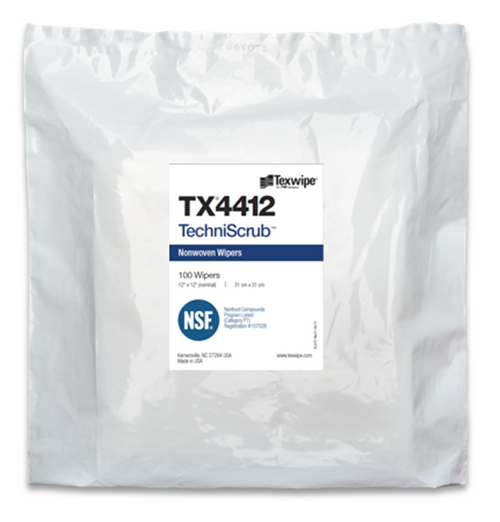
Texwipe TX4409 TechniScrub (9" × 9") is a dry, hydroentangled cellulose/polyester nonwoven engineered for the situations where a smooth wipe is not enough—dried aqueous spills, sticky films, disinfectant residue buildup, and “unknown grime” on carts, handles, and equipment exteriors.
Its defining control feature is two-sided function: a textured “scrub” side to increase mechanical soil break-up and a smoother side for follow-through wiping. Used correctly, that helps teams clean faster without turning technique into a variable—especially in ISO Class 5–8 environments where rework often traces back to inconsistent pressure, too many passes, or overworking a loaded wipe face.
Program note: Treat TX4409 as the “soil release” tool. When residue background is the limiting factor, follow with a defined finishing wipe (often a polyester knit) and an approved solvent strategy.
What it’s for
TX4409 is intended for general-purpose wipe-downs and spill cleanup where you need high absorbency and added scrubbing action without leaving uncontrolled shop-rag behavior inside a controlled environment. It is commonly selected for:
- Bench, cart, and equipment exterior wipe-downs after maintenance or high-traffic handling
- Removal of dried aqueous films and sticky residues that require friction to break free
- Disinfectant wipe-down support (process-dependent) where the “scrub then wipe” pattern improves consistency
- Housekeeping tasks in ISO Class 5–8 areas where absorbency and speed matter, but documentation and cleanliness still apply
Decision drivers
TX4409 earns its place when cleaning outcomes are limited by soil release—not by the chemistry:
- Two-sided mechanics: textured face increases frictional cleaning; smooth face supports controlled follow-through wiping.
- Blend logic: 50% polyester / 50% cellulose balances absorbency with wet strength for practical wipe-down cycles.
- Hydroentangled construction: engineered fiber entanglement (rather than binder-driven bonding) supports durability under scrubbing.
- Published cleanliness framework: typical values for particles/fibers, NVR, and ionic extractables support placement discussions for ISO 5–8 use.
- Packaging discipline: cleanroom packaging with double-bag presentation supports controlled introduction and staging.
- Qualification posture: lot-level control and documented performance context reduce “mystery variable” risk when results drift.
Terminology note: TX4409 is engineered for low-linting performance; no wiper is truly “lint-free” in every process condition.
Materials and construction – explained like an engineer
“Nonwoven blend” is not a sufficient spec when you are troubleshooting residue and releasables. TX4409 uses a hydroentangled cellulose/polyester structure so the web holds together under force and wetting. The cellulose fraction drives fast wet-out and high capacity—critical for spill pickup and disinfectant application/removal—while the polyester fraction improves tensile strength during scrubbing and repeated passes.
The two-sided surface design is the practical differentiator. A textured face increases local shear at the surface (useful for dried films), but it also increases mechanical interaction with the substrate. That is why mature programs separate roles: use the textured face to release soil, then complete the step with controlled strokes and a clean face (or a defined finishing wipe) to prevent redeposit.
Specifications in context
- Size: 9" × 9" (approx. 23 cm × 23 cm)
- Substrate: 50% polyester / 50% cellulose; hydroentangled nonwoven
- Surface: textured scrub side + smoother wipe side
- Packaging (typical): 150 wipers/bag; 10 bags/case; double-bag presentation (confirm the exact sell-pack on receipt)
- Intended environments: ISO Class 5–8 (final suitability depends on the process window and technique)
- Shelf life (non-sterile, manufacturer-stated): 5 years
Autoclave note: TX4409 is described as autoclavable in a dry state. “Autoclavable” is not a sterile product claim by itself; if you sterilize in-house, you own cycle qualification, packaging compatibility, and post-cycle performance verification.
Cleanliness and performance metrics
For most facilities, wiper risk lives in three buckets: releasables (particles/fibers), residues (NVR), and ions (corrosion/ECM sensitivity). TX4409’s published typical values support qualification conversations and help define where it belongs in the wipe hierarchy.
- Sorption capacity: 520 mL/m² (typical). High capacity is an advantage for spills and wet wipe-downs—unless over-wetting turns the step into pooling and streaking.
- Sorptive rate: < 1 second (typical). Fast wet-out reduces the “multiple passes to get it wet” failure mode.
- Particles (>0.5 µm): 70 × 106 particles/m² (typical).
- Fibers (>100 µm): 55,000 fibers/m² (typical).
- NVR: 0.03 g/m² (DI water) and 0.02 g/m² (IPA) (typical). If haze persists after dry-down, the first levers are face rotation, wetness control, and chemistry discipline—not added pressure.
- Ionic extractables (typical): sodium 12 ppm, potassium 1 ppm, chloride 10 ppm (standard products listed). If ionic background is the constraint, consider validating the wipe step or selecting an all-polyester architecture for finishing.
USP framing (manufacturer-stated): TechniScrub is described as meeting USP <797> and <800> wiper requirements. In regulated programs, treat this as a starting point and align selection to your SOPs, area classification, and documentation expectations.
Why a “scrub” wiper matters operationally
Many wipe-down failures occur when teams try to force a smooth wipe to do a mechanical job. That drives longer contact time, higher pressure, and repeated passes—exactly the behaviors that increase redeposit and raise fiber/particle contribution. A scrub-texture wipe can reduce total passes by releasing soil faster. The control requirement is to keep technique disciplined: use the scrub side to break the film, then transition to a clean face (and often a smoother finishing tool) to remove the mobilized residue.
Rule of thumb: If the soil is “stuck,” texture helps. If the surface is defect-sensitive or the residue budget is tight, finish with a defined low-linting polyester wipe and a controlled solvent strategy.
Best-practice use
- Start with wipe roles: scrub side to release soil; smooth side (or a fresh wipe face) to remove and control the released contamination.
- Fold for control: quarter-fold to create multiple clean faces; treat each face as single-pass for critical wipe-downs.
- Directional strokes: use straight, overlapping passes; avoid random back-and-forth scrubbing that redistributes mobilized soils.
- Wetness discipline: aim for damp cleaning. Over-wetting elevates pooling, wicking into seams, and dry-down residue.
- Change-out triggers: once a face is loaded or near saturation, it becomes a redistribution tool—discard early.
- Surface sensitivity check: for delicate finishes, validate the scrub texture on representative materials before broad deployment.
Common failure modes — and how to prevent them
- Using scrub texture as a default on delicate surfaces: may increase cosmetic risk. Prevent by defining where texture is allowed and where finishing tools are required.
- Overworking a saturated wipe: turns high sorption into redeposit. Prevent with strict face rotation and early discard rules.
- Over-wetting: increases streaking and residue after dry-down. Prevent with controlled dispensing and “damp, not wet” targets.
- Failing to separate scrub and finish steps: mobilizes soils but leaves them behind. Prevent by planning a two-phase wipe (release, then removal/finish).
- Assuming “autoclavable” equals “sterile”: creates compliance gaps. Prevent by aligning sterilization claims to validated packaging and process controls.
Closest comparators
The most defensible comparisons are to other engineered nonwoven programs where absorbency and controlled documentation matter—then the differentiator becomes texture, wetness control, and packaging discipline.
Berkshire Choice® Nonwoven 500 (polyester/cellulose nonwoven) is a relevant dry-wipe comparator when the goal is high absorbency and general-purpose controlled wiping. Evaluate published contamination context, packaging configuration, and how the wipe behaves under your disinfectant and solvent set.
Contec PROSAT® Sterile Theta™ (hydroentangled cellulose/polyester presaturated with 70% IPA/DI) is an appropriate comparator when the primary control need is wetness standardization and solvent accountability rather than a dry scrub-texture mechanic. If operator variability in solvent loading is the failure mode, a presaturated system is often the more direct control step.
Where TX4409 fits in a cleanroom wiping program
TX4409 is a strong choice for ISO 5–8 operations that need a mechanical cleaning step inside the controlled program: fast wet-out, high absorbency, and a textured face that improves soil release so operators do not compensate with excessive pressure and repeated passes. Use it for maintenance wipe-downs, dried spills, and stubborn film removal—then keep the program mature by defining a finishing strategy when residue background or defect sensitivity is the governing requirement.
Source basis
- SOSCleanroom product page: “Texwipe TX4409 TechniScrub 9" × 9" Cellulose and Polyester Cleanroom Wiper” (positioning, intended ISO range, packaging configuration).
- ITW Texwipe technical data sheet: “TechniScrub® Wipers (TX4409, TX4412)” (substrate and two-sided design, typical performance and contamination characteristics, sorption and cleanliness metrics, shelf life, USP framing, autoclave note).
- Berkshire product information: Choice® Nonwoven 500 / value-tier nonwoven wipe programs (category positioning and intended-use framing for dry nonwoven wipe programs).
- Contec product information: PROSAT® Sterile Theta™ wipes (hydroentangled cellulose/polyester presaturated system; ISO range; wetness-control framing).
Source: SOSCleanroom Technical Vault | Last reviewed: Jan. 3, 2026
© 2026 SOS Supply. All rights reserved.