The Technical Vault
By SOSCleanroom
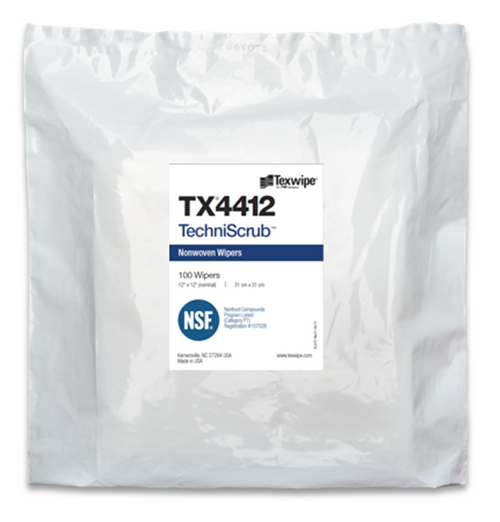
TX4412 TechniScrub 12" x 12": Dual-Surface Deposit Removal With High Sorption for ISO 5–8 General Cleaning
Last reviewed: Jan. 4, 2026 | Audience: contamination control, cleanroom operations, EHS, quality
Texwipe TX4412 TechniScrub is a nonwoven cleanroom wiper built for “real-world” cleaning tasks: removing deposits, absorbing spills, and wiping down equipment and parts without forcing your team into an over-specified sterile wipe. Its core advantage is mechanical: one side is textured for deposit break-up, and the opposite side is smoother for follow-up wiping to a visual-clean endpoint.
TX4412 is commonly used in ISO Class 5–8 environments where sorption capacity and chemical compatibility matter more than ultralow-shedding knit behavior. It is supplied as 100 wipers per bag (10 bags per case), and it is individually lot coded for traceability. SOSCleanroom supports teams that want consistent shift-to-shift outcomes by standardizing the wiper/chemistry pairing, the wipe technique, and reorder cadence so cleaning performance does not drift over time.
What it’s for
TX4412 is intended for general cleanroom wiping and cleaning of surfaces, equipment, and parts; spill control; applying and removing lubricants, adhesives, residues, and other solutions (including disinfectants) under your SOP; and solvent wiping with common chemistries such as IPA, ethanol, acetone, and degreasers when validated for the surface and process endpoint. It is also commonly selected to support USP <797> and USP <800> workflows where a robust, lot-traceable wipe is required for routine cleaning steps.
Decision drivers
TechniScrub is best selected when you want a “deposit-removal + follow-up wipe” behavior from a single sheet, and when your process benefits from higher sorption and a forgiving nonwoven hand feel.
- Dual-surface cleaning behavior: Textured side helps break up deposits; smoother side supports a more uniform follow-up wipe to a visual endpoint.
- Sorption capacity: Higher sorptive capacity can reduce wipe count for spill control and wet wiping steps, which can reduce rework and operator time.
- Edge strategy (cut edge): Cut edges are a practical choice for many ISO 5–8 general cleaning steps; confirm fit if your endpoint is extremely fiber-sensitive.
- Chemical compatibility posture: Designed for compatibility with a broad range of cleaning solutions; confirm in your chemistry/contact-time and surface-energy conditions.
- Room-class fit: Positioned for ISO Class 5–8 and EU Grade B–D use; qualify to your facility’s acceptance limits and wipe method.
- Traceability: Individually lot coded packaging supports investigations and incoming control discipline.
- Autoclave option: Dry wipers are described as autoclave safe; validate the cycle and packaging configuration you intend to use before adopting.
Materials and construction
TX4412 is a 50% polyester / 50% cellulose nonwoven constructed to combine the absorbency of cellulose with the strength and chemical resistance contribution of polyester. In process terms, that blend is a common “workhorse” architecture: it takes up fluid quickly, tolerates many cleaning chemistries, and holds together during deposit removal where pure cellulose wipes can tear and pure synthetic wipes can feel less absorbent.
The dual-face design is the functional detail worth training around. When operators consistently use the textured side first (deposit break-up) and reserve the smoother side for the final pass, results are more repeatable and streaking/re-deposition events tend to drop.
Specifications in context
Part number: TX4412 (TechniScrub dry wipers).
Size: 12" x 12" (31 cm x 31 cm) nominal.
Type: Dry wiper (non-sterile).
Material: 50% polyester / 50% cellulose nonwoven.
Edge strategy: Cut edge.
ISO range (manufacturer positioning): ISO Class 5–8 (Class 100–100,000; EU Grade B–D).
Shelf life (non-sterile, dry): 5 years from date of manufacture.
Packaging (SOSCleanroom listing and manufacturer table):
• Bag unit: 100 wipers per bag.
• Case unit: 10 bags per case (1,000 wipers/case).
Physical typicals (manufacturer TDS): basis weight 72 g/m2; sorptive capacity 520 mL/m2; sorptive rate <0.3 seconds.
In context, TX4412 is usually selected when “absorb fast, wipe clean, keep moving” matters—equipment wipe-downs, spill response, and general cleaning steps where your acceptance criteria are compatible with a cellulose/polyester nonwoven and a cut-edge profile.
Cleanliness and performance metrics
Use wiper metrics as a qualification framework: particles/fibers indicate shedding potential, NVR indicates residue risk, and ionic extractables indicate corrosion/ionic contamination risk. Published values are typical analyses and should be confirmed under your chemistry, contact time, and inspection endpoint.
Typical contamination metrics (TechniScrub TDS):
• Particles (LPC ≥0.5 µm): 70 x 106 particles/m2
• Fibers (>100 µm): 55,000 fibers/m2
Nonvolatile residue (NVR):
• IPA extractant: 0.01 g/m2
• DI water extractant: 0.03 g/m2
• Ethanol extractant: 0.01 g/m2
Ionic extractables (typicals):
• Sodium: 12 ppm • Potassium: 1 ppm • Chloride: 10 ppm
Operational interpretation: TX4412 is a strong fit for general cleaning and wipe-down steps where sorption and deposit removal drive the outcome. If your endpoint is unusually fiber-sensitive or you are wiping high-energy optics/surfaces that punish re-deposition, validate the cut-edge nonwoven behavior against your acceptance criteria before locking it into an SOP.
Lot traceability, texture-side control, and autoclave considerations
TechniScrub is described as individually lot coded, which supports basic quality controls (incoming inspection, deviation investigations, and “what changed?” troubleshooting). On the floor, the bigger control lever is consistent face usage: treat the textured side as the “break-up” tool and reserve the smooth side for the final pass. The manufacturer also notes dry wipers are autoclave safe; if you intend to autoclave TX4412, validate the cycle, packaging, and post-cycle handling so the wipe does not become the weak link in your control plan.
Rule of thumb: Use textured-first, smooth-last, then discard. If you see drag marks or re-deposition, you are usually reusing a loaded face or over-wetting the sheet.
Best-practice use
Nonwoven blended wipes are highly effective when technique is standardized. Your goal is to prevent re-deposition by controlling wetting, face rotation, and stroke pattern.
- Define the sequence: Textured side for deposit removal; smooth side for final wipe. Train this explicitly to reduce operator-to-operator variability.
- Control wetting: Dampen rather than flood. Over-wetting increases streaking, mobilizes residues, and encourages re-deposition.
- Fold for face management: Fold into quarters; treat each face as single-use for a defined area. Rotate faces early, not late.
- Straight passes with overlap: Wipe clean-to-less-clean in parallel strokes with overlap; avoid circular wiping unless your SOP requires it.
- Match chemistry to objective: Use validated solutions for soil type (oils, adhesives, disinfectant residues). Confirm compatibility for sensitive plastics, coatings, and painted surfaces.
Common failure modes
Re-deposition and streaking: Usually driven by over-wetting, wiping too large an area with one face, or using the textured side for the final pass. Correct by tightening wetting control, enforcing face rotation, and standardizing textured-first / smooth-last.
Visible fiber events in fiber-sensitive areas: Cut-edge nonwoven behavior may not match ultra-sensitive endpoints. Correct by validating against your acceptance criteria or escalating to a sealed-edge synthetic platform for those steps.
Inconsistent results across shifts: Commonly caused by “personal technique.” Correct by locking fold method, stroke pattern, face limits, and discard triggers into the SOP and training aids.
Residue outcome does not match expectations: Typical NVR/ionic values may not predict your solvent/contact-time endpoint. Correct with method-fit validation and, if needed, adjust chemistry, contact time, or wipe selection.
Closest competitors
Berkshire Durx® 670 (cellulose/polyester hydroentangled nonwoven): Competes on the same blended-substrate mechanism (absorbency + chemical compatibility) and is commonly positioned for ISO Class 5 and above. Mechanistically similar for general cleaning and wipe-down tasks; confirm edge profile, packaging, and published contamination metrics against your process endpoint before substitution.
Contec Amplitude™ EcoCloth™ (cellulose/polyester hydroentangled nonwoven): Competes as a high-sorbency cellulose/polyester nonwoven intended for general-purpose wipe-down and spill control. Mechanistically, it competes on loft/sorption efficiency and solvent compatibility. Confirm room-class fit, packaging controls, and any contamination/compatibility requirements specific to your site.
Where it fits in a cleanroom wiping program
TX4412 fits as a general cleaning and wipe-down wiper in ISO Class 5–8 programs where the cleaning objective includes deposit removal and spill absorption, and where the process can accept a cellulose/polyester nonwoven with a cut edge. Many programs use a tiered approach: blended nonwovens like TechniScrub for routine cleaning and spill response, then escalate to sealed-edge synthetic wipes for the most fiber-sensitive steps or for final wipes tied to tight residue/particle limits. Qualification should be based on your actual surfaces, soils, chemistries, and inspection endpoints—not on “typicals” alone.
SOSCleanroom can help standardize the wiper/chemistry pairing and the operator technique so performance is repeatable, supply is stable, and change control is easier when you need to adjust the program.
Terminology note: Engineered for low-linting performance; no wiper is truly “lint-free” in every process condition.
Source basis
- SOSCleanroom product page — Texwipe TX4412 TechniScrub 12" x 12" Cellulose and Polyester Cleanroom Wiper: https://www.soscleanroom.com/product/wipers/texwipe-tx4412-techniscrub-12-x-12-cellulose-and-polyester-cleanroom-wiper/
- SOS-hosted PDF (stable reference) — TechniScrub™ Dry Wipers Technical Data Sheet (TDS_TechniScrub_2017_CuR2.pdf; TEX-LIT-TDS-039 Rev.00-04/17; includes TX4412 packaging + typicals): https://www.soscleanroom.com/content/texwipe_pdf/TDS_TechniScrub_2017_CuR2.pdf
- Manufacturer PDF — Texwipe TechniScrub™ TDS (ENG): https://www.texwipe.com/images/uploaded/documents/Wipers/Texwipe-TechniScrub-TDS-ENG.pdf
- Manufacturer product page (TX4412 family context): https://www.texwipe.com/tx4412
- IEST-RP-CC004.3 — Evaluating Wiping Materials Used in Cleanrooms and Other Controlled Environments (test-method context referenced in TDS): https://www.iest.org/
- ASTM E2090-12 — Size-differentiated counting of particles and fibers released from cleanroom wipers (test-method context referenced in TDS): https://www.astm.org/
- ISO 14644 (parts 1 and 2) — Cleanroom classification and monitoring context: https://www.iso.org/
- Berkshire Durx® 670 product page (mechanism comparator): https://berkshire.com/shop/cleanroom-wipes/nonwoven-wipes/durx-670/dr670121220p/
- Contec Amplitude™ EcoCloth™ datasheet (mechanism comparator): https://cleanroom.contecinc.com/hubfs/1%20-%20Website%20Assets/Product%20Center/Product%20Data%20Sheets/Cleanroom/Wipes/pdf
Source: SOSCleanroom Technical Vault | Last reviewed: Jan. 4, 2026
© 2026 SOS Supply. All rights reserved.