The Technical Vault
By SOSCleanroom
Laser-Edge, High-Sorption, Low-Handling Risk: Why TX49 Vertex Is Built for Wiping That Can’t Drift
Last reviewed: Jan. 2, 2026 | Audience: contamination control, cleanroom operations, EHS, quality
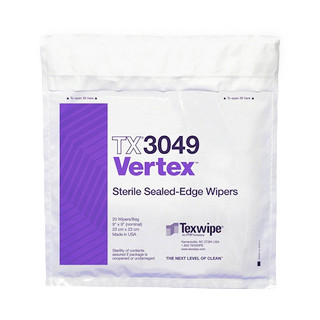
Texwipe TX49 Vertex™ (9" × 9") is a dry, high-sorption continuous-filament polyester knit cleanroom wiper with a laser edge, engineered for programs that want soft handling on sensitive surfaces while still driving down the two operational causes of wipe variability: inconsistent absorbency and inconsistent handling.
Vertex is not just a substrate choice. It is a manufacturing-and-packaging control posture designed to limit human contact prior to use and tighten lot-to-lot consistency. That matters when your “routine wipe” sits close to defect-sensitive work, where the easiest way to create investigation churn is to allow an uncontrolled consumable to drift.
Reliability is part of the control plan. SOSCleanroom supports continuity of supply and documentation discipline so operators are not pushed into last-minute substitutions that change absorbency, edge behavior, and background cleanliness.
What it’s for
TX49 is best used for spill control, solution pickup/removal, and routine wipe-down where high sorption and a soft “hand” reduce the number of wipes needed and lower the risk of abrasion-driven surface marks. It is commonly selected for benches, carts, tool exteriors, staging surfaces, and component wipe-down where operators need fast uptake without stepping into bulky absorbent pads or uncontrolled shop wipes.
Because it is a knit polyester architecture, it is also a practical choice when you want broad chemical compatibility and stable performance across multiple cleaning chemistries (qualification should be based on your solvent/disinfectant set and your acceptance criteria).
Decision drivers
TX49 earns placement when the facility needs high absorbency with cleanroom-grade control features:
- Substrate and construction: 100% continuous-filament polyester knit for durability, soft feel, and low-linting behavior under realistic wiping force.
- Edge strategy: laser edge to reduce edge-driven releasables versus simple cut edges in aggressive folding and corner work.
- High sorption performance: designed to reduce the number of wipes needed in spill control and wet cleaning steps.
- Handling-risk reduction posture: positioned as processed and packaged to minimize human contact prior to opening the bag, supporting tighter contamination-control expectations.
- Packaging discipline: case configuration supports predictable kitting and point-of-use replenishment (avoid “open-bag drift” by staging and resealing per SOP where applicable).
- Program stability through SOSCleanroom: consistent sourcing, documentation handoff, and supply continuity reduce the risk of unqualified substitutions.
Materials and construction – explained like an engineer
“Polyester wipe” is not a specification. What matters is fiber type and edge behavior. TX49 is a continuous-filament polyester knit, meaning long filaments (not staple fibers) form a stable knit structure that resists shedding under abrasion and repeated folding. That is one reason knit polyester is widely used as a cleanroom “daily driver” architecture.
The laser edge is an operational control. When operators quarter-fold, push into corners, or wipe across fasteners and interfaces, edges can become the dominant releasables source. Laser edging helps reduce edge fray and limits the “stringers” failure mode that shows up when wipes are overworked.
Terminology note: TX49 is engineered for low-linting performance; no wiper is truly “lint-free” in every process condition.
Specifications in context
TX49 is a 9" × 9" nominal (23 cm × 23 cm) laser-edge wiper packaged 150 wipers per bag and 10 bags per case. The 9" × 9" format is large enough to create stable folded faces for controlled wiping, while still small enough to reduce incidental contact with adjacent surfaces and to encourage frequent change-outs.
If you need a standardized wetness step in the same platform, the Vertex family also includes a pre-wetted variant (TX49P) positioned as pre-wetted with 70% USP-grade IPA / 30% DI water in a smaller-count bag/case configuration. Treat dry and pre-wetted versions as different control inputs in the SOP (wetness changes residue behavior, dry-down, and technique expectations).
Cleanliness and performance metrics
For most cleanroom programs, wipe risk resolves into three buckets: releasables (particles/fibers), residues (NVR), and ions (corrosion/ECM sensitivity). Manufacturer-published values should be treated as typical analyses and used as a qualification starting point, not as a per-lot contractual specification.
-
Absorbency: sorptive capacity is listed as 450 mL/m² with a sorptive rate of 0.3 seconds. Translation: fast wet-out and high uptake reduce “wipe count” in spill pickup and wet cleaning.
-
Particles and fibers: ≥0.5 µm LPC is listed as 9.5 × 10⁶ particles/m² (with additional particle bands reported), and fibers >100 µm are listed as 200 fibers/m². Translation: a strong profile for a high-sorption knit wipe; still apply technique controls (face rotation, discard discipline) to keep real-world outcomes stable.
-
NVR: IPA extractant is listed as 0.02 g/m² and DI water extractant as 0.01 g/m². Translation: if haze or streaking appears after dry-down, the usual levers are wetness control, chemistry concentration control, and earlier face changes—not additional pressure.
-
Ions: multiple ions are listed as ND or very low typical values (with chloride listed <0.05 ppm and sodium listed <0.17 ppm, among others). Translation: good fit where ionic background matters, while still validating in your actual chemistry and process window when corrosion/ECM is a known defect mechanism.
Why “Vertex” matters operationally
In day-to-day operations, wipes fail more often due to handling than due to the fiber. The Vertex posture is aimed at reducing pre-use handling exposure and improving consistency. Practically, that supports faster investigations when something shifts: fewer uncontrolled touchpoints upstream means fewer plausible root causes downstream.
Rule of thumb: When edge-driven releasables become the acceptance driver, step toward sealed-edge/sealed-border controls. When spill-control wipe count and handling-risk reduction are the drivers, a high-sorption knit with engineered edging (and disciplined technique) is often the more practical control move.
Best-practice use
TX49 performs best when technique treats the wipe as a controlled process input:
- Quarter-fold for control: create multiple clean faces; rotate faces aggressively to prevent redeposition.
- One-direction strokes: parallel, overlapping passes reduce smear and keep soils moving off the surface.
- Wetness discipline: for wet cleaning, target “damp” control instead of flooding seams and interfaces.
- Change-out triggers: discard when the face is loaded or near saturation; a saturated wipe becomes a redistribution tool.
- Segregate roles: keep cleaning wipes separate from verification sampling tools when the workflow becomes measurement-sensitive.
Common failure modes — and how TX49 helps
A wiper becomes the contamination source in predictable ways: overworking one face, pushing solvent into seams, using back-and-forth scrubbing on residue-sensitive finishes, and allowing edge degradation to drive fibers. TX49’s continuous-filament knit and laser edge reduce common edge and abrasion-driven failure modes, but the remaining controls are procedural: face rotation, directional strokes, and chemistry discipline.
Closest comparators
The most defensible comparisons are to other polyester knit cleanroom wipes used for similar wipe-down and spill-control workloads—especially where edge strategy and absorbency are key decision points.
Contec Polynit (polyester knit, knife-cut edge) is a close comparator when soft feel and general wipe-down performance are priorities, but the program is comfortable with a cut-edge risk posture for the specific task.
Berkshire MicroSeal 1200 (sealed-edge polyester knit) is the more appropriate comparator when edge-driven releasables are the dominant risk and the program needs stronger edge control for defect-sensitive surfaces.
Where TX49 fits in a cleanroom wiping program
TX49 is a strong choice as a high-sorption, engineered-edge knit wiper for routine wipe-down and spill-control workloads where the facility wants soft handling, reduced wipe count, and a tighter contamination-control posture than commodity wipes. When the risk shifts toward the most defect-sensitive surfaces and edge control becomes the primary acceptance driver, the technical step-up is typically sealed-edge/sealed-border knit polyester. When wetness repeatability is the constraint (and open-bottle variability is driving outcomes), the step sideways is a validated pre-wetted system.
Source basis
- SOSCleanroom product page: TX49 Vertex 9" × 9" Polyester High Absorption Laser Edge Cleanroom Wiper:
https://www.soscleanroom.com/product/wipers/texwipe-tx49-vertex-9-x-9-polyester-high-absorption-laser-edge-cleanroom-wiper/
- ITW Texwipe datasheet (Vertex™ High Sorption Wipers; TX42/TX49/TX42P/TX49P; effective June 2011):
https://www.soscleanroom.com/content/texwipe_pdf/42%2049%2042p%2049p.pdf
- Comparator category context: Contec Polynit (polyester knit, cut-edge) and Berkshire MicroSeal 1200 (sealed-edge knit) product literature for positioning and edge-control framework.
Source: SOSCleanroom Technical Vault
Last reviewed: Jan. 2, 2026
© 2026 SOS Supply. All rights reserved.