The Technical Vault
By SOSCleanroom
Texwipe TX49P Vertex® pre-wetted 70% IPA: laser-edge polyester wipe control for ISO Class 3–7 cleaning
Last reviewed: Jan. 4, 2026 | Audience: contamination control, cleanroom operations, EHS, quality
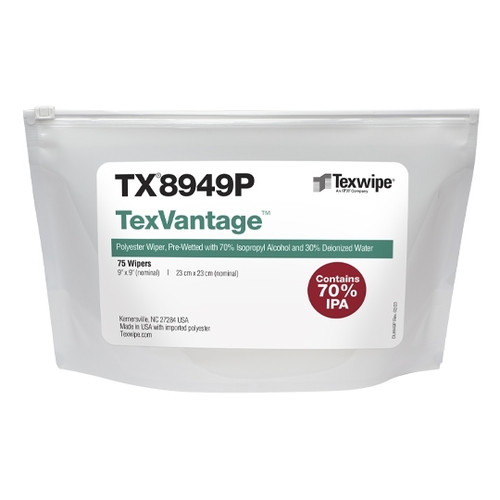
TX49P is a 9-inch by 9-inch Vertex® knit polyester cleanroom wiper that is pre-wetted with USP-grade 70% isopropyl alcohol (IPA) / 30% DI water and packaged in a reclosable format to keep solvent delivery repeatable from the first wipe to the last. When you are troubleshooting streaking, haze, or “why did this batch clean differently,” the root cause is often not the solvent itself—it is the variability in how it was applied and how the wipe edge behaves under pressure.
Vertex® is built around edge control and process consistency. TX49P pairs a laser-style sealed edge (to reduce perimeter fray and edge-shed) with controlled presaturation (to reduce over-wetting, under-wetting, and VOC variability). In practice, it is used as a “ready-to-go” wipe for high-sensitivity surfaces, spill response, and final wipedown where outcome depends on controlled wetness, low residues, and predictable dry-down.
What it’s for
Controlled cleaning and wipe-down in critical environments using a consistent 70% IPA / 30% DI water presaturation—especially when operators need repeatable solvent loading, reduced edge-shed risk, and predictable drying behavior on equipment, tools, fixtures, and sensitive surfaces.
Decision drivers
If you are selecting a pre-wetted wipe for ISO-classified space, focus on edge strategy, solvent control, residue/ions, and how packaging preserves consistency across the bag’s life.
- Laser-style sealed edge: Helps control perimeter fray and reduces the “edge-shed” failure mode that can show up as particles/fibers at contact boundaries.
- Presaturation consistency: Pre-wetted with 0.2 µm filtered USP-grade 70% IPA / 30% DI water to standardize solvent loading and reduce operator variability.
- Residue control (NVR): Low nonvolatile residue matters when you are chasing streaking, haze, or film transfer on smooth metals, glass, coated parts, and polymer housings.
- Ionic control: Low extractable ions support sensitive electronics and critical cleaning where corrosion, dendritic growth risk, or ionic contamination limits are in play.
- Packaging that preserves wetness: Reclosable bags are a wetness-control feature—open-bag time and closure discipline directly affect late-bag performance.
- Program and audit fit: Lot coding and documentation availability simplify investigations, deviations, and cleaning validations that require traceability.
Materials and construction
TX49P uses a continuous-filament knit polyester substrate designed for sorption and mechanical strength while keeping particle and fiber release tightly controlled. The “control feature” is the edge: a laser-style sealed perimeter bonds and stabilizes the knit boundary so the wipe behaves consistently when dragged, folded, or wrapped around a tool.
The presaturation step is the other control lever. Instead of relying on bottles, spray triggers, or pour methods (all of which introduce wetness variability and VOC swing), TX49P is manufactured and packaged to deliver repeatable wetness and optimized cleaning efficiency with consistent dry-down behavior when used correctly and promptly resealed.
Specifications in context
Format: 9" x 9" (23 cm x 23 cm) knit polyester, laser edge, pre-wetted with 70% IPA / 30% DI water. Packaging: 75 wipers per reclosable bag; 4 bags per case (300 wipes per case). Cleanroom use range: positioned for ISO Class 3–7 environments (with cleanroom program escalation to sterile variants when aseptic assurance is required). Shelf life: non-sterile pre-wetted products are listed at 3 years from date of manufacture (store per guidance; manage as a flammable solvent-containing product).
Cleanliness and performance metrics
Treat “typicals” as starting points, not incoming acceptance limits. Use them to align the wipe to your risk (particles/fibers, residues, ions), then qualify under your actual chemistry, surface, and technique.
Typical contamination/performance values (Vertex® 40 series basis):
• LPC (≥0.5 µm): 9.5 x 10⁶ particles/m² (typical).
• Fibers (>100 µm): 200 fibers/m² (typical).
• NVR (IPA extractant): 0.02 g/m² (typical).
• NVR (DIW extractant): 0.01 g/m² (typical).
• Extractable ions (typical): sodium 0.17 ppm; potassium 0.01 ppm; chloride 0.05 ppm.
• Absorbency (typical): sorptive capacity 450 mL/m²; sorptive rate 0.3 second.
How to read this operationally: If you are troubleshooting visible residue, prioritize NVR and technique (folding discipline, single-pass strokes, and not over-working a drying surface). If you are controlling particle/fiber counts at the point-of-use, edge strategy and “how you pull, fold, and present the edge” matter as much as the stated typicals.
Pre-wetted solvent control and packaging discipline
TX49P’s performance depends on keeping wetness consistent throughout the bag’s life. The reclosable slider bag reduces evaporation and helps preserve repeatable wetness and VOC levels, but only if closure discipline is built into the work step. Treat the bag like a controlled “dispense system,” not general packaging. Also treat it like a solvent-containing product: follow facility flammables guidance, SDS precautions, and temperature/storage requirements.
Rule of thumb: Open the bag at point-of-use, pull only what you need for the step, then fully reclose the slider immediately—do not “leave it cracked” on a cart during a run.
Best-practice use
Most cleaning failures with pre-wetted wipes trace back to technique: how the wipe is folded, how many faces you use, and whether you re-deposit what you just lifted.
- Fold to control contact faces: Quarter-fold and present a fresh face frequently; avoid “re-scrubbing” with a loaded face.
- Single-direction strokes on critical surfaces: Use overlapping, unidirectional passes (especially on stainless, coated parts, and plastics prone to haze).
- Edge management: Keep the sealed edge oriented away from the most sensitive line-of-contact if the surface is prone to cosmetic marking; apply even pressure.
- Final wipedown logic: For film-prone residues, use one wipe to lift/solubilize, then a second wipe (fresh face) to finish—do not chase drying streaks with a nearly dry wipe.
- Spill control: For localized spills, “dam” the spill perimeter first, then work inward; replace wipes early to avoid spreading contamination.
- Glove hygiene: Change gloves if you touch non-controlled surfaces, then resume wiping—pre-wetted wipes can mask contamination transfer until inspections or counts fail.
Common failure modes
Evaporation-driven under-wetting: Bags left open lead to late-bag wipes that drag, streak, and require rework; fix with closure discipline and staging only what you will use immediately. Overworking a drying surface: Chasing “just one more pass” can re-deposit dissolved soils and create haze; fix with single-pass strokes and fresh faces. Cross-contamination: Using the same wipe face across zones (floor to bench, non-critical to critical) transfers soils; fix with zone-based wipe use and glove change discipline. Heat exposure: Pre-wetted wipes used near elevated temperatures increase vapor and flammability risk; follow SDS guidance and use caution at elevated temperatures.
Closest competitors
Contec PROSAT® Polynit Heatseal Wipes (70% IPA/30% DI water): Similar “mechanism” (knit polyester, sealed edge, presaturated solvent delivery). Differences typically come down to sealed-edge method, packaging format, and how your facility qualifies residues and fibers under your technique and dwell times.
Berkshire SatPax® MicroSeal®-VP (70% IPA/30% DI water): Also targets ISO Class 3+ programs with sealed-edge knit polyester in a resealable pouch format. If your program is highly sensitive to cosmetic outcomes (streaking, haze) or you run long wipe sessions from a single pouch, compare how each product preserves saturation across the pouch life and how each behaves on your exact surface/coating stack.
Where it fits in a cleanroom wiping program
TX49P is a strong fit for ISO Class 3–7 cleaning where presaturation consistency and edge control reduce variability in outcomes. It is commonly used as a primary “process wipe” for equipment and surfaces where operators need controlled solvent delivery without managing bottles, spray triggers, or pour methods. If your risk profile requires aseptic assurance (e.g., Grade A/B workflows, sterile field proximity, or validated sterile supply chains), the program typically escalates to sterile pre-wetted alternatives while retaining the same technique and closure discipline.
Terminology note: Engineered for low-linting performance; no wiper is truly “lint-free” in every process condition.
Source basis
- SOSCleanroom product page: “Texwipe TX49P Vertex 9" x 9" Polyester Laser Edge Cleanroom Wiper Pre-Wetted 70% IPA” — https://www.soscleanroom.com/product/wipers/texwipe-tx49p-vertex-9-x-9-polyester-laser-edge-cleanroom-wiper-pre-wetted-70-ipa/
- SOS-hosted PDF copy (Vertex TX42/TX49/TX42P/TX49P datasheet, effective June 2011): https://www.soscleanroom.com/content/texwipe_pdf/42%2049%2042p%2049p.pdf
- Texwipe manufacturer page: “Vertex® Pre-Wetted TX49P” — https://www.texwipe.com/pre-wetted-vertex-high-sorption-tx49p
- Texwipe technical data sheet: “Texwipe-VertexSeries-TDS.pdf” (US-TDS-022 REV. 03/23) — https://www.texwipe.com/images/uploaded/documents/Wipers/Texwipe-VertexSeries-TDS.pdf
- Texwipe SDS (pre-wetted 60%–70% IPA wipes; includes TX49P in product code list): “TX1034_US_CA_SDS_ENG_May_31_2023.pdf” — https://www.texwipe.com/images/uploaded/documents/Safety%20Data%20Sheets/2023%20wipe%20sds%20us-can-mex/60-70/TX1034_US_CA_SDS_ENG_May_31_2023.pdf
- Contec competitor reference (PROSAT® Polynit Heatseal Wipes, 70% IPA/30% DI water): https://cleanroom.contecinc.com
- Berkshire competitor reference (SatPax® MicroSeal®-VP 70% IPA/30% DI water): https://berkshire.com
Source: SOSCleanroom Technical Vault | Last reviewed: Jan. 4, 2026
© 2026 SOS Supply. All rights reserved.