The Technical Vault
By SOSCleanroom
Absorbency With Controls: Why TX622 VersaWipe Is Built for Spill Pickup and Daily Wipe-Downs in ISO 5–8 Areas
Last reviewed: Jan. 2, 2026 | Audience: contamination control, cleanroom operations, quality, EHS
Many “wipe-down failures” in controlled environments are not chemistry failures — they are absorbency and handling failures. Aqueous spills, disinfectant wipe cycles, and routine bench resets can turn into smear, redeposit, and unintended residues when the wiper can’t wet out fast, can’t hold the load, or breaks down under real wiping force.
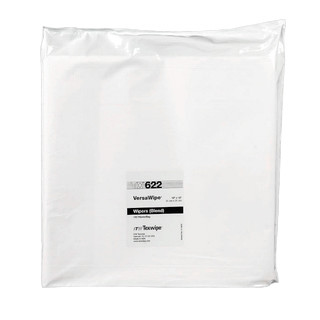
Texwipe TX622 VersaWipe (12" × 12") is engineered for that daily reality: a hydroentangled nonwoven blend (55% cellulose / 45% polyester) positioned for general wiping and spill control where you want high absorbency, wet strength, solvent compatibility, and a published contamination framework for responsible placement in ISO 5–8 programs. It is explicitly positioned as “lowest NVR in a nonwoven blended wiper,” which is a meaningful claim in this category when your program is trying to keep blended wipes from becoming a residue variable.
What it’s for
TX622 is best used for general-purpose wiping, aqueous spill pickup, and routine cleaning where high absorbency and low extractables are prime selection drivers. It is commonly used for bench and fixture wipe-downs, tool and equipment exterior cleaning, and controlled-area housekeeping where teams want a blended wipe that behaves consistently and is supported by documentation and traceability posture through approved sourcing.
Decision drivers
TX622 earns its place when absorbency is required, but you still need controlled-environment discipline:
- Blend logic (55/45): cellulose drives rapid wet-out and capacity; polyester contributes wet/dry strength and more stable handling under wiping force.
- Hydroentangled construction: designed for excellent bidirectional strength and contains no chemical binders, reducing one common contributor to extractables variability in binder-based nonwovens.
- Solvent compatibility: positioned as compatible with most solvents (qualification should still be based on your solvent, contact time, and residue budget).
- Packaging discipline: solvent-safe Bag-Within-A-Bag® cleanroom packaging supports controlled introduction and minimizes “open stack” handling exposure.
- Operational controls: statistical quality control, plus lot-level posture that supports investigation discipline when trends shift.
- Autoclavable: useful where facilities want to evaluate in-house sterilization workflows — with the understanding that in-house sterilization is a user-owned validation and documentation burden.
Materials and construction – explained like an engineer
“Cellulose/polyester nonwoven” can describe everything from robust hydroentangled fabrics to binder-heavy wipes that behave like uncontrolled shop materials. TX622’s hydroentangled architecture matters because it is built for strength without relying on chemical binders, and because it maintains integrity when operators move fast, apply pressure, or wipe larger surface areas.
In practice, the wiper’s performance is driven by the balance: cellulose provides absorbency and pickup (especially for aqueous spills), while polyester helps the wipe resist tearing and reduces the chance that aggressive wiping turns the wiper into a fiber source.
Specifications in context
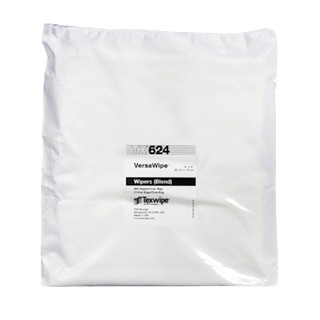
TX622 is a 12" × 12" (31 cm × 31 cm) format packaged 150 wipers per bag, double-bagged, 10 bags per case. The 12" × 12" footprint is a practical control for larger wipe-down zones (benches, carts, panels, doors, pass-through interiors) because it supports one-direction overlapping strokes while still allowing disciplined folding into multiple clean faces.
Program note: if country-of-origin is a controlled attribute in your quality system, confirm it through documentation tied to the lots received. Do not rely on assumptions or generalized statements when COO is part of acceptance criteria.
Cleanliness and performance metrics
For blended wipes, selection discipline usually comes down to three risk categories: releasables (particles/fibers), residues (NVR), and ions. VersaWipe’s published values are presented as typical analyses — useful for placement and qualification discussions, but not contractual specifications.
- Absorbency: typical sorptive capacity 280 mL/m²; typical sorptive rate < 1 second. Operationally, fast wet-out reduces the “multiple-pass spread” problem during spill pickup and disinfectant wipe cycles.
- Particles/fibers: typical LPC (>0.5 µm) 63 × 106 particles/m²; typical fibers (>100 µm) 50,000 fibers/m². This is often acceptable for many ISO 5–8 wipe-down tasks — but it is not the same risk posture as sealed-edge, all-polyester knits used for the most defect-sensitive finishing steps.
- NVR: typical NVR 0.01 g/m² (IPA extractant) and 0.03 g/m² (DI water extractant). This is one reason VersaWipe is positioned as a low-NVR blended option; technique still matters (wetness control and early face changes are the levers).
- Ions: typical ions include sodium 31 ppm, potassium 3.5 ppm, chloride 16 ppm. If corrosion sensitivity, ECM risk, or high-impedance electronics drive acceptance, treat ionic background as a defect mechanism and validate the wipe-down step to your acceptance criteria.
Terminology note: TX622 is engineered for low-linting performance; no wiper is truly “lint-free” in every process condition.
Why Bag-Within-A-Bag packaging matters operationally
In real facilities, wipe outcomes often degrade because of handling: open bags left exposed, wipes carried between stations, and overuse of a single wipe face past saturation. TX622’s cleanroom packaging is designed to reduce handling exposure and support controlled introduction. It also reduces the temptation to “stretch” one wipe too long — one of the most common causes of redeposit and streaking after dry-down.
Best-practice use
TX622 performs best when technique is treated like a control system, not a preference:
- Fold for faces: quarter-fold to create multiple clean faces; rotate aggressively and discard early once a face is loaded.
- Direction control: use straight, overlapping, one-direction strokes; avoid circular scrubbing unless an SOP explicitly requires it.
- Wetness control: aim for damp, not wet; over-wetting increases pooling, wicking into seams, and residue left behind after dry-down.
- Spill logic: blot/pickup first, then finish with controlled strokes using fresh faces to avoid spreading contamination.
- Two-step discipline for sensitive surfaces: bulk pickup with TX622, then a defined finishing wipe (often a lower-background polyester knit or sealed-edge knit) when residue and particles are the limiting risk.
Common failure modes — and how to prevent them
- Overworking a saturated wipe: turns absorbency into redeposit. Prevent with face-rotation rules and early discard triggers.
- Over-wetting and pooling: increases streaking and residue after dry-down. Prevent with controlled solvent application and “damp-clean” targets.
- Dry wiping textured surfaces with high pressure: increases friction-driven particles/fibers. Prevent by dampening appropriately or switching to an architecture better suited to abrasion points.
- Using a blended wipe as the default final pass: can elevate residue/ionic background in ultra-sensitive steps. Prevent by defining roles: spill/routine wiping vs finishing vs validation sampling.
Closest comparators
The most defensible comparisons are to other hydroentangled cellulose/polyester cleanroom nonwovens used for similar “absorbency-first, controlled” wiping tasks:
Contec PROSAT® / nonwoven blended wipe programs are often evaluated when buyers want a similar controlled-environment nonwoven blend category with strong packaging discipline and a broad program family.
Berkshire nonwoven cleanroom wipes (blended families) are a common comparator class for general wiping and spill pickup; the evaluation should focus on published contamination data, packaging controls, and how the wipe behaves in your chemistry set and surface conditions.
Rule of thumb: When absorbency is the constraint, blended nonwovens like TX622 are a strong fit. When the limiting risk is edge-driven releasables or ultra-low residue finishing, the technical step-up is typically a sealed-edge or sealed-border polyester knit.
Where TX622 fits in a cleanroom wiping program
TX622 fits best as a routine wipe-down and spill-control workhorse in ISO 5–8 environments where you need high absorbency, strong wet handling, and a documented cleanliness framework to support disciplined placement. It is a strong choice for daily wipe-downs, aqueous spills, and general cleaning steps where speed and pickup matter — provided the program preserves role clarity: blended wipes for spill/routine cleaning, a defined finishing wipe for the most residue- or particle-sensitive steps, and method-aligned consumables when the wipe becomes part of a validation sampling system.
Source basis
- SOSCleanroom product page: “Texwipe TX622 VersaWipe 12" × 12" Cellulose/Polyester Cleanroom Wiper” (positioning, packaging, features/benefits, general use framing). https://www.soscleanroom.com/product/wipers/texwipe-tx622-versawipe-12-x-12-cellulose-and-polyester-cleanroom-wiper/
- ITW Texwipe datasheet DS-629 (Effective: December 2009): “VersaWipe® Wipers TX622 / TX624 / TX629” (55/45 blend, hydroentangled construction, binder statement, packaging, typical absorbency and contamination characteristics; test method references including IEST-RP-CC004.3 and ASTM E2090-00). https://www.soscleanroom.com/content/texwipe_pdf/624%20629%20622.pdf
- Comparator context: Contec nonwoven wipe programs (PROSAT family/category positioning).
- Comparator context: Berkshire nonwoven cleanroom wipes (blended wipe category positioning).
Source: SOSCleanroom Technical Vault | Last reviewed: Jan. 2, 2026
© 2026 SOS Supply. All rights reserved.