The Technical Vault
By SOSCleanroom
When “Small Format” Prevents Big Problems: Why TX624 VersaWipe Is a Practical Control for Tight-Space Wipe-Downs
Last reviewed: Jan. 2, 2026 | Audience: contamination control, cleanroom operations, EHS, quality, maintenance
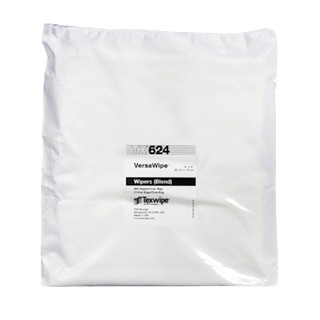
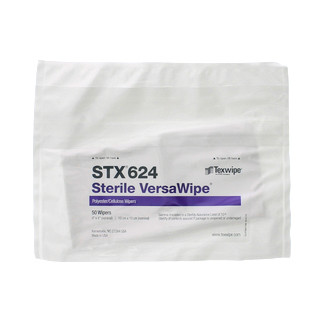
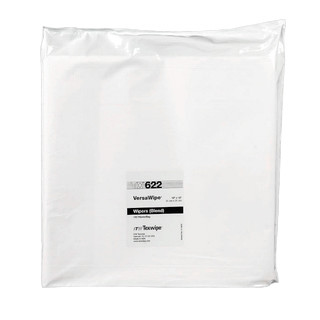
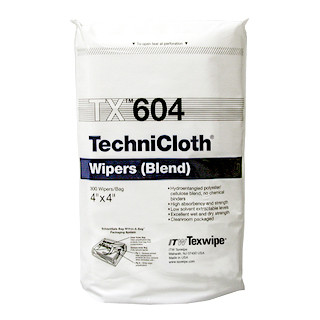
Texwipe TX624 VersaWipe (4" × 4") is a dry, hydroentangled cellulose/polyester nonwoven wiper designed for controlled-environment tasks where the constraint is not “can it wipe,” but “can it wipe without creating a new variable.” In real cleanrooms, small wipe-downs in small spaces (tooling interfaces, fixtures, carts, handles, covers, benchtop corners) often fail due to over-handling, over-wetting, and reusing a loaded face. TX624’s small format makes correct technique easier to repeat at speed.
VersaWipe is built as a general-purpose cleanroom consumable, with a published use framework for ISO Class 4–8 (Class 10–100,000) controlled environments and a construction described as 55% cellulose / 45% polyester, hydroentangled, with no chemical binders. :contentReference[oaicite:1]{index=1}
What it’s for
TX624 is positioned for cleaning and wiping applications in controlled environments, including routine wipe-downs and spill pickup where absorbency matters, and where an engineered blend (cellulose for fast uptake, polyester for strength) helps prevent the “falls apart when wet” behavior of lower-grade cellulose options. It is also commonly selected for “small feature” work where a full-size wipe drives accidental contact and unnecessary exposure time. :contentReference[oaicite:2]{index=2}
Decision drivers
TX624 earns its place when the program needs a small-format blended wipe with controlled-environment posture:
- Blend logic: cellulose supports fast absorbency; polyester supports wet strength and handling stability. :contentReference[oaicite:3]{index=3}
- Construction control: hydroentangled nonwoven described as no chemical binders, reducing one common source of variability seen in binder-heavy nonwovens. :contentReference[oaicite:4]{index=4}
- Chemical posture: manufacturer positioning includes compatibility with common cleanroom solvents/chemistries for general wiping tasks. :contentReference[oaicite:5]{index=5}
- Format as a control: 4" × 4" supports deliberate, single-pass face use in tight spaces without “wipe sprawl.” :contentReference[oaicite:6]{index=6}
- ISO placement framework: described for ISO Class 4–8 applications (final suitability depends on your process window and technique). :contentReference[oaicite:7]{index=7}
Materials and construction – explained like an engineer
“Cellulose/polyester wipe” is not a specification—it is a category. The practical engineering question is how the wipe behaves under load: wet-out speed, tensile integrity during wiping, and how the structure releases or retains what it picks up. TX624 is described as a hydroentangled blend. Hydroentanglement mechanically interlocks fibers (rather than relying on chemical binders), which typically improves strength uniformity and reduces binder-driven extractables variability. :contentReference[oaicite:8]{index=8}
Terminology note: TX624 is engineered for low-linting performance; no wiper is truly “lint-free” in every process condition. Your actual releasables outcome is driven by surface texture, pressure, wetness, and whether a loaded face is reused.
Cleanliness and performance metrics
VersaWipe is positioned with an ISO Class 4–8 use framework and a controlled-environment packaging/handling posture. Treat published cleanliness values (when referenced in your program documentation) as qualification starting points, then confirm acceptability in your solvent set, soil type, contact time, and surface sensitivity window.
If your dominant risk is residue after dry-down (optics, coatings, cosmetic surfaces) or edge-driven releasables (critical assembly interfaces), the technical step-up is typically a polyester knit or sealed-edge architecture rather than a blended nonwoven. Use TX624 where absorbency and handling efficiency are the drivers—and keep “final-pass” roles explicitly gated in the SOP.
Why 4" × 4" matters operationally
Small wipes reduce three common failure modes: (1) wiping beyond the intended zone and dragging dissolved soil across adjacent features, (2) over-wetting because a large wipe “demands” more solvent to feel damp, and (3) overuse of a single wipe because the operator perceives “it still has clean area.” A 4" × 4" format pushes the right behavior: short strokes, frequent face changes, and faster discard when the wipe is loaded.
Rule of thumb: If the cleaning zone is smaller than your folded wipe face, the wipe size is working against you. Match wipe size to the feature size to reduce redeposit and over-handling.
Best-practice use
- Single-direction strokes: use straight, overlapping passes; avoid “scrub back and forth” unless required by a validated instruction.
- Face discipline: treat each exposed face as single-use in critical wipe-downs; discard early when loaded.
- Wetness control: aim for damp, not wet; over-wetting increases pooling and residue after dry-down.
- Corner and interface technique: use the wipe edge deliberately (light pressure) rather than forcing the wipe into sharp interfaces where fiber release risk increases.
- Spill logic: blot/pickup first, then finish with controlled strokes using fresh faces.
Common failure modes — and how TX624 helps
A blended nonwoven becomes a problem in predictable ways: over-wetting that turns wiping into redistribution, reusing a loaded face, and high-pressure wiping on abrasive textures that drives fiber release. TX624’s blend and hydroentangled construction are designed to support absorbency with wet strength for routine tasks, but the outcome is still technique-driven. The control levers are small-format discipline, face rotation, directional strokes, and solvent/dwell consistency.
Closest comparators
The most defensible comparisons are to other cellulose/polyester nonwoven cleanroom wipes in similar small formats, intended for absorbency-driven wiping and spill pickup.
Berkshire BlueSorb 750 (4" × 4" blend wipe) is a close comparator in the same category logic (polyester/cellulose blend, positioned for ISO Class 5 and higher applications, general wipe-downs and spill pickup). :contentReference[oaicite:9]{index=9}
Other cellulose/polyester blend nonwoven cleanroom wipes (various manufacturers) are often functionally similar on absorbency, but selection should be driven by documentation depth, packaging discipline, and how the wipe behaves in your chemistry set and on your surfaces—especially when residue after dry-down is a known defect mechanism.
Where TX624 fits in a cleanroom wiping program
TX624 is a strong choice for the “small-feature, absorbency-first” tier inside ISO Class 4–8 programs: tight-space wipe-downs, routine housekeeping touches, small spill response, and controlled application/removal where the operator benefits from a wipe that wets quickly and stays intact. When the risk shifts to ultra-sensitive final-pass surfaces or when residue/ionic background becomes the limiting constraint, the technical step-up is typically an all-polyester knit (and, when warranted, sealed-edge/sealed-border).
Source basis
- SOSCleanroom product page: “Texwipe TX624 VersaWipe 4" × 4" Cellulose and Polyester Cleanroom Wiper” (positioning, size, ISO range, packaging presentation). https://www.soscleanroom.com/product/wipers/texwipe-tx624-versawipe-4-x-4-cellulose-and-polyester-cleanroom-wiper/
- ITW Texwipe technical data sheet: “VersaWipe Dry Wipers” (TX624 construction and blend, hydroentangled/no-binder statement, ISO use framework, packaging configuration). https://www.soscleanroom.com/wp-content/uploads/2020/08/Texwipe-VersaWipe-Dry-Wipers-TDS.pdf
- Comparator category reference: Berkshire BlueSorb 750 4" × 4" cellulose/polyester blend wipe (category positioning and intended applications). https://www.hisco.com/Product/BS750-0404-40-6509
Source: SOSCleanroom Technical Vault | Last reviewed: Jan. 2, 2026
© 2026 SOS Supply. All rights reserved.