The Technical Vault
By SOSCleanroom
Sealed-Border Discipline for Critical Wiping: How TX8659 Vectra Alpha 10 LT Reduces Edge-Driven Variability in ISO 3+ Environments
Last reviewed: Jan. 3, 2026 | Audience: contamination control, microelectronics, cleanroom operations, quality, EHS
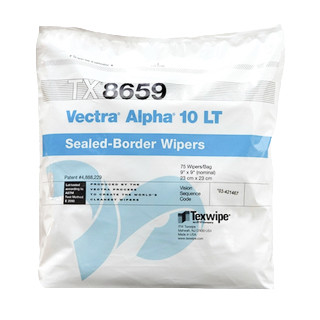
Texwipe TX8659 Vectra Alpha 10 LT (9" × 9") is a dry, laundered 100% continuous-filament polyester knit cleanroom wiper built around one intent: keep the wiper from becoming the uncontrolled variable when wiping tasks touch yield-sensitive hardware. The defining feature is the sealed-border edge (sealed after laundering) designed to reduce edge-related stringers and particle contribution during folding, corner work, and higher-pressure wiping. It is positioned for use in cleanrooms rated ISO Class 3 and above, with common placement in ISO 3–5 tool and workstation cleaning where edge behavior matters as much as fabric performance.
The “LT” posture is about risk reduction, not marketing. Texwipe’s datasheet notes no titanium dioxide (TiO2) is added during manufacturing, which is relevant in microelectronics programs that treat background additives as a potential defect mechanism. Pair that with published typical cleanliness metrics (particles, fibers, NVR, and ionic extractables), and TX8659 becomes a deliberate control step when teams want sealed-edge behavior without moving into specialty formats that change operator feel and wipe mechanics.
What it’s for
TX8659 is best used for critical cleaning of work surfaces and equipment, including wipe-downs where edge control and low-background behavior are part of the acceptance logic. It is positioned for environments ISO Class 3 and above and is commonly evaluated for microelectronics and other precision operations where wiping steps occur near sensitive surfaces, open process hardware, or inspection-driven cleanliness requirements.
Decision drivers
TX8659 earns its place in a high-control wiping program based on a short list of technical controls:
- Substrate and knit stability: 100% continuous-filament polyester, double-knit no-run interlock engineered for durability under wiping force and repeated folding.
- Edge strategy as a contamination control: sealed border intended to reduce edge-driven fiber release and “stringers” when wiping corners, fasteners, and interfaces.
- Low-background manufacturing posture: datasheet notes no TiO2 added during manufacturing for programs that treat additives as a risk factor.
- Published typical cleanliness framework: particles/fibers, NVR, and ionic extractables provide a defendable starting point for qualification and change control.
- Absorbency tuned for routine solvent workflows: typical sorptive capacity and sorptive rate support solvent wipe-down cadence without “dry dragging.”
- Packaging discipline: bag-and-case configuration supports controlled introduction and staged access at wipe points.
Materials and construction – explained like an engineer
“Polyester cleanroom wiper” is a category label, not a spec. The difference-maker is continuous-filament polyester (long filaments) combined with a stable knit pattern that resists unraveling under abrasion. TX8659 uses a no-run interlock knit, which is selected to hold together when the wipe is folded into smaller faces, pressed into corners, or dragged across brushed stainless and tool surfaces.
The second engineering lever is the edge. A sealed border is not about aesthetics; it is an attempt to control the highest-risk zone (the perimeter) where folding, pinching, and directional changes concentrate stress. If a process is seeing edge-driven fibers, stringers, or inconsistent results between operators, edge strategy is often the first mechanical control to tighten—before changing chemistry or rewriting the entire wipe SOP.
Specifications and configuration (practical planning)
- Size: 9" × 9" (TX8659).
- Packaging: 150 wipes/bag (typically 2 inner bags of 75); 10 bags/case.
- Sorption behavior (typical): sorptive capacity 300 mL/m² with sorptive rate 0.5 seconds (use-dependent). For a 9" × 9" wipe, that capacity translates to roughly ~16 mL per wipe at the stated area-normalized capacity—useful as a sanity check when setting “wet enough” guidance for solvent wipe-downs.
Treat packaging and wipe access as part of the control plan. The best wiper still fails if staging drives excessive handling, “one wipe for too long,” or inconsistent face rotation across shifts.
Cleanliness and performance metrics
For most ISO 3–5 programs, wipers are assessed as a risk input in four buckets: releasables (particles/fibers), residues (NVR), ions (ECM/corrosion sensitivity), and mechanical behavior (edge stability under wiping force). TX8659’s published typical values are best treated as a qualification baseline, not a contractual spec.
- Particles (readily releasable): ≥0.5 µm typical 2.6 × 10⁶ particles/m².
- Fibers: ≥100 µm typical 830 fibers/m².
- NVR: DI water extractant typical 0.003 g/m².
- Ionic extractables: typical 0.01 meq/g.
Translation: this is a sealed-border knit intended for critical wiping where edge behavior and background control are part of the decision logic. If the process is residue-sensitive, tighten technique first (wetness control, face rotation, single-direction strokes). If the process is ion-sensitive, treat ionic control as a defect mechanism and validate with your actual chemistries and acceptance criteria.
Why sealed-border matters operationally
In daily operations, wipers “fail” less often because the fabric is wrong and more often because edge mechanics and operator handling are inconsistent: aggressive folding, corner work, snag points, and back-and-forth scrubbing all concentrate stress at the perimeter. A sealed border is a mechanical attempt to stabilize that risk zone. The practical benefit is consistency—fewer surprises when the wipe is pushed into seams, dragged along fixtures, or used in repetitive cycles where edge wear accumulates across a shift.
Best-practice use
TX8659 performs best when operators treat wiping as a controlled method, not a housekeeping gesture:
- Quarter-fold for control: create multiple clean faces; rotate faces aggressively and discard once a face is loaded.
- Directional strokes: use straight, overlapping passes (clean-to-dirty). Avoid “scrub back and forth” unless an SOP requires it.
- Control wetness: for solvent wiping, apply solvent consistently and avoid over-wetting that drives pooling and mobilizes residues beyond the intended wipe path.
- Edge-aware wiping: when wiping corners/fasteners, reduce pressure spikes and change faces more frequently to prevent redeposit.
Also keep terminology honest: TX8659 is engineered for low-linting performance; no wiper is truly “lint-free” in every process condition.
Common failure modes — and how TX8659 helps
A wiper becomes a contamination source in predictable ways: reusing a contaminated face too long, pushing too much pressure at edges and corners, snagging on hardware, and leaving residues due to inconsistent solvent loading. TX8659’s knit stability and sealed-border strategy are intended to reduce edge degradation during aggressive wiping. The remaining controls are procedural: face rotation, directional strokes, chemistry discipline, and change-out rules tied to visible soil and saturation.
Closest comparators
The most defensible comparisons are to other polyester knit cleanroom wipes designed around edge control and critical-area wiping.
Berkshire MicroSeal® 1200 is a sealed-edge, cleanroom-laundered polyester knit wipe positioned for critically low particles, fibers, and extractables—often evaluated when the program wants a sealed-edge architecture with strong cleanliness posture.
Contec Polynit Heatseal Wipes (sealed-edge knit polyester) are a close comparator category when facilities want sealed-edge behavior, low particles/extractables positioning, and (in sterile configurations) validated sterility options for higher-grade life science areas.
Rule of thumb: When edge control becomes the acceptance driver, sealed-edge/sealed-border is typically the next mechanical control step. When wetness repeatability is the constraint, consider a controlled pre-wetted system designed to standardize solvent loading.
Where TX8659 fits in a cleanroom wiping program
TX8659 fits as a sealed-border, ISO 3+ daily-driver for critical wiping steps where edge-driven releasables and background control are meaningful risks. Use it for tool wipe-downs, workstation cleaning, and solvent-aided wiping where consistent mechanical behavior matters across operators and shifts. If the process becomes even more defect-sensitive (or if sterile introduction is required), step into the appropriate sealed-edge/sterile architecture aligned to the area classification and SOP. If solvent loading consistency is the limiting factor, step sideways into a validated pre-wetted system rather than relying on technician-controlled wetting.
Process note: “No TiO2 added” is a meaningful control only if your program treats additives as a defect mechanism. Keep it in scope through incoming documentation review and lot-level change control.
Source basis
- SOSCleanroom product page: “Texwipe TX8659 Vectra Alpha 10 LT 9" × 9" Polyester Cleanroom Wiper” (positioning, sealed-border description, ISO placement notes). https://www.soscleanroom.com/product/wipers/texwipe-tx8659-vectra-alpha10-lt-9-x-9-polyester-cleanroom-wiper/
- ITW Texwipe datasheet (via SOSCleanroom PDF): “Vectra® Alpha 10 LT — Sealed Border Wipers” (construction, packaging, typical particles/fibers/NVR/ions, sorption metrics, TiO2 statement). https://www.soscleanroom.com/wp-content/uploads/2019/03/Vectra-Alpha-10LT-Sealed-Border-Wipers-TDS.pdf
- Berkshire product category page: “MicroSeal® 1200” (sealed-edge laundered polyester wipe positioning). https://berkshire.com/product-category/cleanroom-wipes/knitted-wipes/microseal-1200/
- Contec Cleanroom product page: “Sterile Polynit Heatseal Wipes” (sealed-edge knit polyester positioning, ISO 3–8 placement, sterility notes). https://cleanroom.contecinc.com/product/1779528570
Source: SOSCleanroom | Last reviewed: Jan. 3, 2026
© 2026 SOS Supply. All rights reserved.