The Technical Vault
By SOSCleanroom
Absorbency Without the Guesswork: Why TX8932 TexVantage Is the “Utility-Control” Wiper for ISO 5–8 Spill Response and Daily Wipe-Downs
Last reviewed: Jan. 3, 2026 | Audience: contamination control, cleanroom operations, EHS, quality
Texwipe TX8932 TexVantage (12" × 12") is a dry, hydroentangled cellulose/polyester cleanroom wiper built for the work that actually drives housekeeping outcomes: fast aqueous pickup, routine wipe-downs of benches and carts, and solution application/removal where you want a controlled consumable—without defaulting to shop rags or binder-heavy nonwovens.
The technical value of TX8932 is not “it wipes.” It is that the architecture and published contamination context let you place it intentionally in an ISO 5–8 program as a repeatable utility layer—absorbing quickly, staying intact when wet, and reducing the chance that a small spill turns into a fiber or residue event after dry-down.
What it’s for
TX8932 is positioned for aqueous spill cleanup, general-purpose wiping, and cleaning precision components in controlled environments where absorbency and wet strength matter as much as cleanliness. It is a practical choice for bench resets, cart wipe-downs, tool and fixture wipe-offs, and support cleaning steps where solutions are applied and then removed under standard work.
Decision drivers
TX8932 earns its place when your program needs absorbency and speed, but still requires a defensible contamination posture:
- Hydroentangled construction: mechanical entanglement (not chemical binders) supports consistent handling and reduces one common extractables variable seen in binder-based nonwovens.
- Absorbency-first behavior: designed to wet-out quickly and pick up aqueous spills with fewer passes—reducing “spread radius” during cleanup.
- Wet strength: polyester contribution supports durability and reduces tear-driven fibers when pressure increases.
- Published contamination context: typical particles/fibers, NVR, and ions provide an initial placement framework for ISO 5–8 work.
- Packaging discipline: cleanroom packaging and double-bag presentation support controlled introduction and staging.
- Program stability through SOSCleanroom: consistent supply and documentation continuity help prevent unqualified substitutions that change wiping behavior under schedule pressure.
Materials and construction – explained like an engineer
“Cellulose/polyester wiper” can mean radically different things. What matters is the nonwoven web architecture and how it behaves when damp and under load. TX8932 uses a hydroentangled structure: jets entangle fibers into a cohesive sheet that is engineered to survive folding, blotting, and repeated wipe strokes without the “paper tear” behavior common in lower-control cellulose products.
Operationally, cellulose drives rapid wet-out and fluid hold for spill control; polyester supports tensile strength and helps keep the wipe intact when you apply pressure or encounter textured surfaces.
Terminology note: TX8932 is engineered for low-linting performance; no wiper is truly “lint-free” in every process condition. Technique (pressure, surface texture, wetness, and face rotation) determines real-world shedding behavior.
Specifications in context
TX8932 is a 12" × 12" format supplied 150 wipers per bag and 20 bags per case, with double-bagged presentation. The 12" × 12" size is a practical control point: it supports one-direction, overlapping strokes on benches and carts while still allowing quarter-folding and frequent face rotation.
Translate packaging into behavior: larger wipes reduce “multiple small wipes per job,” but they only help if you keep face discipline—fold consistently, rotate faces aggressively, and discard when the face is loaded or nearing saturation.
Cleanliness and performance metrics
For most facilities, wipe selection becomes defensible when you can discuss three risk buckets: releasables (particles/fibers), residues (NVR), and ions. Treat published values as a qualification starting point—not a substitute for your own acceptance testing where yield, adhesion, optics, or corrosion sensitivity is the constraint.
- Particle releasables: typical >0.5 µm LPC is 65 × 106 particles/m².
- Fiber releasables: typical >100 µm fibers are 50,000 fibers/m².
- NVR (film risk after dry-down): typical NVR is 0.01 g/m² (IPA) and 0.03 g/m² (DI water).
- Ionic extractables: typical ions include Na 35 ppm, K 5 ppm, and Cl 20 ppm (standard products listed).
- Sorbency behavior: typical sorptive capacity is 280 mL/m² with a sorptive rate of <0.3 seconds.
Rule of thumb: Use absorbent blends like TX8932 for spill pickup and routine wipe-downs where speed and pickup dominate. When the acceptance driver is the lowest possible residue/ions—or when edge-driven releasables are driving defects—step to the appropriate polyester knit or sealed-edge architecture, or validate a dedicated finishing step.
Packaging, sterility decisions, and traceability
Packaging discipline is an under-rated control. Double-bagged presentation supports controlled introduction and staging, which reduces handling-driven contamination and makes it easier to maintain “clean side / dirty side” behavior in real operations.
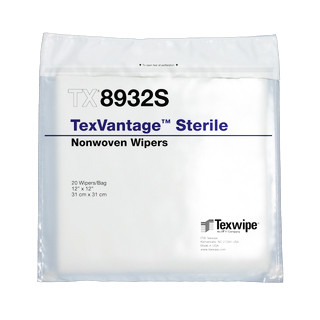
Sterility is a separate decision gate. TX8932 is generally treated as a non-sterile utility wipe unless your receiving documentation for the exact SKU states otherwise. If your workflow requires sterile introduction or aseptic transfer controls, move to the validated sterile configuration (for example, TX8932S) aligned to your SOP and area classification.
TexVantage is also described as autoclavable. “Autoclavable” is not a sterile product claim by itself; if you sterilize in-house, you own cycle qualification, packaging compatibility, post-cycle performance verification, and documentation controls.
Best-practice use
TX8932 performs best when technique is treated like a process input, not a preference:
- Quarter-fold for control: create multiple clean faces; treat each face as single-pass for the cleanest work.
- Wipe pattern: use straight-line, overlapping strokes; avoid casual back-and-forth scrubbing that redeposits soils.
- Spill logic: blot/pick up first, then finish with controlled strokes using fresh faces.
- Wetness control: damp lifts and captures; over-wet spreads soils, pools in seams, and increases dry-down artifacts.
- Change-out triggers: discard when the face is loaded, near saturation, or begins to smear.
Common failure modes — and how TX8932 helps
Most “wipe failures” are procedural and predictable: overworking one face, over-wetting and pooling, dry wiping textured surfaces, and using a spill-control wipe as a default final-pass tool on residue-sensitive surfaces. TX8932 helps by providing fast uptake and wet strength that reduce repeated passes and tearing. The remaining controls are yours: face rotation, directional strokes, and an explicit step-up option for the most defect-sensitive surfaces.
Closest comparators
The most defensible comparisons are to other hydroentangled cellulose/polyester cleanroom wipes used for spill control and routine wipe-downs:
Contec Amplitude™ EcoCloth™ (cellulose/polyester spunlaced wipes) is a close comparator for absorbency-driven spill control and dry wiping. Compare sorbency, documentation depth, and how the wipe behaves under your disinfectant set.
Berkshire Gamma Wipe® 67 (sterile polyester/cellulose blend) is the appropriate comparator when sterile presentation and gamma irradiation posture drive the decision. Compare sterility barrier packaging, documentation, and intended ISO placement.
Valutek spunlace nonwoven cellulose/polyester wipers are a credible category peer for hydroentangled blend wiping. Compare published releasables/residue data, packaging controls, and lot-to-lot consistency expectations.
Where TX8932 fits in a cleanroom wiping program
TX8932 is best positioned as the utility-control dry wipe for ISO 5–8 operations: spill response, daily wipe-downs, and solution application/removal where absorbency and wet strength reduce rework and keep housekeeping stable. Keep the program mature by defining step-up tools—sealed-edge polyester knit for defect-sensitive surfaces and validated sterile configurations where aseptic transfer is required—so the wiper never becomes the uncontrolled variable.
Source basis
- SOSCleanroom product page: “Texwipe TX8932 TexVantage 12" × 12" Cellulose and Polyester Cleanroom Wiper.” https://www.soscleanroom.com/product/wipers/texwipe-tx8932-texvantage-12-x-12-cellulose-and-polyester-cleanroom-wiper/
- ITW Texwipe datasheet: “TexVantage™ Polyester/Cellulose Wipers” (TX8932 size/packaging; typical sorbency, releasables, NVR, ions; ISO 5–8 positioning; chemical resistance notes; sterile family context). https://www.soscleanroom.com/content/texwipe_pdf/8939%208932%208932s.pdf
- Comparator context: Contec Amplitude™ EcoCloth™ cellulose/polyester wipes. https://healthcare.contecinc.com/product/1779445407
- Comparator context: Berkshire Gamma Wipe® 67 sterile polyester/cellulose blend wipes. https://berkshire.uk.com/shop/cleanroom-wipes/sterile-wipes-gamma/gamma-wipe-67-non-woven-sterile-wipes/
- Comparator context: Valutek Spunlace Non-Woven Wiper data sheet (hydroentangled cellulose/polyester blend category reference). https://www.terrauniversal.com/media/asset-library/V/T/VTSNTR-Data-Sheet-V3.0.pdf
Source: SOSCleanroom Technical Vault | Last reviewed: Jan. 3, 2026
© 2026 SOS Supply. All rights reserved.