The Technical Vault
By SOSCleanroom
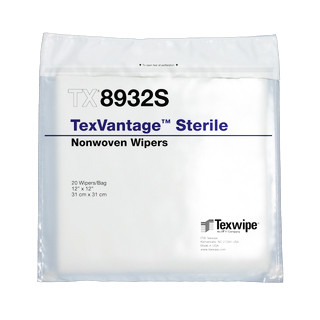
TX8932 TexVantage 12" x 12" Cellulose/Polyester Wipers: High-Sorption Nonwoven for ISO 5–8 Spill Control and General Cleaning
Last reviewed: Jan. 4, 2026 | Audience: contamination control, cleanroom operations, EHS, quality
TX8932 TexVantage is a 12" x 12" hydroentangled nonwoven wiper built around a straightforward cleanroom reality: many cleaning tasks are dominated by sorption and “bulk pickup,” not micro-polish. The 60% cellulose portion drives liquid uptake and wet spill control, while 40% polyester adds strength and helps limit particle and fiber release compared with cellulose-only wipes when operators apply firm pressure or work across textured surfaces.
Where TX8932 earns its keep is repeatability in routine work: aqueous spill cleanup, general wipe-downs, and solution application/removal in ISO 5–8 environments when you need a durable, high-sorption wipe that tolerates common disinfectants (including bleach, phenols, and quats) and can be staged as a controlled consumable with lot traceability and solvent-safe, cleanroom packaging.
What it’s for
General-purpose cleaning and spill control in controlled environments, including wiping equipment and surfaces, applying and removing process liquids (lubricants, residues, disinfectants), and lining trays for parts handling. It is commonly selected for ISO Class 5–8 rooms where sorption and durability matter more than sealed-edge microfiber-style finishing.
Decision drivers
Choose TX8932 when your task is defined by liquid pickup, chemical compatibility, and throughput (how many square feet you can clean per wipe) while maintaining appropriate cleanliness for ISO 5–8 operations.
- Sorption-first cleaning: Cellulose boosts uptake and helps control aqueous spills and pooled solutions.
- Durability under pressure: Hydroentangled nonwoven with bidirectional strength supports firm wiping and reduces tearing during cleanup.
- Chemical resistance: Designed to withstand exposure to common disinfectants (bleach, phenols, quats) used in routine sanitation cycles.
- Cleanroom packaging discipline: Solvent-safe cleanroom packaging supports staging wipes as controlled consumables and reduces “recontamination by handling.”
- ISO range fit: Listed for ISO 5 through ISO 8; validate by task criticality (critical surface vs. noncritical utility wipe-down).
- Edge strategy acceptance: Cut-edge construction is appropriate when your risk is dominated by sorption/cleanup and you manage wipe technique and changeout triggers.
- Program compliance (pharma/compounding): Manufacturer-positioned to meet USP <797> and USP <800> wiper requirements; confirm alignment with your site’s cleaning agent strategy and documentation expectations.
Materials and construction
TX8932 is a hydroentangled cellulose/polyester nonwoven (40% polyester / 60% cellulose) with a cut edge. Hydroentangling interlocks fibers using high-pressure water jets rather than chemical binders, which supports chemical tolerance and reduces the chance of binder-related residue concerns in routine wipe-downs.
The blend is intentionally “task-balanced”: cellulose provides high sorption capacity for spill cleanup and solution handling, while polyester contributes tensile strength and helps reduce particle and fiber release during aggressive wiping compared with cellulose-only materials. As with any cut-edge nonwoven, technique (pressure, directionality, and wipe change frequency) is a primary control variable.
Specifications in context
Size: 12" x 12".
Wiper family: TexVantage.
Material: Cellulose/Polyester nonwoven (40/60).
Edge: Cut edge.
Cleanroom range (listed): ISO 5 (Class 100) through ISO 8 (Class 100,000).
Packaging (case): 20 bags per case; 150 wipers per bag (3,000 wipers per case). Manufacturer technical data identifies the dry format as double-bagged with solvent-safe cleanroom packaging.
In practice, this specification set makes TX8932 a strong “bulk cleaning” consumable: it gives operators enough surface area and sorption to complete wipe-down lanes without constant changeouts, while the bag/case configuration supports controlled staging (e.g., “one case per room” or “one case per area” inventory logic).
Cleanliness and performance metrics
“Typical” wiper metrics are best used as a qualification starting point. For cleanroom wiping, the operational lens is: (1) particles/fibers shed (recontamination risk), (2) NVR (residue risk), and (3) ions (surface compatibility risk). Manufacturer test methods reference IEST-RP-CC004.3 and ASTM E2090 for particle/fiber evaluation approaches.
Typical performance (TexVantage Nonwoven / TX8932): LPC (≥0.5 µm) 65 x 106 particles/m2; fibers (>100 µm) 50,000 fibers/m2. NVR: IPA extractant 0.01 g/m2; DI water extractant 0.03 g/m2. Ions (typicals): sodium 35 ppm, potassium 5 ppm, chloride 20 ppm. Absorbency typicals: sorptive capacity 280 mL/m2; sorptive rate <0.3 seconds. If your process is residue-sensitive, validate NVR on your actual surfaces with your actual chemistry (especially quats and oxidizers) and define an acceptable streak/residue threshold.
Wiping technique controls and standards-based hygiene
The wipe is only half the system. The other half is technique: how you control re-contact, manage clean faces, and prevent chemical carryover. For most facilities, the highest ROI control is a simple, repeatable lane method (straight passes, defined overlap, defined changeout triggers) paired with chemistry segregation (do not mix incompatible disinfectants across the same wipe sequence unless your site procedure explicitly allows it).
Rule of thumb: One wipe face per lane. If you would not be comfortable touching that wipe face to a “clean” stainless panel, rotate to a clean face or replace the wiper. Define the trigger as “visible load,” “loss of glide,” or “end of lane,” whichever comes first.
Best-practice use
Use TX8932 to pick up contamination and keep it in the wipe. The core objective is to avoid smearing and re-deposition.
- Fold for clean faces: Fold into quarters (or smaller) and rotate faces deliberately. Treat each face as a single-use cleaning “tool head.”
- Lane method with overlap: Wipe in straight, overlapping passes (10–20% overlap). Avoid circular scrubbing unless your cleaning suggestion/procedure requires it for a defined soil mechanism.
- Match chemistry to soil: For quats/phenolics/bleach cycles, avoid cross-mixing on the same wipe sequence unless validated. Consider a DI-water follow-up wipe if residue is a known risk on your surfaces.
- Pressure discipline: Apply enough pressure to maintain contact, but do not “grind” the wipe into surfaces. Excess force can elevate fiber release and increase streaking as the wipe loads.
- Autoclave use (if applicable): If your operation uses autoclaving of dry wipes, confirm cycle compatibility and packaging controls under your quality system.
- Controlled staging: Open only one bag at a time in the area of use; reseal/close packaging promptly to avoid environmental exposure and handling contamination.
Common failure modes
The most common failure mode is re-deposition: operators continue wiping after the face is loaded, converting the wipe into a spreading tool. Other recurring issues include (1) chemical carryover between incompatible disinfectants, (2) using a high-sorption wipe for “final finish” on residue-sensitive surfaces without a validated follow-up, and (3) uncontrolled handling (bags left open, wipes staged on noncontrolled surfaces). Reduce these risks by defining wipe-face changeout rules, separating chemistries, and treating wipes as controlled consumables within the room.
Closest competitors
Contec blended nonwoven cleanroom wipers (cellulose/synthetic blends): Often similar in intent (general-purpose cleaning and spill control). Compare on published particle/fiber release, NVR, and available documentation packages that match your QA expectations.
Berkshire blended nonwoven cleanroom wipers: Comparable for routine wipe-downs; practical differences typically show up in absorbency behavior, residue profiles with your disinfectants, and how the material holds together under abrasion. If your room is residue-sensitive, prioritize side-by-side streak/residue qualification on your actual stainless, polymer, and coated surfaces.
Where it fits in a cleanroom wiping program
TX8932 fits best as a workhorse wipe for ISO 5–8 routine cleaning, spill response, and solution handling where high sorption and durability are the primary needs. In many programs it sits “upstream” of final-detail wipes: use TX8932 to remove bulk soil and liquids, then escalate to a lower-residue or edge-controlled wiper when the surface is critical, residue-sensitive, or customer-visible. For USP-aligned compounding or pharma cleaning programs, treat the wipe, the chemistry, and the wipe pattern as a validated system—document your lane method, wipe-face change triggers, and chemical segregation rules as part of your cleaning suggestions/procedure set.
Terminology note: Engineered for low-linting performance; no wiper is truly “lint-free” in every process condition.
Source basis
- SOSCleanroom product page: Texwipe TX8932 TexVantage 12" x 12" Cellulose and Polyester Wipers (CASE) — https://www.soscleanroom.com/product/wipers/texwipe-tx8932-texvantage-12-x-12-cellulose-and-polyester-wipers-case/
- SOS-hosted manufacturer datasheet (stable reference): TexVantage™ Polyester/Cellulose Wipers TX8932/TX8932S/TX8939 — https://www.soscleanroom.com/content/texwipe_pdf/8939%208932%208932s.pdf
- Texwipe manufacturer Technical Data Sheet (external): TexVantage™ Nonwoven, TEX-LIT-TDS-018 Rev.01-02/17 — https://www.texwipe.com/images/uploaded/documents/Wipers/Texwipe-TexVantageNonWoven-TDS-ENG.pdf
- Texwipe product page (external): TexVantage™ TX8932 Dry Nonwoven Cleanroom Wipers, Non-Sterile — https://www.texwipe.com/texvantage-tx8932
- Test method anchors referenced in manufacturer TDS: IEST-RP-CC004.3 (IEST) and ASTM E2090 (ASTM) — https://www.iest.org/ | https://www.astm.org/
Source: SOSCleanroom Technical Vault | Last reviewed: Jan. 4, 2026
© 2026 SOS Supply. All rights reserved.