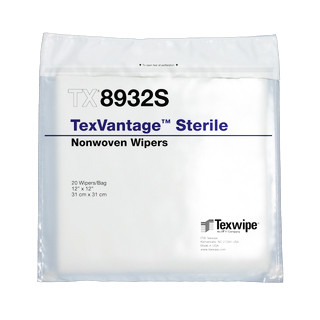
Texwipe TX8932S Sterile TexVantage 12" x 12" Cellulose and Polyester Cleanroom Wiper

$204.24
(No reviews yet)
SKU:
TX8932S
Availability:
Stock Item
Shipping:
Calculated at Checkout
International Shipping:
Restricted to U.S. destinations only
Quantity Option (Case):
5 Bags of 100 Wipers Per Case
Type:
Dry Wiper
Wiper Family:
TexVantage
Wiper Material:
Cellulose/Polyester
Wiper Size:
12" x 12"
Wiper Edge:
Cut Edge
Sterile:
Yes
ISO Class:
ISO 5 (Class 100) - ISO 8 (Class 100,000)
Country of Origin:
Made in the USA

TX8932S Sterile TexVantage 12" x 12" Cellulose and Polyester Cleanroom Wiper

TX8932S Sterile TexVantage is low-linting (no wiper is truly ‘zero-lint’ in every process condition), high-absorbency cellulose/polyester nonwoven wiper used for spill control, general-purpose wipe-downs, and solution application/removal in ISO Class 5–8 controlled environments. It is a hydro-entangled 40% polyester / 60% cellulose blend designed to combine cellulose sorption capacity with polyester strength and lower particle-release behavior, and it is supplied sterile for use where sterile handling, documentation, and controlled transfer matter.

Best-seller note: TX8932S is widely specified for sterile gowning rooms and routine sterile wipe-downs where fast wetting, dependable wet strength, and practical spill pickup performance are the priority—without the workflow burden of in-house sterilization.

Specifications:
  • Size: 12" x 12" (31 cm x 31 cm) nominal
  • Material/Structure: 40% polyester / 60% cellulose
  • Construction: Nonwoven, hydro-entangled construction with bidirectional strength
  • Edge: Cut edge
  • Wiper family: TexVantage
  • Sterile: Yes (gamma irradiated to 10-6 Sterility Assurance Level per AAMI guideline framing)
  • Packaging: 100 wipers/bag (5 inner bags of 20 wipers); 5 bags/case
  • Case unit: 5 bags of 100 wipers per case
  • Use environments: ISO 5 (Class 100) – ISO 8 (Class 100,000) (final suitability depends on your process and cleaning method)
  • Country of origin: Made in the USA
  • Absorbency (typical): Sorptive capacity 280 mL/m2; sorptive rate <0.3 seconds
  • LPC (> 0.5 µm) (typical): 90 x 106 particles/m2
  • Fibers (>100 µm) (typical): 80,000 fibers/m2
  • Nonvolatile residue (typical): IPA extractant 0.01 g/m2; DIW extractant 0.03 g/m2
  • Ions: Sodium/Potassium/Chloride: n/a (sterile datasheet listing)
About the Manufacturer: 

Texwipe (an ITW company) differentiates itself in cleanroom wiping by treating the wiper as an engineered product, not a commodity consumable. In TexVantage™ blended nonwovens, that engineering shows up in hydro-entangled construction (mechanical bonding for bidirectional strength) and substrate selection (cellulose for sorption capacity; polyester for strength and lower particle-release behavior versus cellulose alone) to support spill pickup and routine wipe-downs in ISO 5–8 programs.


For sterile workflows, Texwipe adds gamma irradiation and lot-level documentation (Certificate of Processing confirming radiation dosage, Certification of Compliance, and expiration dating). SOSCleanroom (SOS) supports that manufacturing discipline with a close working relationship with Texwipe focused on continuity of supply, clean documentation handoff (certs, lot traceability), and practical application support—so customers can standardize wiping materials with predictable performance while maintaining procurement reliability and audit readiness.

TX8932S Features:
  • Nonwoven, hydro-entangled construction with bidirectional strength
  • Solvent-safe cleanroom packaging
  • Chemically resistant to withstand exposure to solutions such as bleach, phenols and quats
  • Statistical process control of wiper quality
  • Autoclave safe
  • Gamma irradiated sterile packaging with lot-specific documentation and expiration dating
TX8932S Benefits:
  • Fast wetting + strong spill pickup: Cellulose drives rapid wetting and sorption capacity for aqueous cleanup and solution handling
  • Wet strength under real wiping: Polyester reinforcement supports durability when the wipe is saturated and under hand pressure
  • Practical sterile program fit: Sterile presentation reduces the burden of in-house sterilization, documentation, and handling controls
  • Chemistry flexibility: Positioned to withstand exposure to common disinfectants (bleach, phenols, quats)—verify compatibility to your chemistry and SOP
  • Audit readiness: Lot-specific sterility documentation and expiration dating support controlled-environment recordkeeping
Common Applications:
  • ISO Class 5-8
  • Aqueous spill cleanup
  • Cleaning precision components
  • General-purpose wiping
  • Applying common cleaning and disinfecting solutions
  • Ideal for wipe downs in sterile gowning rooms
Best-Practice Use:
  • Fold for control: Fold into quarters to create multiple clean faces; rotate faces instead of re-wiping with a loaded surface.
  • Wipe pattern: Use straight-line strokes (top-to-bottom or left-to-right) to avoid re-depositing contamination.
  • Wet vs. dry: For disinfectant wipe-downs, dampen—do not over-saturate—so you maintain control and reduce dripping.
  • Spill pickup: Start from the clean boundary and work inward to the spill zone; increase change-outs rather than pushing fluid across surfaces.
  • Change-out triggers: Replace the wiper when the face becomes visibly soiled, tacky, or leaves streaks/residue.
Selection Notes (TX8932S vs. Other Options)
  • TX8932S vs. TX8932 (non-sterile): Choose TX8932S when sterile presentation, lot sterility documentation, and expiration dating are required; choose TX8932 when sterility is not required and you want the same 12" x 12" TexVantage substrate in non-sterile packaging.
  • TX8932S vs. TX8939 (9" x 9"): Choose TX8939 for smaller wipe zones and tighter work areas; choose TX8932S when coverage per wipe matters and you want fewer passes on larger surfaces.
  • Cut-edge blended nonwoven vs. sealed-edge synthetic knits: Choose blended nonwovens for spill control and routine wipe-downs where absorbency and wet strength are the priority; choose sealed-edge/border synthetics when edge-control and ultra-low releasables are the dominant qualification drivers (validate to your SOP).

Link to Texwipe Technical Datasheet:
Click Here

Other Similar Products Available From SOSCleanroom.com

TexVantage Dry Wipers

  • TX8939: 9" x 9" nominal (23 cm x 23 cm), nonwoven cellulose/polyester blend, 300 wipers/bag
  • TX8932: 12" x 12" nominal (31 cm x 31 cm), nonwoven cellulose/polyester blend, 150 wipers/bag

Sterile TexVantage Dry Wipers

  • TX8932S: 12" x 12" nominal (31 cm x 31 cm), sterile nonwoven cellulose/polyester blend, 100 wipers/bag

Notes: Looking for application guidance or qualification context for Texwipe TX8932S Sterile TexVantage 12" x 12" cellulose/polyester cleanroom wipers? Open the SOSCleanroom Technical Vault tab above for practical wiping technique, selection notes (TX8932S vs. alternatives), and the documentation details teams typically review when standardizing sterile blended nonwoven wipes across ISO Class 5–8 controlled environments.

SOSCleanroom.com supports contamination-control programs with cleanroom consumables in stock, fair pricing, and responsive technical support—backed by same-day shipping options and customer service that understands real cleanroom workflows.

Product page updated: Jan. 2, 2026 (SOS Technical Staff)

© 2026 SOS Supply. All rights reserved.

The Technical Vault
By SOSCleanroom
Sterile by Design, Not by Guesswork: How TX8932S TexVantage Controls Spill Pickup, Wet Strength, and Sterility Risk in ISO-Class Wiping
Last reviewed: Jan. 2, 2026 |  Audience: contamination control, cleanroom operations, EHS, quality, aseptic/sterile manufacturing

Texwipe TX8932S TexVantage (12" × 12") is a sterile, hydroentangled cellulose/polyester nonwoven wiper built for the jobs that routinely break “nice, dry wiping” assumptions: aqueous spill pickup, disinfectant application/removal, and wet wipe-down steps where a wipe must stay intact, stay absorbent, and stay within a defined sterility posture.

The technical value is not just the substrate. It is the system-level control: a blended nonwoven engineered for fast uptake and wet strength, paired with a sterile presentation (gamma irradiation to a stated sterility assurance level) and documentation posture that supports qualification and investigations when the wipe becomes part of an aseptic or validation-sensitive workflow.

What it’s for

TX8932S is best used for sterile-area wiping where absorbency and wet durability matter: routine wipe-downs of benches and carts, aqueous spill pickup, and application/removal of common cleaning and disinfecting solutions in controlled environments. It is frequently selected when teams want a blended wipe that absorbs quickly and stays strong when wet, while keeping sterility controls, traceability, and documentation discipline in scope.

Decision drivers

TX8932S earns its place in a sterile wiping program based on a short list of controls that map directly to failure modes:

  • Substrate logic: hydroentangled 60% cellulose / 40% polyester blend—cellulose drives rapid wet-out and pickup; polyester supports wet strength and handling stability.
  • Sorption behavior: published sorptive capacity and fast sorptive rate support spill pickup and controlled wet wiping without turning the wipe into “smear and spread.”
  • Sterility posture: sterile presentation with gamma irradiation to a stated 10−6 SAL (sterility assurance level) for the sterile configuration.
  • Packaging and staging: cleanroom packaging and sterile barrier handling reduce handling-driven contamination and support controlled introduction to critical areas.
  • Published contamination context: typical particles/fibers, NVR, and ionic extractables support qualification discussions and change-control reviews.
  • Program stability: consistent sourcing through SOSCleanroom supports standardization, lot continuity, and faster investigations when a trend shifts.
Materials and construction – explained like an engineer

“Cellulose/polyester wipe” is still too broad. What matters is how the fibers are locked together. TX8932S uses a hydroentangled (spunlace) structure—fibers mechanically entangled using high-pressure water rather than chemical binders. Mechanically, that improves integrity during wet wiping and reduces one common variable in nonwoven systems: binder-related extractables.

The blend is deliberate. Cellulose wets fast and pulls aqueous films into the structure (good for spill pickup and disinfectant wipe-down). Polyester contributes tensile strength and abrasion tolerance, reducing “fall-apart” behavior during corner work, edge wiping, and higher-pressure strokes.

Keep terminology honest: TX8932S is engineered for low-linting performance, but no wiper is truly lint-free in every process condition. Stroke pressure, surface texture, wetness, and overworking a loaded face drive most fiber and particle events—not the product name on the bag.

Cleanliness and performance metrics

For sterile-area wiping, qualification usually comes down to whether the wipe introduces risk in four categories: releasables (particles/fibers), residues (NVR), ions (corrosion/ECM risk), and sterility/handling integrity. Published values should be treated as a qualification starting point rather than a contractual per-lot specification unless explicitly stated otherwise.

  • Sorption capacity: typical 280 mL/m²; sorptive rate < 0.3 seconds — designed to wet quickly and pick up aqueous spills without prolonged “chase wiping.”
  • Particles and fibers: typical LPC (>0.5 µm) 65 × 106 particles/m²; fibers (>100 µm) 50,000 fibers/m² — appropriate for many wipe-down and spill-control roles, with technique and face-rotation as the dominant control lever.
  • NVR (film risk after dry-down): typical 0.01 g/m² (IPA) and 0.03 g/m² (DI water) — if haze or streaking appears, the main levers are wetness control, chemistry concentration control, and early face change-out.
  • Ions (defect mechanism, not paperwork): typical sodium 35 ppm, potassium 5 ppm, chloride 20 ppm (standard products listed). For corrosion-sensitive assemblies or high-impedance electronics, validate the wipe/chemistry pairing in your real acceptance window.
Why sterile packaging and documentation matter operationally

In real facilities, wipes fail less often due to the substrate and more often due to handling: how they are staged, how long sterile barriers are open, and whether operators touch the wipe and then touch product-contact surfaces. TX8932S is positioned as gamma irradiated for the sterile configuration with supporting documentation (commonly including certificates tied to sterilization and processing). Treat those documents as part of your change-control and deviation workflow, not as a “nice-to-have.”

Rule of thumb: In aseptic workflows, define “wipe roles” the same way you define “glove roles.” A sterile wipe is only sterile until handling breaks the barrier or the workflow breaks the technique.

Best-practice use

TX8932S performs best when technique is treated as a control plan, not a preference.

  • Face control: quarter-fold (or eighth-fold for smaller targets) to create multiple clean faces; treat each face as single-pass for critical wipe-downs.
  • Stroke discipline: use straight-line, overlapping strokes; avoid back-and-forth scrubbing unless an SOP explicitly requires it for soil removal.
  • Wetness control: aim for “wet enough to work” but not “flood and chase.” Over-wetting drives pooling, wicking, and residue artifacts after dry-down.
  • Spill logic: blot/pick up first, then finish with controlled strokes using fresh faces to prevent redeposit.
  • Sterile handling: stage opening events; minimize open-barrier time; avoid laying wipes on uncontrolled surfaces; discard anything with ambiguous handling history.
Common failure modes — and how TX8932S helps

A wiper becomes a contamination source in predictable ways: overworking a loaded face, over-wetting and spreading soils into seams, scrubbing abrasive textures that drive fiber release, and breaking sterile technique during staging. TX8932S helps by combining fast uptake with wet strength (reducing “wipe collapse”), and by pairing the wipe with a sterile/documented posture for workflows where sterility and traceability are part of the acceptance criteria. The remaining controls are procedural: face rotation, stroke discipline, chemistry control, and sterile handling discipline.

Closest comparators

The most defensible comparisons are to other sterile hydroentangled cellulose/polyester nonwoven wipes intended for similar wipe-down and spill-control roles in controlled environments.

Contec SterileSorb™ (sterile hydroentangled polyester/cellulose nonwoven) is a close comparator when programs want a sterile, highly absorbent nonwoven with low levels of particles and extractables—often evaluated in similar wipe-down/spill-control roles.

Berkshire sterile nonwoven wipe families (sterile, absorbent nonwoven offerings) are appropriate comparators when packaging presentation, documentation depth, and wet-handling behavior are the key decision drivers.

Valutek sterile nonwoven wipe families are credible alternatives in the same use tier; comparison should focus on published cleanliness metrics, sterile barrier configuration, and consistency of wet strength and face life under your chemistry set and wipe cadence.

Selection cue: If your dominant risk is sterile handling and spill pickup, a sterile hydroentangled blend is often the right tool. If your dominant risk is ultra-low residue or edge-driven releasables on the most defect-sensitive surfaces, qualify a tighter-control polyester architecture for the finishing step.

Where TX8932S fits in a cleanroom wiping program

TX8932S fits best as a sterile-area workhorse for absorbency-driven wiping: fast uptake for aqueous spills, durability for wet wipe-downs, and a sterile/documented posture that supports controlled introduction and investigations. Use it for routine sterile wipe-downs, spill response, and chemistry application/removal where wet strength and sterility controls matter. Keep the program mature by defining role separation between (1) spill/routine wiping, (2) residue-sensitive finishing, and (3) validation-sensitive sampling—so wipes do not become the uncontrolled variable in yield, sterility assurance, or audit outcomes.

Terminology note: TX8932S is engineered for low-linting performance; no wiper is truly “lint-free” in every process condition.

Source basis
  • SOSCleanroom product page: “Texwipe TX8932S Sterile TexVantage 12" × 12" Cellulose and Polyester Cleanroom Wiper” (construction, sterile positioning, packaging configuration, ISO range guidance, chemical resistance and autoclave-safe positioning). https://www.soscleanroom.com/product/wipers/texwipe-tx8932s-sterile-texvantage-12-x-12-cellulose-and-polyester-cleanroom-wiper/
  • ITW Texwipe datasheet (TexVantage™ Polyester/Cellulose Wipers — TX8939 / TX8932 / TX8932S) (published typical performance: sorption, LPC/particles, fibers, NVR, ions; sterile gamma irradiation posture and SAL statement; listed documentation posture). https://www.soscleanroom.com/content/texwipe_pdf/8939%208932%208932s.pdf
  • Comparator context: Contec SterileSorb™ Wipes (sterile hydroentangled polyester/cellulose nonwoven positioning). https://healthcare.contecinc.com/product/1779432621
  • Comparator context: Berkshire sterile nonwoven wipe listing (category availability and positioning). https://hisco.com/Product/BEZSVT1230
  • Comparator context: Valutek sterile cleanroom wipe category/product example (category positioning and availability). https://valutek.com/cleanroom-wipers/sterile-cleanroom-wipers-sterile-nonwoven-cleanroom-wipers/
Source: SOSCleanroom |  Last reviewed: Jan. 2, 2026
© 2026 SOS Supply. All rights reserved.