The Technical Vault
By SOSCleanroom
Laser-Edge Durability as a Process Control: What TX29 Was Built to Solve on Sharp Edges, Fixtures, and Abrasive Surfaces
Last reviewed: Jan. 3, 2026 | Audience: contamination control, cleanroom operations, EHS, quality
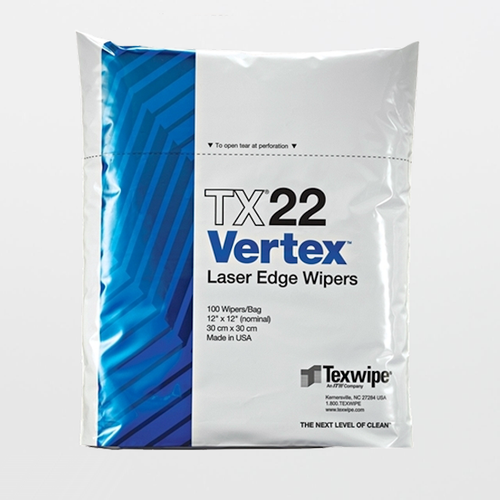
Texwipe TX29 Vertex (9" × 9") is a dry, 100% polyester, double-knit cleanroom wiper positioned for
high-durability wiping where sharp edges, rough finishes, and aggressive handling are the real failure modes.
In these workflows, wiper performance is less about “does it wipe?” and more about whether it stays intact and predictable while
you clean fixtures, remove residues, or wipe down equipment surfaces that snag and shred typical cut-edge wipes.
Status note: SOSCleanroom lists TX29 as discontinued and directs users to alternatives such as
TX49 Vertex and TX2069 ThermaSeal 60. If TX29 is referenced in legacy SOPs or validations,
treat substitution as a controlled change (edge type, absorbency behavior, and contamination background can shift) and document the
transition rather than allowing “last-minute” replacement to become an untracked variable. :contentReference[oaicite:0]{index=0}
What it’s for
TX29 is positioned for cleaning jobs where durability and edge control matter: wiping rough surfaces and sharp edges, routine
wipe-downs of equipment and fixtures, and general controlled-environment cleaning where a wiper that frays or tears becomes a particle
and fiber source. SOSCleanroom also positions TX29 for applications that include residue removal and solution application/removal in
day-to-day cleaning steps. :contentReference[oaicite:1]{index=1}
Decision drivers
TX29’s technical rationale is straightforward: reduce the “wipe becomes debris” failure mode when the surface is unforgiving.
- High-durability polyester knit: 100% polyester, double-knit construction aimed at maintaining integrity when wiping corners, edges, and textured finishes. :contentReference[oaicite:2]{index=2}
- Edge strategy (laser-edge intent): designed to minimize fraying behavior that can spike fibers during aggressive wiping and repeated folding. :contentReference[oaicite:3]{index=3}
- Manufacturing controls (micro-environment posture): SOSCleanroom describes an integrated, hands-free “micro-environment” process with real-time monitoring and alarm response, and manufacturing aligned to ISO Class 3 conditions. :contentReference[oaicite:4]{index=4}
- Biocompatibility / endotoxin screening posture: SOSCleanroom states quarterly microbial testing using an Agarose Overlay Method and bacterial endotoxin testing, positioned to support programs that care about nonpyrogenic/non-cytotoxic risk signals. :contentReference[oaicite:5]{index=5}
- Traceability and packaging discipline: packaging and SKU-level configuration are part of operational control—especially when these wipes are staged at high-use wipe points. (TX29 packaging on SOSCleanroom is 150 wipers/bag; 10 bags/case.) :contentReference[oaicite:6]{index=6}
Materials and construction – explained like an engineer
The engineering question for a “durable wipe” is not marketing softness—it is how the wipe behaves when the surface is trying to
tear it apart. Sharp edges, burrs, knurled knobs, brushed stainless, and threaded fasteners create concentrated stress points.
If the wipe edge frays, you do not just lose wipe life—you create releasables that can migrate into the process.
TX29’s design intent is to keep the wipe stable under those stresses through a polyester knit substrate and an edge approach aimed
at limiting fray/edge-driven fibers in real handling. This is precisely the operational niche where “strong enough” becomes a
contamination control decision, not a convenience preference. :contentReference[oaicite:7]{index=7}
Cleanliness and performance metrics
For many facilities, the “pass/fail” risk is driven by releasables (particles/fibers), residues (NVR), and ions—plus, in some life
science and compounding environments, additional concern around endotoxins and cytotoxicity.
SOSCleanroom’s TX29 listing emphasizes quarterly microbial testing and bacterial endotoxin testing posture as part of the product’s
contamination-control framing, alongside manufacturing controls intended to limit variability. Treat these as supplier posture signals
and still qualify the wipe in your actual use window (surface type, pressure, wetness, chemistry, and face-rotation discipline). :contentReference[oaicite:8]{index=8}
Why edge control matters operationally
Edge behavior is where many wipes fail in practice. Operators fold wipes repeatedly, pinch edges into corners, drag them across
threaded features, and scrub around fasteners. A durable substrate can still shed if the edge degrades. When a wipe is used on sharp
edges (fixture rails, stamped metal, machined corners), edge stability often becomes the dominant contamination-control lever.
Rule of thumb: When the failure mode is “snag → fray → fibers,” the most defensible step is an edge-control upgrade
(laser/thermal/ultrasonic sealing). When the failure mode is “variable wetness → streaks/residue,” the more defensible step is a
controlled pre-wetted system.
Best-practice use
TX29 performs best when technique prevents redeposition and limits wiper overuse—especially during aggressive wiping where a loaded face
quickly becomes a smear tool.
- Quarter-folding discipline: create multiple clean faces; treat each face as a single-pass surface in sensitive wipe-down steps.
- Directional strokes: use controlled, overlapping, one-direction passes; avoid “scrub back and forth” patterns that grind soils into surfaces and accelerate edge wear.
- Wetness control: aim for damp rather than wet; over-wetting increases pooling and residue after dry-down.
- Change-out triggers: replace early when the wipe face loads or begins to streak—do not “get one more pass” out of a contaminated face.
- Edge-aware wiping: on sharp features, reduce pressure and change angles; let the wipe do the work rather than forcing abrasion.
Common failure modes — and how TX29 helps
A wipe becomes an uncontrolled variable in predictable ways: snagging and edge fray on sharp geometry, overworking a saturated face,
wiping too dry on high-friction textures, and using a “durable wipe” as a universal finishing tool when the step is actually
residue-critical. TX29’s intended value is durability and edge behavior on difficult surfaces; the remaining controls are procedural:
face rotation, directional strokes, and chemistry discipline. :contentReference[oaicite:9]{index=9}
Closest comparators
Because TX29 is discontinued, the most useful comparisons are to the replacement paths SOSCleanroom itself points to—wipes that preserve
the “edge-control + durability” intent while fitting current availability.
Texwipe TX49 Vertex (laser-edge, 9" × 9") is a direct in-family alternative that SOSCleanroom recommends as the
replacement product line for TX29. It is positioned for ISO Class 3–8 use and maintains the sealed-edge Vertex posture for critical cleaning
applications.
Texwipe TX2069 ThermaSeal 60 (thermally sealed edge, 9" × 9") is the other SOSCleanroom-recommended replacement path
when the technical need is edge control and process stability in routine cleanroom wiping. :contentReference[oaicite:11]{index=11}
Where TX29 fits in a cleanroom wiping program
TX29 belongs in the “abrasion- and edge-risk control” tier: sharp edges, fixtures, and rough surfaces where a tearing wipe becomes a
contamination source. If you are still running TX29 in legacy programs, manage end-of-life responsibly: identify the steps where edge
integrity is the actual requirement, qualify an in-stock replacement (TX49 or TX2069 per SOSCleanroom guidance), and document the change
so the wiping material does not become an investigation trigger later. :contentReference[oaicite:12]{index=12}
Terminology note: TX29 is engineered for low-linting performance; no wiper is truly “lint-free” in every process condition.
Source basis
- SOSCleanroom product page: “Texwipe TX29 Vertex 9" × 9" Polyester High Durability Laser Edge Cleanroom Wiper” (discontinued status; positioning; construction; packaging 150/bag and 10 bags/case; manufacturing control statements; quarterly microbial and endotoxin testing statements; benefits framing). https://www.soscleanroom.com/product/wipers/texwipe-tx29-vertex-9-x-9-polyester-high-durability-laser-edge-cleanroom-wiper/
- SOSCleanroom product page: “Texwipe TX49 Vertex 9" × 9" Polyester High Absorption Laser Edge Cleanroom Wiper” (replacement path; packaging configuration; ISO range listing; made-in-USA listing). https://www.soscleanroom.com/product/wipers/texwipe-tx49-vertex-9-x-9-polyester-high-absorption-laser-edge-cleanroom-wiper/
- SOSCleanroom product page: “Texwipe TX2069 ThermaSeal 60 9" × 9" Polyester Cleanroom Wiper” (replacement path; thermally sealed edge family positioning). https://www.soscleanroom.com/product/wipers/texwipe-tx2069-thermaseal60-9-x-9-polyester-cleanroom-wiper/
- Texwipe technical data sheet: “Vertex® Series – Dry | Pre-Wetted | Sterile” (Vertex family positioning, applications, and general features/benefits framework). https://www.texwipe.com/images/uploaded/documents/Wipers/Texwipe-VertexSeries-TDS.pdf
Source: SOSCleanroom Technical Vault | Last reviewed: Jan. 3, 2026
© 2026 SOS Supply. All rights reserved.