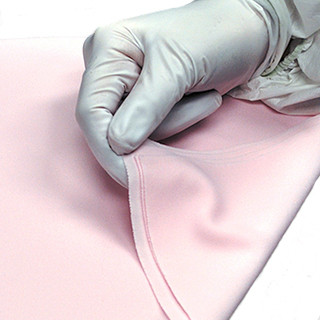
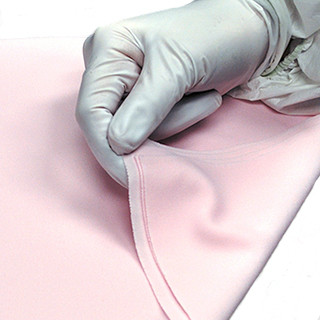
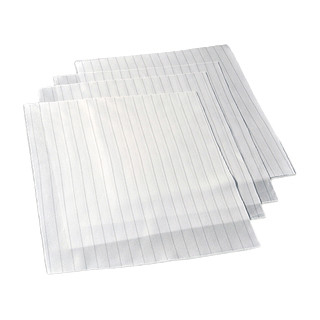
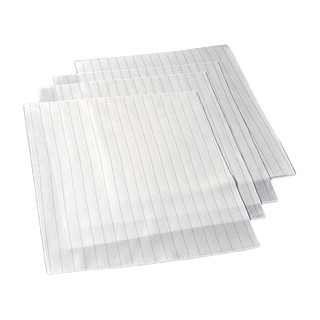
SKU shown on SOSCleanroom: VS10P-1212U.150 (150 wipers per bag).
1) Practical solutions in a critical environment
This pink ESD-focused polyester knit wiper is designed for day-to-day wipe-down work where two problems tend to collide:
(1) you need a wiper that won’t become a contamination source, and (2) you cannot tolerate static-related risk around
sensitive assemblies. SOSCleanroom lists this product as an ISO Class 6 (Class 1000) cleanroom wiper and
identifies it as antistatic, durable, and abrasion resistant. The manufacturer positions the VISION Pink line
for electronics assembly and controlled environments and notes compatibility across ISO Class 5–8 applications (process-dependent).
Practical takeaway: use this wiper when you need a consistent, color-identifiable wipe for benches, fixtures, tools, and
equipment surfaces—especially in ESD-aware work cells—then pair it with your facility’s accepted chemistry and verification method.
2) What is this wiper used for
- ESD-aware wipe downs in electronics assembly/repair, PCB/SMT handling areas, and inspection benches.
- Routine removal of light particulate and process soils from fixtures, carts, and tooling where knit polyester durability helps.
- Color-based wipe control (pink) to reduce mix-ups between “process-critical” wipes and general shop wipes.
- Solvent or solution-assisted cleaning where the wiper must hold together and not shred on edges or burrs (within your validated limits).
3) Why should customers consider this wiper
- ESD/anti-static intent: positioned for ESD-safe environments and electronics work cells.
- Durable knit structure: manufacturer emphasizes abrasion resistance and low particle generation for controlled environments.
- Process recognition: double-bag packaging and lot-to-lot traceability are called out by the manufacturer.
- Operational control: pink color helps visually separate ESD wipes from other wipe types on the line.
- Right-size format: 12" x 12" is a practical “one-wipe fold” size for wide faces (covers, lids, trays, staging surfaces).
4) Materials and construction
Manufacturer documentation describes the VISION Pink line as a polyester knit wipe made from 100% polyester,
emphasizing a durable, absorbent, abrasion-resistant construction and very low particle generation and extractables for sensitive work.
SOSCleanroom describes the fabric as premium virgin polyester with continuous filament knit construction and notes the product is
antistatic.
A terminology note that matters in quality conversations: some sources may use the phrase “lint-free.”
In practice, no wiper is truly lint free in every use case; what you are selecting for is low-linting behavior
under your friction level, solvent system, and inspection standard.
5) Specifications in context
Below are the SKU-level attributes that drive real-world wiping performance and audit defensibility. If a value is not published
in the source basis, it is listed as “not stated.”
| Attribute |
VISION 1 Pink ESD 12" x 12" (VS10P-1212U.150) |
| Size |
12" x 12" |
| Material |
Polyester knit (100% polyester) |
| Basis weight |
115 gsm (manufacturer listing) |
| ESD / anti-static positioning |
ESD/anti-static (manufacturer positioning; numeric surface resistivity not stated) |
| Cleanroom compatibility |
Manufacturer: ISO Class 5–8 compatible; SOS listing emphasizes ISO Class 6 for this item |
| Sterility |
Non-sterile (manufacturer listing) |
| Packaging |
150 wipers/bag; 10 bags/case (manufacturer and SOS listing) |
| Packaging discipline |
Double bagged (manufacturer listing) |
| Edge finish |
Not stated in source basis |
| Washed / laundered status |
SOS page labels “Un-Laundered”; manufacturer page does not state laundered status for this pink ESD variant |
| Color |
Pink |
6) Cleanliness metrics
For wipe selection in controlled environments, two “numbers-first” categories typically show up in investigations and validations:
ionic extractables (risk of corrosion, conductivity drift, or residue-driven failures) and NVR
(non-volatile residue that can haze optics, interfere with coatings, or show up as film). For this SKU, publicly posted sources
emphasize “extremely low” particles and extractables but do not publish numeric ion/NVR tables.
Typical ion extractables
| Ion |
Typical value |
Notes |
| Sodium / Chloride / Potassium / Sulfate (and others) |
Not published |
Numeric ionic data not stated in the source basis for this SKU |
Typical NVR
| Metric |
Typical value |
Notes |
| Non-volatile residue (NVR) |
Not published |
If your process is NVR-limited, request certificates/technical data before qualification |
7) Packaging, sterility and traceability
- Packaging unit: 150 wipers per bag; 10 bags per case (VS10P-1212U.150).
- Packaging discipline: double-bag packaging is stated by the manufacturer.
- Sterility: non-sterile (manufacturer listing).
- Traceability: manufacturer states lot-to-lot traceability.
- Country of origin (manufacturer statement): not stated in the source basis publicly available at time of writing.
8) Best-practice use
Knit polyester wipes perform best when technique is consistent. The goal is simple: remove contamination without redepositing it,
and avoid turning the wipe into a “moving brush” that drags soil across a surface.
Operator-level wiping technique module (practical)
- Fold for control: quarter-fold a 12" x 12" wipe into a manageable pad; present one clean face at a time.
- One direction, one pass (when possible): wipe in a single direction and lift—avoid scrubbing circles that redeposit soil.
- Face discipline: rotate to a fresh face after each defined area (bench segment, fixture, or tool) to prevent cross-contamination.
- Wet correctly: if using a solvent or solution, dampen uniformly (no “hot spot” puddles) and avoid over-wetting that leaves streaks or wicking trails.
- ESD basics still apply: a wipe labeled ESD/anti-static is not a substitute for grounding and approved ESD work practices.
- Post-wipe handling: do not set a used wipe back on the bench. Dispose or segregate immediately per your contamination-control rules.
9) Common failure modes
- Over-wetting: excess solvent leaves streaks and can mobilize residues instead of removing them.
- Re-using a “dirty face”: the wipe becomes the contamination source (classic root cause in “mystery smear” investigations).
- Wrong chemistry: solvent incompatibility or uncontrolled additives can leave film (NVR risk).
- Friction mismatch: using heavy pressure on rough edges, burrs, or sharp fixtures can damage any wipe and increase particle release.
- Static complacency: relying on the wipe alone instead of full ESD controls (grounding, garments, workstation compliance).
10) Closest competitors
The closest comparisons are not “brand vs brand,” but substrate and process fit: knit vs nonwoven, sealed-edge vs cut-edge,
sterile vs non-sterile, and how your quality system verifies residue and particles. From SOSCleanroom’s own “other wipers” references,
the following are commonly cross-shopped categories:
- Hydro-entangled poly/cellulose blends (general cleanroom wiping): e.g., Texwipe TX629 VersaWipe category.
- Premium processed polyester options (critical environments): e.g., Texwipe Vectra Alpha 10 LT category.
- Pre-wetted sterile/non-sterile wipe systems (workflow-driven): e.g., sterile pre-wetted polyester/cellulose or polypropylene wipe categories depending on your chemistry and sterility needs.
11) Critical environment fit for this wiper
For ISO Class 6 workflows, the practical question is whether your wipe is behaving like a controlled consumable under real handling:
opening the bag, staging wipes, wetting with approved chemistry, wiping at a defined pressure, then disposing without back-contaminating
the bench. This SKU is positioned for ESD-aware electronics use, with pink color helping with visual control and mix-up prevention.
If your process is sensitive to residue (films, haze, ionic drift), confirm requirements with your quality team and consider requesting
supporting technical data/certificates before final qualification. SOSCleanroom can help you align the wiper format, packaging, and reorder cadence
to reduce substitutions and keep your line stable.
12) SOSCleanroom note about SOP's
The Technical Vault is written to help customers make informed contamination-control decisions and improve day-to-day handling technique.
It is not your facility’s Standard Operating Procedure (SOP), batch record, or validation protocol.
Customers are responsible for establishing, training, and enforcing SOPs that fit their specific risks, products, equipment, cleanroom classification, and regulatory obligations.
Always confirm material compatibility, cleanliness suitability, sterility requirements, and acceptance criteria using your internal quality system and documented methods.
If you adapt any technique guidance from this entry, treat it as a starting template. Your team should review and approve the final method, then qualify it for your specific surfaces,
solvents, cleanliness limits, inspection methods, and risk profile. In short: use these best-practice suggestions to strengthen your SOPs—not to replace them.
13) Source basis
Product pages
Manufacturer PDFs / reference documents
Standards / regulatory bodies (as applicable)
SOSCleanroom is the source for this Technical Vault entry.
Briefed and approved by the SOSCleanroom (SOS) staff.
If you have any questions please email us at Sales@SOSsupply.com
Last reviewed: January 7, 2026
© 2026 SOSCleanroom