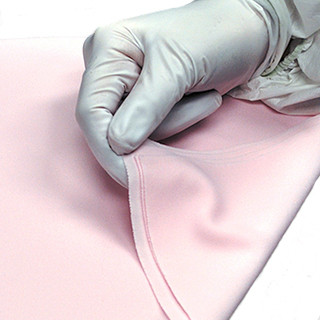
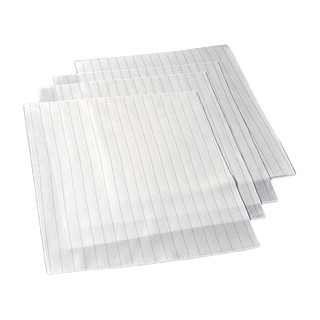
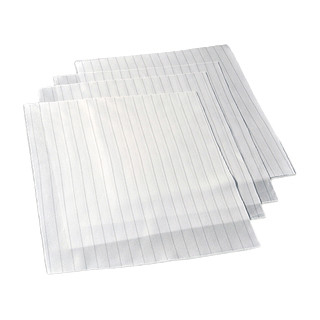
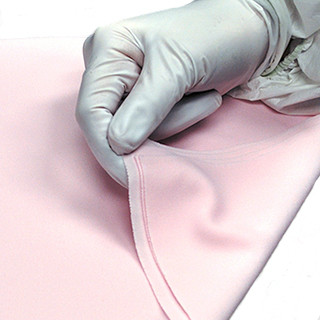
VISION 50 ESD Cleanroom 12" x 12" Wiper (ISO Class 5): Heavy-weight knit control for static-sensitive wipe-down

SKU on SOSCleanroom: VS50-1212 (bag or case).
Practical solutions in a critical environment
In ESD-controlled work zones, wiping is never “just cleaning.” A wipe can either remove contamination or redistribute it via static attraction,
edge shedding, or solvent drag marks. The VISION 50 ESD 12" x 12" wiper is positioned for ISO Class 5 (Class 100) wipe-down where teams want
a heavy-weight polyester knit that’s anti-static, cleanroom laundered, and packaged with lot traceability. It’s designed to reduce variability between operators:
one wipe, one fold pattern, one direction of travel—repeatable across shifts.
What is this wiper used for
- Bench and work-surface wipe-down in static-sensitive assembly, inspection, and packaging areas.
- Tooling and fixture wipe-down where particulates and light residue can drive yield loss.
- Final wipe before cover/close-out (lids, totes, trays, and protected work cells).
- Solvent-compatible wipe-down where teams want a durable knit that stays intact under moderate abrasion.
- Controlled “touch points” (glove contact areas, handles, doors, carts) where static and residue can build up quickly.
Why should customers consider this wiper
- ESD / anti-static knit construction: carbon core nylon fibers are described as continuously filamented throughout the knit for static-control intent.
- Heavy-weight feel (140 gsm): supports wipe pressure without “flimsy wipe” skipping or early saturation break-through.
- Cleanroom laundering and packaging discipline: described as laundered using ultra-filtered water and HEPA-filtered air drying, with sealed packaging and lot traceability.
- Double-bagged and vacuum packed: helps reduce bag-borne contamination transfer into the gowning area or wipe station.
- Low-linting intent (not “lint-free”): no wiper is truly lint-free—what matters is controlled fiber release and consistent handling technique.
Materials and construction
VISION 50 ESD is described as a polyester knit made from premium quality virgin polyester fibers with
carbon core nylon fibers continuously filamented through a no-run knit construction. The wiper is described as
cleanroom laundered and individually inspected with lot-to-lot traceability. Edges are described as knife-cut,
which is a practical tradeoff: it can be a cost-effective knit option, but operators should treat edges as the “highest-risk zone” for fiber transfer
if they scrub aggressively or wipe rough surfaces.
Specifications in context
These are the operational specs that typically drive whether a 12" x 12" ESD wipe behaves consistently at the wipe station (folding, wet-out,
drag feel, and wipe coverage).
| Attribute |
VISION 50 ESD 12" x 12" (VS50-1212) |
| Size |
12 in x 12 in |
| Material |
Polyester knit; carbon core nylon fibers (ESD / anti-static intent) |
| Basis weight |
140 gsm (heavy weight) |
| Thickness |
0.49 mm |
| Edge type |
Knife-cut edges |
| Cleanroom class listing |
ISO 5 (Class 100) through ISO 8 (Class 100000) listed on manufacturer catalog page |
| Sterility |
Non-sterile (dry) |
| Packaging |
100 wipes/bag; 10 bags/case (1,000 wipes/case) |
| Inspection / traceability (manufacturer description) |
Individually inspected; lot-to-lot traceability; referenced to ISO 9000 practices |
| Autoclavable |
Yes (listed by manufacturer) |
Cleanliness metrics
Cleanliness metrics are most useful when your QA team ties them to a specific method (extraction conditions, solvent, and reporting units).
For this SKU, SOSCleanroom and the primary manufacturer product page emphasize low extractables, but do not publish SKU-level ionic extractables
and NVR values in the sources listed below. Tables are included to keep qualification structured.
Typical ion extractables
| Ion |
Typical value |
Notes |
| Sodium (Na+) |
Not published |
Not stated in source basis |
| Chloride (Cl-) |
Not published |
Not stated in source basis |
| Potassium (K+) |
Not published |
Not stated in source basis |
| Calcium (Ca2+) |
Not published |
Not stated in source basis |
Typical NVR
| Metric |
Typical value |
Notes |
| Non-volatile residue (NVR) |
Not published |
Not stated in source basis |
Packaging, sterility and traceability
- Packaging (SOSCleanroom): 100 wipes per bag; 10 bags per case (1,000 wipes/case).
- Packaging (manufacturer description): double bagged and vacuum cleanroom packed; also described as hermetically sealed in cleanroom-cleaned packaging under class 10 air-stream.
- Sterility: Non-sterile (dry).
- Traceability: described as individually inspected with lot-to-lot traceability (ISO 9000 referenced by manufacturer description).
- Country of origin (manufacturer statement): Malaysia (listed on Hospeco Brands catalog page for VS50-1212).
Best-practice use
The best wipe can still fail if technique is inconsistent. For ISO-class wipe-down, the goal is controlled removal: trap contamination in the wipe,
avoid redepositing it, and keep the “dirty edge” from contacting cleaned surfaces.
Operator-level wiping technique module
- Fold discipline: fold into quarters to create eight clean faces. Rotate faces on a timer or by area coverage—do not “chase” a streak with the same face.
- Direction control: wipe in one direction (top-to-bottom or back-to-front). Avoid circular “polishing” that can redeposit particles.
- Edge awareness: treat knife-cut edges as higher-risk; keep edges off critical optical/electrical contact surfaces when possible, and avoid aggressive scrubbing on rough fixtures.
- Wet-out consistency (if using solvent): use measured dispense (by stroke count or mL) so “too dry” doesn’t drag and “too wet” doesn’t flood seams or fasteners.
- Pressure control: moderate, even pressure is better than heavy force. High force can increase fiber release and can drive contamination into surface texture.
- ESD workflow: keep wipes stored in the controlled area packaging until point-of-use; avoid staging open wipes near fans or high-airflow returns.
- Stop rules: if the wipe face shows visible loading, streaking, or snagging—switch faces or replace the wipe immediately.
Common failure modes
- “Wipe looks clean” fallacy: operators reuse the same face too long, turning a cleaning action into a redistribution action.
- Edge shedding on rough hardware: knife-cut edges can snag on burrs, threads, or sharp corners—prep surfaces or change technique if snagging occurs.
- Over-wetting: excess solvent can carry contaminants into seams, labels, and under fasteners—especially on benches with lap joints.
- Under-wetting: a too-dry wipe increases drag and can leave haze or streaking from uneven contact pressure.
- Packaging breaches at the station: leaving bags open invites airborne loading before use—open, remove, reseal.
Closest competitors
If you’re standardizing an ESD wipe family, these are common cross-shops based on ISO class target, size, and ESD intent:
- ULTIMATE 5 ESD Cleanroom 12" x 12" Wiper (ISO Class 3–4): typically considered when teams want a tighter ISO class target in an ESD wipe.
- VISION 1 PINK ESD Cleanroom 12" x 12" Wiper (ISO Class 6): typically considered when the environment target is less stringent but ESD handling is still required.
- VISION 50 ESD 9" x 9" (ISO Class 5): same family behavior in a smaller format for tighter access or smaller wipe zones.
Critical environment fit for this wiper
VISION 50 ESD is positioned for ISO Class 5 (Class 100) use and is also listed across ISO Class 5–8. In practical terms, it’s a strong fit when you need:
(1) durable knit contact, (2) ESD / anti-static intent, and (3) packaging/traceability discipline that supports receiving inspection and lot control.
For wipe stations, this product also supports standardization: consistent size, consistent fold geometry, consistent wipe coverage.
SOSCleanroom note about SOP's
The Technical Vault is written to help customers make informed contamination-control decisions and improve day-to-day handling technique.
It is not your facility’s Standard Operating Procedure (SOP), batch record, or validation protocol.
Customers are responsible for establishing, training, and enforcing SOPs that fit their specific risks, products, equipment, cleanroom classification, and regulatory obligations.
Always confirm material compatibility, cleanliness suitability, sterility requirements, and acceptance criteria using your internal quality system and documented methods.
If you adapt any technique guidance from this entry, treat it as a starting template. Your team should review and approve the final method, then qualify it for your specific surfaces,
solvents, cleanliness limits, inspection methods, and risk profile. In short: use these best-practice suggestions to strengthen your SOPs—not to replace them.
Source basis
- SOSCleanroom product page (pricing, pack configuration, and SOS listing): https://www.soscleanroom.com/product/wipers/vision-50-esd-cleanroom-12-x-12-wiper-iso-class-5/
- Manufacturer product page (construction, laundering/packaging narrative, weight/thickness, packaging table): https://high-techconversions.com/product/vision-5-class-100-esd-cleanroom-wipers/
- Manufacturer catalog page with COO listing + download link (VS50-1212 details): https://www.hospecobrands.com/products/hbg-products/wiping-solutions/vision-50-esd-cleanroom-wipe-12-x-12-100-bg-10-bgs-cs
- Manufacturer PDF download link as provided on catalog page (availability/format may vary by browser): https://www.hospecobrands.com/publications/catalog?MainProductId=VS50-1212&filename=VS50-1212.pdf&pdf=true
- ISO (cleanroom classification reference): https://www.iso.org/standard/53394.html
- FDA (regulatory context, when applicable to customer programs): https://www.fda.gov/
- ASTM (materials/testing context; ESD programs often reference ASTM methods): https://www.astm.org/
- IEST (contamination-control guidance context): https://www.iest.org/
SOSCleanroom is the source for this Technical Vault entry.
Briefed and approved by the SOSCleanroom (SOS) staff.
If you have any questions please email us at Sales@SOSsupply.com
Last reviewed: January 7, 2026
© 2026 SOSCleanroom