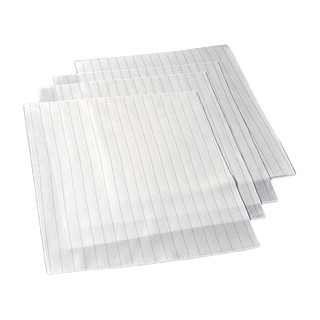
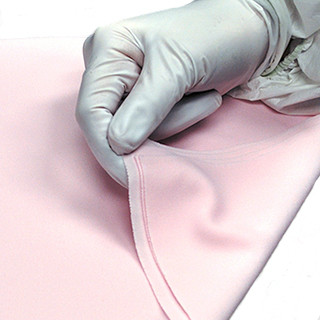
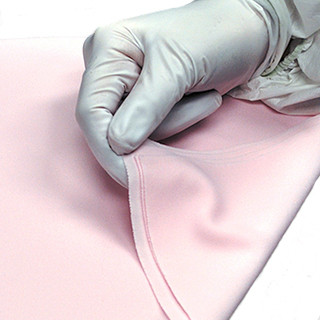
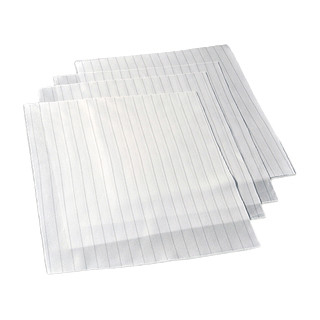
Product image shown for quick visual ID (size shown may not reflect scale).
1) Practical solutions in a critical environment
In ISO Class 5 work where electrostatic discharge (ESD) risk overlaps with particle and extractables control, the “right” wiper is often the one that stays predictable:
it does not snag, does not shed excessively, and does not become a surprise source of residue when paired with your cleaning solvent.
Vision 50 VS50-99 is positioned as an ESD/anti-static polyester knit wiper intended for ISO Class 5–8 environments, with a manufacturing and laundering approach designed to reduce
particulate emission and keep chemical extractables low enough for many electronics-adjacent cleaning tasks. Use it when you need a durable, absorbent knit wiper that can be introduced
into controlled areas without treating the wiping step as an uncontrolled variable.
2) What is this wiper used for
- General surface wipe-down in ISO Class 5 (Class 100) zones where ESD control matters (benchtops, fixtures, carts, tool exteriors).
- Pre-clean and final wipe steps prior to inspection (optics-adjacent handling, housings, covers, shields, and non-critical exterior surfaces).
- Solvent-assisted cleaning where a knit structure improves pickup and durability (validate compatibility with your specific solvent system).
- Routine “touch” cleaning around sensitive electronics where uncontrolled tribocharging is a practical defect driver.
3) Why should customers consider this wiper
- ESD-safe intent: Designed as ESD/anti-static, for wiping in electronics-adjacent controlled environments.
- Heavyweight knit durability: A 140 gsm polyester knit build targets abrasion resistance and usable absorbency.
- Controlled packaging discipline: Double-bagged, vacuum cleanroom packed with lot-to-lot traceability.
- Cleanroom laundering process described: Laundered in a Class 100 cleanroom using ultra-filtered water and HEPA-filtered air during drying.
- Right-sized throughput: 150 wipes per bag supports point-of-use staging without opening a “too big” case pack at once.
4) Materials and construction
Vision 50 VS50-99 is described as a polyester knit wiper built from premium virgin polyester fibers with conductive/ESD elements integrated into the knit structure, intended to reduce
static charge accumulation during wiping. It is specified with knife-cut edges (not a sealed edge), which is a practical detail: knife-cut can be a strong value choice for knit durability and cost,
but edge behavior should be verified against your particle sensitivity and inspection methods.
Note on terminology: You will often see “lint-free” used casually in the market. In controlled environments, treat that phrase as shorthand. No wiper is truly lint-free; the operational goal is
low-linting performance appropriate to your surface, solvent, and cleanliness limits.
5) Specifications in context
Use the table below as a “shop-floor translation” of what matters when this wiper meets real work: ESD exposure, solvent contact, abrasion, and visual residue risk.
If a value is not published in the source basis, it is listed as not published.
| Attribute |
VS50-99 (9" x 9") |
| Wiper type |
Polyester knit, ESD / anti-static intent |
| Size |
9" x 9" |
| Basis weight |
140 gsm |
| Thickness |
0.49 mm |
| Edge type |
Knife-cut |
| ISO class positioning |
ISO Class 5–8 |
| Sterility |
Non-sterile (as positioned by manufacturer) |
| Packaging (unit) |
150 wipes per bag; 12 bags per case |
| Packaging details |
Double bagged and vacuum cleanroom packed; lot traceability |
| Surface resistivity |
108 to 1010 (not published on SOS page; published by a reseller listing) |
| Autoclavable |
Yes (manufacturer claim) |
6) Cleanliness metrics
Vision 50 is described as extremely low in chemical extractables and positioned as low in ionic levels, but numeric ion extractables and NVR values are not published in the source basis gathered here.
For qualification, treat the tables below as a checklist for what your QA team typically requests (or what you may need to set acceptance criteria around).
Typical ion extractables
| Ion |
Typical value |
Notes |
| Sodium (Na+) |
Not published |
Request extractables or CoA if your process is ion-sensitive. |
| Chloride (Cl-) |
Not published |
Often a key driver for corrosion risk in metal-adjacent work. |
| Potassium (K+) |
Not published |
Set limits based on internal risk assessment and cleaning validation. |
| Total ionic load |
Not published |
Use your sampling method and acceptance criteria as the benchmark. |
Typical NVR (non-volatile residue)
| Metric |
Typical value |
Notes |
| NVR |
Not published |
If visual residue is critical, verify via your solvent/evaporation method. |
| Extractables statement |
“Extremely low” (qualitative) |
Translate “low” into numbers using your internal qualification protocol. |
7) Packaging, sterility and traceability
- Packout: 150 wipes per bag; 12 bags per case (case option typically saves vs. bag ordering).
- Packaging control: Double bagged and vacuum cleanroom packed; described as hermetically sealed and individually inspected with lot-to-lot traceability.
- Sterility: Non-sterile (this is a cleanroom-laundered, dry wiper; do not treat it as sterile unless your documentation explicitly states sterility and method).
- Country of origin (manufacturer statement): Not stated for VS50-99 in the source basis reviewed here.
8) Best-practice use
In practice, wipers fail less because of the fabric and more because of technique: over-wetting, reusing faces, dragging contamination back across the target zone, or letting ESD controls drift.
Use the checkpoints below to keep the wiping step “quiet” in your process.
Operator technique checkpoints
- Fold discipline: Fold to create multiple clean faces; rotate to a fresh face on a defined cadence (e.g., each pass or each small zone).
- One direction, one zone: Wipe in a single direction (or consistent S-pattern) and avoid backtracking that redeposits particles.
- Wetness control: If using solvent, target “damp-wipe” rather than dripping saturation; excess solvent can mobilize residues and leave drying marks.
- Pressure consistency: Use moderate, repeatable pressure; pressing harder rarely cleans better and can increase surface abrasion risk.
- ESD fundamentals: Pair the wiper with your grounding and ionization approach—do not assume the wiper alone solves ESD risk.
- Discard rules: Discard after use on a “dirty” surface, after wiping adhesives/grease, or if fibers/edge fray are observed during inspection.
9) Common failure modes
- Residue streaking after solvent wipe: Often driven by over-wetting, slow evaporation, or moving contamination into solution and spreading it.
- Particle trails from edges: Knife-cut edges can behave differently than sealed edges; confirm edge performance on your most sensitive surfaces.
- ESD drift in real work: A wiper can be ESD-positioned and still fail the process if operators are ungrounded, garments are out of spec, or ionization is not maintained.
- Cross-contamination: Reusing faces, wiping “clean-to-dirty,” or staging open bags in uncontrolled areas can negate cleanroom laundering advantages.
10) Closest competitors
Competitor selection should follow the mechanism: ESD intent, knit durability, edge control, and your extractables/particle limits. Consider these as “like-for-like” comparisons:
- ITW Texwipe TX1050 Vectra AlphaSorb10 (9" x 9"): A sealed-border polyester option when edge control and absorbency are prioritized.
- ITW Texwipe TX29 Vertex (9" x 9"): A durability-oriented polyester wiper family often chosen when abrasion resistance is central.
- High-Tech Conversions Vision 20 (polyester knit, non-ESD): If you like the knit handling but do not require ESD positioning, a non-ESD sibling line may be acceptable after qualification.
11) Critical environment fit for this wiper
Vision 50 VS50-99 is a practical match when your controlled environment has two simultaneous expectations: (1) particle/contamination control typical of ISO Class 5 work and (2) ESD discipline
because electronics or charge-sensitive assemblies are nearby. The heavyweight knit structure is often chosen for durability and wipe “feel,” while the ESD/anti-static positioning targets charge control
during routine handling.
If your critical-to-quality risk is dominated by edge shedding, ultra-low residue limits, or optical-grade visual standards, validate the knife-cut edge behavior and your solvent method on representative
coupons before broader rollout. For many facilities, the fastest path is a small pilot: define a wipe method, define a pass count, define discard rules, then measure visible residue and particle response
under your actual lighting and inspection tools.
12) SOSCleanroom note about SOP's
The Technical Vault is written to help customers make informed contamination-control decisions and improve day-to-day handling technique.
It is not your facility’s Standard Operating Procedure (SOP), batch record, or validation protocol.
Customers are responsible for establishing, training, and enforcing SOPs that fit their specific risks, products, equipment, cleanroom classification, and regulatory obligations.
Always confirm material compatibility, cleanliness suitability, sterility requirements, and acceptance criteria using your internal quality system and documented methods.
If you adapt any technique guidance from this entry, treat it as a starting template. Your team should review and approve the final method, then qualify it for your specific surfaces,
solvents, cleanliness limits, inspection methods, and risk profile. In short: use these best-practice suggestions to strengthen your SOPs—not to replace them.
13) Source basis
Product pages
- SOSCleanroom product page (VS50-99): https://www.soscleanroom.com/product/wipers/vision-50-esd-cleanroom-9-x-9-wiper-iso-class-5/
- Manufacturer product page (Vision 50 line; select 9" x 9"): https://high-techconversions.com/product/vision-5-class-100-esd-cleanroom-wipers/
Manufacturer PDFs (line-level references)
- Dry Cleanroom & Lab Wipes (lists Vision 50 VS50 sizes) — L-HTC-0021-S, 04.24.23: https://high-techconversions.com/wp-content/uploads/2023/05/L-HTC-0021-S_Dry_Cleanroom_Wipes.pdf
- High-Tech Conversions line card — HTC-Line-Card_2023: https://high-techconversions.com/wp-content/uploads/2023/03/HTC-Line-Card_2023.pdf
- Products & Services catalog — HTC_Brochure_2023: https://high-techconversions.com/wp-content/uploads/2023/09/HTC_Brochure_2023.pdf
Standards and regulatory bodies (reference starting points)
- ISO cleanroom classification: https://www.iso.org/standard/53394.html
- FDA (quality/regulatory context, as applicable): https://www.fda.gov/
- ASTM (test methods, as applicable): https://www.astm.org/
- IEST (recommended practices, as applicable): https://www.iest.org/
SOSCleanroom is the source for this Technical Vault entry.
Briefed and approved by the SOSCleanroom (SOS) staff.
If you have any questions please email us at Sales@SOSsupply.com
Last reviewed: 2026-01-07
© 2026 SOSCleanroom