Practical solutions in a critical environment
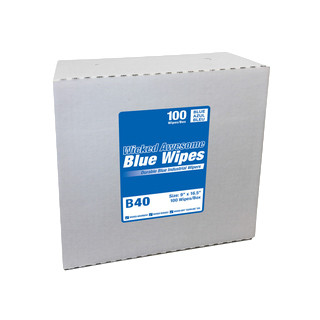
B40 Wicked Awesome Blue Wipes are designed for the “real-world wipe-down” step: spray, wipe, and move on—without the wipe tearing, collapsing, or leaving obvious debris behind.
If you are wiping solvents, oils, light adhesives, or routine shop soils and your current towel disintegrates, the cleanup becomes a two-step process (wipe the spill, then wipe the towel remnants).
This SKU is meant to reduce that rework by using DRC (double re-crepe) bonded cellulose in a box format that pulls reliably and supports consistent operator technique.
It is frequently used as a strength-first, economical wipe where you want a practical balance: absorbent enough to carry a cleaner and pick up soil, but structured enough to stay intact during the pass.
Many teams also prefer blue wipes for visual management—color can help segregate tasks (maintenance vs. assembly vs. final wipe) and make it easier to see soil loading and trigger a timely change-out.
This entry uses “low-linting” language intentionally. Nothing is truly lint-free across all surfaces and wiping forces; edge geometry, abrasion, and residue type drive shedding behavior.
The goal is repeatable performance that matches your process risk and inspection method.
What is this wipe used for
- General spray-and-wipe cleaning on benches, carts, tool exteriors, and workstations.
- Absorbing small spills (including oils and lubricants) where paper towels tear or smear.
- Surface detailing and polishing on durable finishes when you want a softer wipe than many shop rags.
- Applying and removing cleaning/disinfecting solutions when you need a controlled, consistent wipe size.
- Final wipe steps on non-critical assemblies before packaging or transfer (qualify if residue limits apply).
Why should customers consider this wipe
- Wipe stays intact: DRC bonded cellulose is selected for durability during wet wiping and heavier soils.
- Published physical specs: basis weight and thickness help you standardize “feel,” uptake, and wipe coverage per pull.
- Blue visual management: supports quick task segregation and makes soil loading easier to see during change-out decisions.
- Operator-friendly dispensing: top-dispensing, center-pull box supports one-handed pulls and reduces “grabbing a handful.”
- Simple packout control: 100 wipes per box; 9 boxes per case supports predictable stocking and replenishment cadence.
Materials and construction
B40 is made from DRC (double re-crepe) bonded cellulose. In practice, bonded cellulose wipes are chosen when you want absorbency and a cloth-like hand feel without the cost of true laundered fabrics.
The bonding and crepe structure help the wipe maintain integrity during wet wipe-downs and when handling oils/lubricants.
Construction reality check: cellulose-based wipes can leave trace fibers on sharp edges or rough surfaces if you use high pressure or aggressive scrubbing.
The best results typically come from controlled pressure, one-direction passes, and timely face changes.
Specifications in context
| Attribute |
B40 (SKU-specific) |
| Sheet size |
9 in. x 16.5 in. |
| Substrate |
DRC (double re-crepe) bonded cellulose |
| Basis weight |
76.6 gsm (typical) |
| Thickness |
0.71 mm (typical) |
| Dispensing format |
Top-dispensing, center-pull box |
| Packaging (box) |
100 wipes per box |
| Packaging (case) |
9 boxes per case (900 wipes per case) |
| Color |
Blue |
| Weight (SOS listing) |
2.22 lb (listed on SOS product page) |
How to interpret basis weight and thickness: they drive how much solution the wipe can carry, how “stiff” it feels when folded into a pad, and how likely it is to bunch up during a pass.
In day-to-day operations, those two numbers often predict whether operators can complete a wipe step in one controlled pass or whether the wipe collapses and forces re-wiping.
Cleanliness metrics
For regulated or residue-sensitive work, teams typically look for quantified data (ionic extractables and NVR) and then confirm with internal qualification on the actual surface/solvent system.
The published B40 technical sheet emphasizes “low particle generation and chemical extractables” qualitatively, but it does not publish numeric ion or NVR tables for this SKU.
If you need numeric acceptance criteria, treat this as a “validate before critical use” wipe.
| Typical ion extractables |
| Ion |
Typical value |
| Na+, K+, Cl-, SO4-- (and others) |
Not published for this SKU in the available technical sheet |
| Practical note |
If required, define extraction solvent, time, ratio, and method in your internal protocol and test to your limits. |
| Typical NVR (nonvolatile residue) |
| Solvent |
Typical value |
| IPA / DI water / process solvent |
Not published for this SKU in the available technical sheet |
| Practical note |
If residue is a risk (coatings, optics, bonding, analytical sampling), validate wipe + solvent + surface as one system. |
Packaging, sterility and traceability
- Packout: 100 wipes per box; 9 boxes per case (900 wipes per case).
- Dispensing: top-dispensing, center-pull box supports one-handed pulls and reduces over-consumption.
- Sterility: listed as dry and non-sterile in manufacturer product information.
- Country of origin (manufacturer statement): United States (listed by Hospeco Brands Group for B40).
- Traceability tip: in documented programs, record case UPC/lot identifiers (as applicable) at receiving and link the wipe to the cleaning step or maintenance ticket that introduced it into a controlled zone.
Best-practice use
The wipe’s durability helps, but your results still come from technique. Most streaking and rework comes from reusing a loaded face or wiping in circles that redeposit soils.
Fold the wipe into a stable pad, control wetness, and treat each face as a single-use cleaning surface.
Operator technique: wipe module
- Fold for control: fold into quarters to create a flat pad; keep edges aligned to avoid wrinkled streak lines.
- One direction, one pass: wipe in straight lines, then lift. Do not backtrack with the same face.
- Face-change discipline: rotate to a fresh face at defined intervals (e.g., after each linear pass or each panel section).
- Wetness control: damp is usually better than dripping. Over-wetting drives soils into seams, fasteners, and labels.
- Blue wipe advantage: use color to enforce segregation (maintenance wipes never cross into final-assembly wipe steps).
- Stop when loaded: if the wipe visibly darkens, smears, or starts to drag, discard and pull a fresh wipe—do not “finish the step” with a loaded face.
Common failure modes
- Redeposit and streaking: wiping with a loaded face spreads a thin film that looks “clean” until inspection lighting reveals it.
- Task mixing: using the same wipe type for oils and final wipe-down steps drives surprise residues into higher-control areas.
- Abrasion-driven linting: sharp edges and rough surfaces can create shedding on most wipes; reduce pressure and switch faces often.
- Solvent mismatch: aggressive chemistries can soften residues and spread them; confirm cleaner choice and dwell time against your soil and surface.
Closest competitors
B40 is commonly compared to other medium-duty blue shop towels and bonded-cellulose wipes used for spray-and-wipe jobs. The practical comparison points are:
wipe integrity when wet, absorbency, streak tendency, and whether the dispenser format keeps usage controlled.
- Kimberly-Clark WypAll / X40-type blue shop towels: similar “medium-duty” workflow; confirm tearing and residue behavior with your cleaners.
- DuPont Sontara EC medium-duty low-linting wipes: often chosen when you want a cleaner nonwoven feel and controlled linting behavior.
- Other DRC bonded-cellulose center-pull wipes (9 x 16.5 class): match size and published basis weight where possible to keep technique and coverage consistent across shifts.
Critical environment fit for this wipe
B40 fits best as a durable wipe for controlled workflow zones: maintenance benches, equipment wipe-down, carts, and staging areas where tearing and wipe failure create downtime.
If you plan to use it near residue-sensitive assemblies, treat the wipe as a component of your cleaning system and qualify it for your surface, solvent, and inspection method.
Standards and regulators generally expect you to control contamination risk through documented methods and verification—not by relying on generic “cleanroom” labeling alone.
Use this wipe where its strengths reduce rework, and escalate to higher-control wipes when your process demands quantified cleanliness metrics.
SOSCleanroom note about SOP's
The Technical Vault is written to help customers make informed contamination-control decisions and improve day-to-day handling technique.
It is not your facility’s Standard Operating Procedure (SOP), batch record, or validation protocol.
Customers are responsible for establishing, training, and enforcing SOPs that fit their specific risks, products, equipment, cleanroom classification, and regulatory obligations.
Always confirm material compatibility, cleanliness suitability, sterility requirements, and acceptance criteria using your internal quality system and documented methods.
If you adapt any technique guidance from this entry, treat it as a starting template. Your team should review and approve the final method, then qualify it for your specific surfaces,
solvents, cleanliness limits, inspection methods, and risk profile. In short: use these best-practice suggestions to strengthen your SOPs—not to replace them.
Source basis
-
SOSCleanroom product page (SKU, packout, SOS listing weight, and description):
https://www.soscleanroom.com/product/wipers/wicked-awesome-blue-wipes-b40-9-x-16-5/
-
Manufacturer page (High-Tech Conversions) with product description and packout:
https://high-techconversions.com/product/wicked-awesome-blue-wipes-b40/
-
Technical data sheet PDF (basis weight, thickness, dispensing, and qualitative extractables statement):
https://pim-resources.coleparmer.com/data-sheet/78902-14-b40-ds.pdf
-
Manufacturer/distribution product page (Hospeco Brands Group; COO and case details):
https://www.hospecobrands.com/products/hbg-products/wiping-solutions/p-l-wicked-awesome-blue-wipes-9x16-5-if-9-100
-
Hospeco PDF (COO and case dimensional data):
https://publications.tnzdwcms.com/publications/catalog?MainProductId=B40&filename=B40.pdf&pdf=true
-
ISO (cleanroom classification framework): https://www.iso.org/standard/53394.html
-
FDA (regulated manufacturing expectations): https://www.fda.gov/
-
ASTM (test method and standards framework): https://www.astm.org/
-
IEST (contamination control guidance): https://www.iest.org/
SOSCleanroom is the source for this Technical Vault entry.
Briefed and approved by the SOSCleanroom (SOS) staff.
If you have any questions please email us at Sales@SOSsupply.com
Last reviewed: January 7, 2026
© 2026 SOSCleanroom