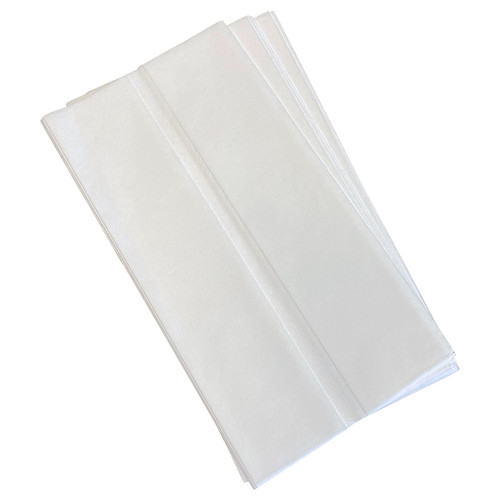
Quick visual check: white wipe supports soil-loading visibility and change-out discipline.
Practical solutions in a critical environment
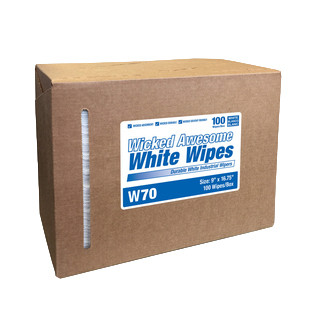
W70 Wicked Awesome White Wipes are built for one outcome: keep the wipe intact during real work. If your current “shop towel” tears, pills, or sheds during wet wipe-downs,
you create a second problem—fibers and streaks that must be removed before you can move on.
W70 is positioned as a strength-first, general-purpose wipe for repeatable cleaning steps on carts, benches, tool exteriors, and maintenance tasks where durability matters more than
ultra-critical extractables control.
SOSCleanroom lists this wipe as Hydroknit® (cellulose/polypropylene blend) with published basis weight and thickness to help programs standardize “feel,” uptake, and wipe coverage per pull.
It is described as low-linting in many processes, but nothing is truly lint-free in every use condition—especially when wiping sharp edges, threaded features, or abrasive residues.
What is this wipe used for
- General wipe-down of work surfaces, carts, tools, and non-critical equipment exteriors.
- Absorbing spills (including solvent, oil, and lubricants) where paper towels shred or leave debris.
- Applying and removing cleaning solutions on durable surfaces (confirm compatibility first).
- “Grab-and-go” wiping from a top-dispensing, center-pull box for fast, one-handed pull control.
- Routine maintenance wiping where you want consistent coverage per wipe (size-driven standard work).
Why should customers consider this wipe
- Strength where it matters: engineered to resist tearing versus typical tissue-style wipes during wet wipe-downs.
- Hydroknit blend behavior: polypropylene/cellulose construction supports absorbency with structure (helps prevent “disintegration”).
- Program control: published basis weight and thickness support standard work and predictable consumption planning.
- White wipe advantage: helps visual inspection—operators can see soil loading and stop re-wiping with a loaded face.
- Packout efficiency: 100/box and 10 boxes/case simplifies stocking and replenishment cadence.
Materials and construction
W70 is described as a Hydroknit® wipe made from a polypropylene and cellulose fiber blend. In practical terms, this blend is commonly selected to balance wet strength
(the wipe stays intact while wiping) with absorbency (cellulose contribution).
This is a dry, non-sterile wipe in a center-pull, top-dispensing box format. If you are using it near sensitive assemblies (optics, coated parts, precision bearings, or residue-sensitive bonding),
treat W70 as a “strength-focused” wipe that may still require your internal qualification for particles/residue before it is introduced into higher-control zones.
Specifications in context
| Attribute |
W70 (Wicked Awesome White Wipes) |
| Size |
9" x 16.75" (size stated) |
| Material / substrate |
Hydroknit®; polypropylene + cellulose blend |
| Basis weight |
68 gsm (published) |
| Thickness |
0.79 mm (published) |
| Color |
White |
| Dispensing format |
Top dispensing, center-pull box (one-handed pull) |
| Packaging (unit) |
100 wipes per box |
| Packaging (case) |
10 boxes per case (1,000 wipes/case) |
| Country of origin (published listing) |
China |
How to use these numbers: basis weight and thickness help you predict how the wipe behaves in the operator’s hand—how much solution it can carry, whether it “pushes” residue vs. picking it up,
and how easily it conforms to corners. For many teams, those two attributes are what separates “paper towel behavior” from “repeatable wipe-down behavior.”
Cleanliness metrics
For higher-control cleaning programs, two common qualification data sets are (1) ionic extractables (what can rinse out into your solvent) and (2) NVR (nonvolatile residue) left behind after solvent evaporates.
The available W70 listings emphasize durability and strength-first wiping but do not publish numeric ionic extractables or NVR tables for this wipe. If you plan to introduce W70 into a regulated or residue-sensitive process,
qualify it with your internal methods (solvent choice, contact time, extraction ratio, and acceptance limits).
Typical ion extractables
| Ion |
Typical value |
Notes |
| Na+, K+, Cl-, etc. |
Not published |
Verify by facility extraction method if used near sensitive residues. |
Typical NVR
| Solvent |
Typical value |
Notes |
| IPA, DI water, or process solvent |
Not published |
Confirm by gravimetric NVR test aligned to your acceptance criteria. |
Packaging, sterility and traceability
- Packaging: 100 wipes per box; 10 boxes per case (published).
- Dispensing style: top-dispensing, center-pull format supports one-at-a-time pull control in fast-paced stations.
- Sterility: non-sterile (listed).
- Country of origin (manufacturer listing): China.
- Traceability note: for documented environments, keep your box label, receiving record, and case-level identifiers tied to the work order or maintenance event when wipes enter controlled zones.
Best-practice use
A durable wipe can still spread contamination if technique is sloppy. Strength helps you finish the step; technique prevents you from moving the soil around.
Use the guidance below as practical starting points and align them to your local cleaning validation and inspection method.
Operator technique: wiping module
- Single-pass discipline: wipe in straight lines; do not “scrub back and forth” with a loaded face.
- Fold for clean faces: fold into quarters; rotate to a fresh face at defined intervals (corners/edges count as separate faces).
- Wetness control: if using a solvent/cleaner, keep the wipe damp—not dripping—to prevent solution migration into seams, fasteners, and labels.
- Pressure management: use moderate, consistent pressure; excessive force increases abrasion risk and can shear residues into micro-scratches.
- Change-out triggers: replace when visibly loaded, when it starts streaking, or if edges begin to fray under normal wiping force.
- Segregate by task: assign wipes by station (maintenance vs. assembly vs. packaging) to reduce cross-use and surprise residues.
Common failure modes
- Redeposit and streaking: re-wiping with a loaded face leaves a visible film and spreads soil.
- Compatibility miss: using aggressive solvents on sensitive labels/coatings causes smear or residue transfer (confirm first).
- False “low-lint” assumptions: sharp edges and abrasive residues can create linting even on low-linting wipes; qualify for your surfaces.
- Over-wetting: dripping wipes drive contamination into seams and threaded joints, creating delayed rework.
Closest competitors
Comparisons should be made on substrate behavior (wet strength, absorbency, tendency to streak), not just “paper vs. cloth.” W70 is frequently positioned against durable,
disposable, box-dispensed industrial wipes.
- Kimberly-Clark Professional WYPALL® X (white): commonly used for strong wipe-down steps in industrial programs; validate linting/residue for sensitive processes.
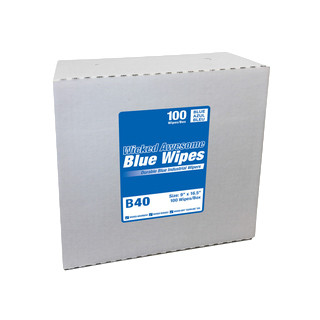
- Wicked Awesome Blue Wipes B40 (blue, similar format): similar “box-pull” workflow with a different substrate and color for task segregation.
- Other hydroknit/poly-cellulose industrial wipes: match size and basis weight where possible to keep operator technique and coverage consistent.
Critical environment fit for this wipe
W70 is best treated as a “strength-first” wipe for controlled workflow zones—maintenance benches, staging areas, tool wipe-down, and non-critical equipment exteriors—where tearing and wipe failure
create downtime. If you want to move it closer to critical assemblies, qualify it like any other consumable: check particle contribution on your surfaces, run a residue screen with your solvent,
and confirm that the wiping step meets your inspection method (visual, UV, gravimetric, or analytical).
Standards and regulatory expectations do not “certify” a wipe for your process by default; they set the expectation that you control contamination risks through documented methods and verification.
If your workflow is regulated (medical device, pharmaceutical, aerospace), treat wipe selection as part of your contamination-control plan and purchasing controls.
SOSCleanroom note about SOP's
The Technical Vault is written to help customers make informed contamination-control decisions and improve day-to-day handling technique.
It is not your facility’s Standard Operating Procedure (SOP), batch record, or validation protocol.
Customers are responsible for establishing, training, and enforcing SOPs that fit their specific risks, products, equipment, cleanroom classification, and regulatory obligations.
Always confirm material compatibility, cleanliness suitability, sterility requirements, and acceptance criteria using your internal quality system and documented methods.
If you adapt any technique guidance from this entry, treat it as a starting template. Your team should review and approve the final method, then qualify it for your specific surfaces,
solvents, cleanliness limits, inspection methods, and risk profile. In short: use these best-practice suggestions to strengthen your SOPs—not to replace them.
Source basis
-
SOSCleanroom product page (specs, packaging, thickness, and listing details):
https://www.soscleanroom.com/product/wipers/wicked-awesome-white-wipes-w70-9-x-16-5/
-
Manufacturer/brand listing (product details and country of origin):
https://www.hospecobrands.com/products/hbg-products/wiping-solutions/wicked-awesome-white-wipes-w70
-
Manufacturer PDF (download link from Hospeco listing):
https://www.hospecobrands.com/publications/catalog?MainProductId=W70&filename=W70.pdf&pdf=true
-
Additional published context (industrial wipes table including W70):
https://www.hospecobrands.com/Files/Images/Bluethundertechnologies/pdf/TDS/BTT_Industrial_Wipes_2016.pdf
-
ISO (cleanroom classification framework reference): https://www.iso.org/standard/53394.html
-
FDA (regulated manufacturing expectations reference): https://www.fda.gov/
-
ASTM (test method and materials standards reference): https://www.astm.org/
-
IEST (contamination control and controlled-environment guidance reference): https://www.iest.org/
SOSCleanroom is the source for this Technical Vault entry.
Briefed and approved by the SOSCleanroom (SOS) staff.
If you have any questions please email us at Sales@SOSsupply.com
Last reviewed: January 7, 2026
© 2026 SOSCleanroom