
Cleanroom Wiper Selection Guide: How to Choose the Right Wiper for Your Controlled Environment
Posted by SOSCleanroom on 5th Jun 2026
Cleanroom Wiper Selection Guide
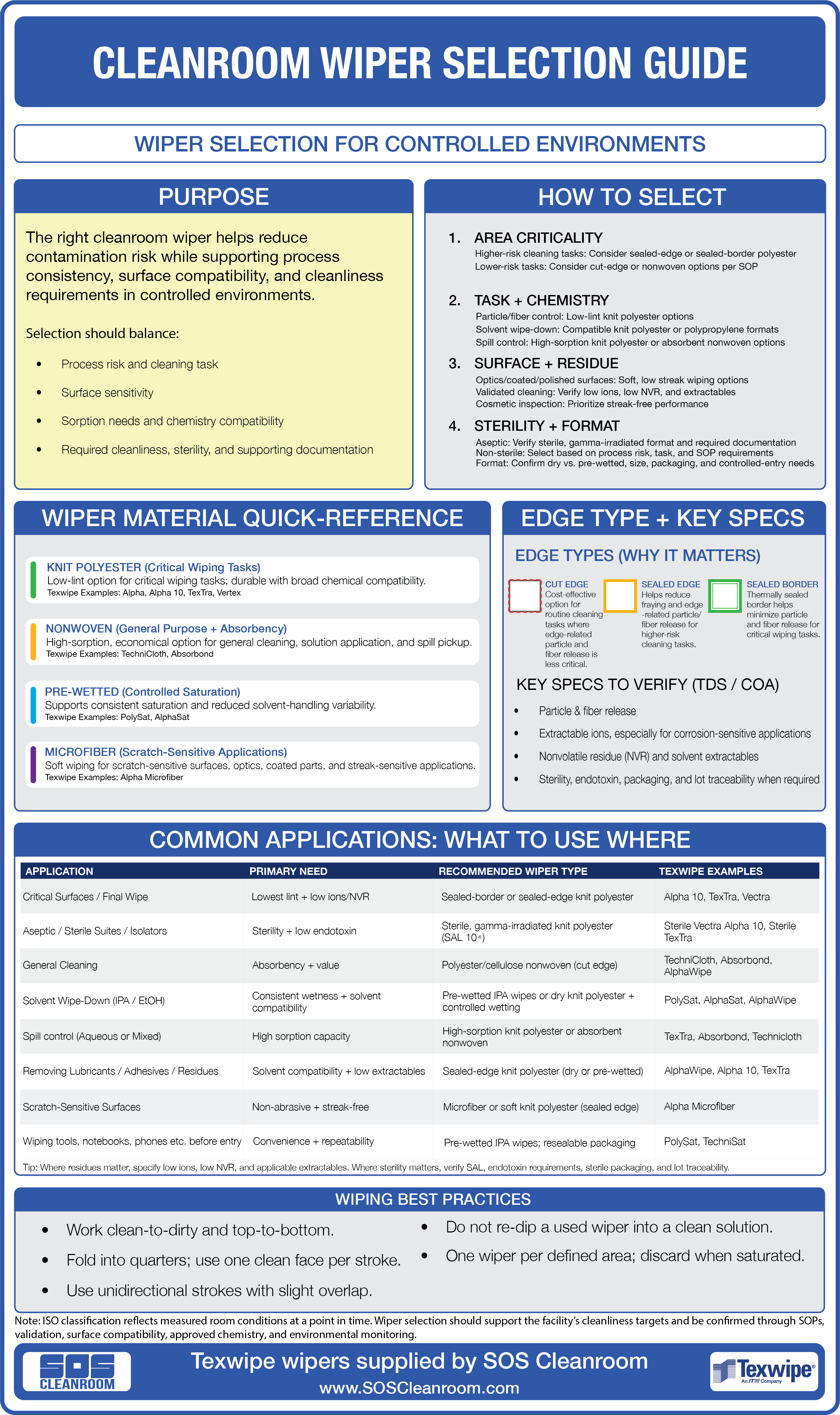
Selecting the right cleanroom wiper is critical for contamination control, surface compatibility, and consistent cleaning results in controlled environments. This guide helps simplify the selection process by outlining key wiper materials, edge types, application uses, and best practices.
Download the Cleanroom Wiper Selection Guide
Why Wiper Selection Matters
The right cleanroom wiper helps reduce contamination risk while supporting process consistency, cleanliness requirements, sterility needs, and required documentation.
Key Factors to Consider
1. Area Criticality
Higher-risk cleaning tasks may require sealed-edge or sealed-border polyester wipers, while lower-risk tasks may use cut-edge or nonwoven options depending on SOP requirements.
2. Task and Chemistry
Consider whether the application requires particle control, solvent compatibility, spill absorption, or controlled saturation from pre-wetted wipers.
3. Surface and Residue Requirements
Sensitive surfaces, optics, coated parts, and validated cleaning processes may require low-lint, low-NVR, low-ion, or streak-free wiping options.
4. Sterility and Format
For aseptic and sterile environments, verify sterility level, endotoxin requirements, packaging format, and lot traceability.
Common Cleanroom Wiper Materials
- Knit Polyester: Best for critical wiping, low-lint applications, and broad chemical compatibility.
- Nonwoven: Ideal for general cleaning, absorbency, solution application, and spill pickup.
- Pre-Wetted: Provides consistent saturation and reduces solvent-handling variability.
- Microfiber: Recommended for scratch-sensitive surfaces, optics, coated parts, and streak-sensitive applications.
Edge Types
- Cut Edge: Cost-effective option for routine cleaning where particle and fiber release is less critical.
- Sealed Edge: Helps reduce fraying and edge-related particle release.
- Sealed Border: Provides the highest level of particle and fiber control for critical wiping tasks.
Recommended Wiper Applications
| Application | Recommended Wiper Type |
|---|---|
| Critical Surfaces / Final Wipe | Sealed-edge or sealed-border knit polyester |
| Aseptic / Sterile Suites | Sterile, gamma-irradiated knit polyester |
| General Cleaning | Polyester/cellulose nonwoven |
| Solvent Wipe-Down | Pre-wetted IPA wipers or dry knit polyester |
| Spill Control | High-sorption polyester or absorbent nonwoven |
| Scratch-Sensitive Surfaces | Microfiber or soft sealed-edge polyester |
Wiping Best Practices
- Work clean-to-dirty and top-to-bottom.
- Fold wipers into quarters and use one clean face per stroke.
- Use unidirectional strokes with slight overlap.
- Do not re-dip a used wiper into a clean solution.
- Use one wiper per defined area and discard when saturated.
Need Help Choosing a Cleanroom Wiper?
SOS Cleanroom can help you select the right cleanroom wiper based on your ISO classification, surface sensitivity, chemistry, sterility needs, and documentation requirements.