
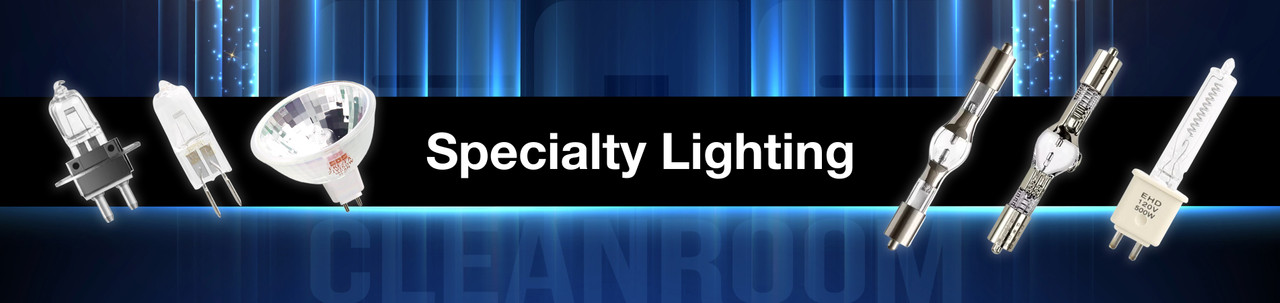
Specialty Lighting Replacement Lamps for Microscopes, Analytical Instruments & Industrial Equipment Covers short-arc mercury (HBO), xenon (XBO), tungsten halogen, and OEM instrument lamps—plus spectral output, arc geometry, ozone variants, ballast compatibility, thermal load, handling, and uptime protection. ▼ EXPAND TECHNICAL GUIDE (click here to open)
Category Overview
Precision Light Sources Where Stability and Spectrum Are Non-Negotiable
Specialty lamps are system components—not general illumination. In microscopy, metrology, semiconductor inspection, spectroscopy, and UV exposure processes, the light source influences image fidelity, measurement repeatability, and process outcomes. Correct lamp selection is a strict matching exercise: technology, wattage, base/connector, arc or filament geometry, envelope/reflector design, and spectral output must align with the original equipment specification.
Spectral Output Arc Geometry Ballast Matching Equipment Uptime
Best suited for: microscopy illumination, fluorescence systems, wafer inspection and metrology, UV exposure and curing, spectroscopy and analytical instrumentation, and industrial scientific imaging.
Common specialty lighting applications:
- Microscopy illumination, fluorescence excitation, and imaging workflows
- Mask aligners, wafer inspection, metrology, and UV exposure systems
- Spectroscopy and analytical instrument light sources
- High-intensity inspection and precision measurement systems
- Replacement lamps to restore OEM performance and protect uptime
UV exposure / mercury sources
→ Short-arc mercury (HBO) lamps (variant-specific)
Bright white light for imaging
→ Xenon short-arc (XBO) lamps for high brightness
Microscope halogen illumination
→ Tungsten halogen (base/voltage specific)
Quick Match: Identify the Correct Lamp Type
| Your equipment need | Typical lamp direction | Why it fits | Critical matching factors |
|---|---|---|---|
| UV exposure / high UV intensity | Short-arc mercury (HBO) | High UV output for exposure and curing applications | Exact series, arc position, wattage, ozone vs ozone-free variant |
| High-brightness imaging / inspection | Short-arc xenon (XBO) | Bright “white” output and stable imaging illumination | Ballast/power supply compatibility, arc centering, reflector geometry |
| Microscope illumination (visible) | Tungsten halogen | Stable visible light for microscopy and imaging | Voltage, base type, reflector/envelope dimensions |
| Instrument-specific analytical source | OEM-specified specialty lamp | Supports instrument calibration and repeatability | Exact part number match required (including suffix/variant) |
Technology Comparison (What You’re Really Selecting)
| Technology | Spectral profile | Strengths | Primary risks if mismatched |
|---|---|---|---|
| Short-arc mercury (HBO) | Discrete peaks with strong UV components | UV exposure, fluorescence excitation efficiency | Wrong ozone variant, arc position shift, ballast incompatibility |
| Short-arc xenon (XBO) | Broad spectrum (“white”), UV–visible | High-brightness imaging, inspection illumination | Arc instability/flicker, thermal stress, reflector mismatch |
| Tungsten halogen | Continuous visible output (limited UV) | Stable microscopy illumination, cost-effective replacement | Wrong voltage/base, reflector geometry mismatch, heat management issues |
Why Correct Lamp Matching Matters
“Close enough” lamps can create instability, incorrect spectral distribution, excess heat, or mechanical misalignment. In microscopy and analytical systems, mismatches reduce image quality and measurement repeatability. In UV exposure applications, spectral and intensity differences can alter dose and process outcomes. Matching by wattage alone is insufficient—base type, arc/filament geometry, spectrum, and variant must match the original specification.
Ozone-Producing vs Ozone-Free Lamps
Some UV lamp variants emit at wavelengths that can generate ozone in air (commonly associated with deep-UV output around 185 nm). Ozone-free variants use specialized quartz/envelope designs to reduce ozone generation. Always follow the OEM requirement—installing the wrong ozone classification can affect safety controls, degrade sensitive materials, and compromise optical housings.
Practical rule: If your existing lamp is specified as ozone-free (or your system is ozone-managed), replace with the same ozone classification.
Electrical Compatibility & Thermal Load
Short-arc systems rely on dedicated ballasts/power supplies designed for specific ignition and operating characteristics. Mismatched lamps can result in flicker, arc wander, reduced output stability, shortened life, or failure to strike. Thermal output must also match the housing design—excess heat can damage reflectors, seals, and nearby optics.
- Ballast match: correct lamp series and operating profile for stable arc operation
- Mechanical fit: base, connector orientation, envelope dimensions, reflector geometry
- Heat management: correct wattage and envelope design to protect housings and optics
Best-Practice Replacement & Handling
- Confirm the exact part number: match lamp series, wattage, base, and variant (suffix matters).
- Verify ozone requirement: ozone-producing vs ozone-free must match the system requirement.
- Avoid fingerprints: oils and contamination on quartz/envelopes can shorten life and create hot spots.
- Follow warm-up guidance: output stability often improves after proper warm-up/conditioning cycles.
- Track operating hours: replace proactively to prevent downtime in critical tools.
Common Mistakes to Avoid
- Matching by wattage only (base, arc geometry, spectrum, and variant still matter)
- Using non-equivalent “generic” lamps where OEM specs are required
- Ignoring ozone-producing vs ozone-free requirements
- Overlooking ballast/power supply compatibility in short-arc systems
- Handling lamps without contamination control (oils/shock reduce life)
For the fastest recommendation, be ready to share: equipment make/model, current lamp part number (including suffix), wattage, base/connector type, and whether ozone-free is required.
Need help selecting?
Talk to a specialty lighting specialist
Email Sales@SOSsupply.com or call (214) 340-8574 for help matching the correct replacement lamp to your equipment.