The Technical Vault
By SOSCleanroom
Class 10 / ISO 4 workflow support (published cleanliness targets)
12" nitrile, 5 mil, microtextured fingertips
ESD properties published (surface resistivity + static decay)
Silicone-free and latex-free (published)
TechniGlove TN1200 Series 12" Techni-Cleaned™ Nitrile Gloves — Class 10 Handling Discipline with Published Particle, Ionic and NVR Targets

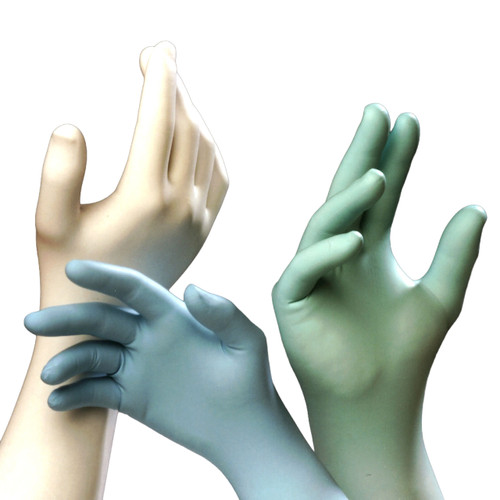
Representative image for TN1200 color variants (white/green/blue). Confirm size/color part number at time of order.
1) Practical solutions in a critical environment
In Class 10 (and ISO 4-managed) operations, gloves are not “just PPE” — they are a primary contamination-control input at the point of use. Most excursions start with ordinary actions: adjusting a fixture, transferring parts, handling a pouch, or wiping a tool. TN1200 is built for that reality with published contamination targets (particles, ions, and DI-water NVR) plus published ESD performance, giving quality and operations teams a clearer, more audit-defensible baseline for qualification and change control.
Sterility note (accuracy-first)
Sterility is not stated as a published attribute for this glove series. TN1200 is commonly used in non-sterile critical manufacturing workflows. If your process requires sterile gloves for aseptic manipulations (for example, within ISO 5 critical zones in regulated sterile processing), ensure your gowning program specifies a sterile glove solution validated to your site’s requirements.
2) What it’s for
TN1200 Series 12" nitrile gloves are intended for contamination-controlled handling where you want:
- A longer cuff for gown-to-glove interfaces and reduced wrist exposure during routine handling and wipe-down tasks.
- Published cleanliness targets (particle, ionic extractables, and DI-water NVR) to support qualification packages.
- Published ESD performance (surface resistivity and static decay) for electronics and precision assembly contexts where electrostatic control matters.
- Latex-free and silicone-free (published) materials where latex sensitivity and silicone transfer concerns are controlled risks.
- Color-coding options (white/green/blue) to support line discipline, zone control, or task segregation.
3) Why should customers consider this glove
- Qualification-ready baseline: published particle, ionic and NVR targets align with how contamination-control programs document risk and acceptance criteria.
- ESD discipline: published surface resistivity and static decay support programs where static control is part of the process window.
- Operator usability in critical work: 5 mil nitrile with microtextured fingertips targets a balance of tactile control and durability for routine handling.
- Line control and mix-up prevention: multiple colors support zone-based glove assignment and visual compliance checks.
- Supply confidence: SOSCleanroom supports critical-environment programs with continuity of supply, responsive support, and process-focused service — because the environment cannot be compromised.
4) Materials and construction
TN1200 is a Techni-Cleaned™ nitrile glove series positioned for controlled environments. Published materials and construction attributes include:
- Material: nitrile (contains no natural rubber latex; silicone-free, as published)
- Finish: powder-free; microtextured fingertips for grip
- Cuff: beaded; 12" overall length to support gown interface
- Style: ambidextrous
- Colors: white, green, blue (supports visual controls)
Classification language note
Published materials reference “Class 10” and also include particle cleanliness metrics reported against IEST-RP-CC005.x family methods. For qualification, use your URS, your site’s risk assessment, and the lot-specific documentation (and, where applicable, batch testing) as the acceptance basis.
5) Specifications
| Attribute |
Published value / listing |
| Series |
TN1200 Series (Techni-Cleaned™) |
| Material |
Nitrile (latex-free; silicone-free, as published) |
| Powder |
Powder-free |
| Style |
Ambidextrous |
| Length |
12" (300 mm) |
| Thickness |
5 mil (0.005") |
| Grip |
Microtextured fingertips |
| Cuff |
Beaded |
| Colors |
White, Green, Blue |
| Tensile strength |
> 12.5 MPa |
| Elongation at break |
> 500% |
| Sterility |
Not stated as sterile |
| Sizes (published availability) |
XSM, SM, MD, LG, XL, 2X (color/size variants use TN1200–TN1205 with W/G/B suffixes) |
| Packaging |
100 gloves per poly-sealed cleanroom bag; 10 bags per case (1,000 gloves/case) |
| Availability (SOSCleanroom listing) |
7–10 business days |
| Country of origin |
Malaysia (published on certification example) |
6) Specifications in context
Use TN1200 when your process benefits from documented cleanliness targets but does not require a sterile barrier system. The 12" length helps with sleeve overlap and reduces wrist exposure during repetitive handling. The published ESD performance matters most when you have charge-sensitive components and a defined ESD program window (work surface, footwear/flooring, garments, humidity control, and glove performance all working together). For regulated work, treat gloves as part of your contamination control strategy: define change frequency, donning discipline, “touch rules” for critical surfaces, and investigation-ready traceability.
U.S. standards first; global context second: In the U.S., programs commonly reference ISO 14644 terminology for cleanroom classification and leverage IEST practices for test method framing and operational discipline. FDA guidance and risk-based contamination control thinking are often applied through internal CCS-style programs and site SOPs. EU GMP Annex 1 can be used as a secondary benchmark for continuous improvement (CCS, material transfer, gowning discipline, documentation rigor) without treating it as a U.S. legal requirement.
Helpful standards and guidance hubs: https://www.iso.org/standard/53394.html | https://www.fda.gov | https://www.astm.org | https://www.iest.org
7) Cleanliness metrics
The values below are presented as published targets for contamination-control evaluation. Always qualify to your URS and acceptance criteria.
Particle cleanliness (published)
| Metric |
Published target |
Method context (published reference) |
| Total particles > 0.5 µm |
< 400 total particles/cm² |
IEST-RP-CC005.x family (method references published) |
Typical ion extractables (published targets)
| Ion |
Published target (µg/cm²) |
| Fluoride | < 0.005 |
| Chloride | < 0.10 |
| Nitrite | < 0.005 |
| Bromide | < 0.020 |
| Nitrate | < 0.10 |
| Phosphate | < 0.005 |
| Sulphate | < 0.020 |
Total NVR (DI water; published)
| Metric |
Published target |
| DI water extractable NVR |
< 1.00 µg/cm² |
ESD properties (published)
| Metric |
Published value |
Test framing (published reference) |
| Surface resistivity |
< 1010 ohm/square (50–60% RH) |
ESD-S11.11 |
| Static decay |
< 0.5 seconds |
RETS-5-003 |
| Surface resistivity “in use” |
< 1 × 10⁹ ohm/square |
ANSI/ESD SP15.1 |
8) Packaging, handling, sterility and traceability
- Packaging (published): 100 gloves per poly-sealed cleanroom bag; 10 bags per case (1,000 gloves/case).
- Traceability pathway (published): documentation options include a certification example and supporting technical data resources used in qualification packages.
- Sterility: not stated as sterile. If sterility is a gate for your process, qualify a sterile glove solution and validate packaging integrity through receipt-to-use handling.
- Handling discipline: treat bags/cases as controlled materials; stage by zone, prevent carton debris migration, and standardize opening and dispense technique to reduce particle introduction.
9) Best-practice use
The glove only performs “clean” if the workflow is clean. Use the points below as an operator-ready checklist for consistent results.
- Donning discipline: control the first contact surface. Avoid touching carts, door hardware, phones, and gown hooks after donning. If you do, change gloves — do not “wipe them off” and continue.
- Change frequency: define change triggers in your CCS/SOP (time-based, task-based, contamination event-based). High-touch handling and wipe-down tasks typically require more frequent changes than assembly steps.
- ESD reality check: published ESD performance is one element. Keep the entire ESD control plan in spec (humidity window, footwear/flooring, grounded work surfaces, garments) or gloves become a “false comfort.”
- Chemical compatibility: nitrile resistance varies by solvent and exposure time. Validate against your actual chemicals and contact times (including splash vs. soak realities).
- Receipt-to-use controls: store by FIFO, protect from UV/heat, and avoid carton debris shedding into controlled zones. If you must bring cases into cleaner areas, wipe-down and bag-out per your material transfer SOP.
Matching consumables: glove + wiper + swab (ISO alignment matters)
For Class 10 / ISO 4–5 workflows, match your glove choice to wiping and swabbing tools intended for critical environments so particles and residues are controlled end-to-end.
For over 35 years, SOS and Texwipe have been close partners, and SOSCleanroom is the authorized Master Distributor of ITW Texwipe for the United States market.
Wipers (ISO 4 context published for the wiper family):
• Texwipe ThermaSeal™ 60 (TX2064 / TX2069) wipers are described as laser cut (thermally sealed) polyester laundered in an ISO Class 4 — useful when edge-driven releasables and particle control matter in critical wiping. Reference docs: https://www.soscleanroom.com/content/texwipe_pdf/2064%202069.pdf and https://www.texwipe.com/thermaseal-60-tx2069
Swabs (qualification required):
Choose a lot-coded cleanroom swab family that your site has qualified for the target area (ISO 4–5) and for the approved solvent/chemistry. Texwipe swab overview (selection discipline, shapes, and use cases): https://www.soscleanroom.com/content/texwipe_pdf/Texwipe%20Swabs%20Brochure.pdf
Note on terminology: when specifying wipes, use “low-lint” or “low-linting” language — no wiper is truly lint-free in every process condition.
Customer SOP disclaimer (education-first)
The guidance above is provided as general cleanroom best-practice education. It is not a substitute for your validated procedures. Always follow your site’s approved SOPs and quality requirements, and validate glove selection, donning/doffing steps, change frequency, and cleaning/wiping chemistry against your materials, risks, and acceptance criteria.
10) Common failure modes
- “Dirty glove” from clean glove: touching non-controlled surfaces (door hardware, carts, keyboards) after donning and continuing work without changing.
- Residue transfer during wipe-down: using too much solvent or reusing a contaminated wiper face, creating streaks or drying rings that appear under inspection lighting.
- ESD gaps: relying on glove ESD metrics while the rest of the ESD control plan (humidity, grounding, garments) is out of spec.
- Wrong glove for the step: using non-sterile gloves where a sterile barrier is required, or using a glove not validated for chemical exposure time and concentration.
- Traceability breaks: losing lot linkage (bag-to-line) and making deviations harder to investigate when a defect or excursion occurs.
11) Closest competitors
For programs comparing non-sterile cleanroom nitrile gloves with published cleanliness and documentation pathways, typical alternatives include:
- Ansell cleanroom nitrile platforms (BioClean/MICROFLEX cleanroom families) — often evaluated when nitrile cleanliness and controlled-environment documentation are key decision gates.
- Kimberly-Clark/Kimtech nitrile cleanroom lines — frequently considered for controlled-environment handling where process discipline and supply continuity matter.
- Other cleanroom nitrile lines with published particle/extractables targets — ensure the comparison includes documentation depth, packaging controls, and lot traceability, not just thickness and grip.
12) Program fit
- Best fit: non-sterile Class 10 / ISO 4-managed handling where published contamination targets and documentation support qualification and change control.
- ESD-sensitive environments: electronics and precision assembly using a defined ESD program window (surface, garments, humidity, grounding) where glove ESD metrics are one validated component.
- Color-control workflows: programs using color to enforce zoning, task segregation, or changeover discipline.
- Not the right fit when: your step requires sterile gloves, or you require a published attribute that is not stated for this series (treat “not stated” as a hard gate unless verified by the manufacturer and your QA).
13) Source basis
SOSCleanroom product page (TN1200 Series 12" nitrile gloves):
https://www.soscleanroom.com/product/apparel/cleanroom-tn1200-series-12-nitrile-gloves-class-10/
Manufacturer product page (TN1200 Series):
https://www.techniglove.com/
Manufacturer product spec PDF (as posted):
https://www.techniglove.com/wp-content/uploads/2026/01/tn100-tnt1200_FRONT.pdf
Certification example / batch documentation PDF (as posted; lot example):
https://www.techniglove.com/wp-content/uploads/2025/07/TechniGlove-240325-TN1200W.pdf
Chemical resistance chart (SOS-hosted):
https://www.soscleanroom.com/content/TechNiGlove_Chem.pdf
Standards and guidance hubs (program reference):
ISO: https://www.iso.org/standard/53394.html
FDA: https://www.fda.gov
ASTM: https://www.astm.org
IEST: https://www.iest.org
Texwipe pairing references (critical wiping/swabbing education):
ISO 4–5 critical wiping guidance: https://www.texwipe.com/iso-4-5-critical
ThermaSeal™ 60 reference (ISO Class 4 laundering described): https://www.soscleanroom.com/content/texwipe_pdf/2064%202069.pdf and https://www.texwipe.com/thermaseal-60-tx2069
Texwipe swab brochure: https://www.soscleanroom.com/content/texwipe_pdf/Texwipe%20Swabs%20Brochure.pdf
SOSCleanroom is the source for this Technical Vault entry.
Briefed and approved by the SOSCleanroom (SOS) staff.
If you have any questions please email us at Sales@SOSsupply.com or give us a call at (214)340-8574.
If you need additional information please try our SOSCleanroom specific AI ChatBot which draws from our extensive cleanroom specific libraries.
Last reviewed: January 10, 2026
© 2026 SOS Supply. All rights reserved.