Technical Vault: KleenGuard™ V10 Element™ Visitor Safety Glasses 33072
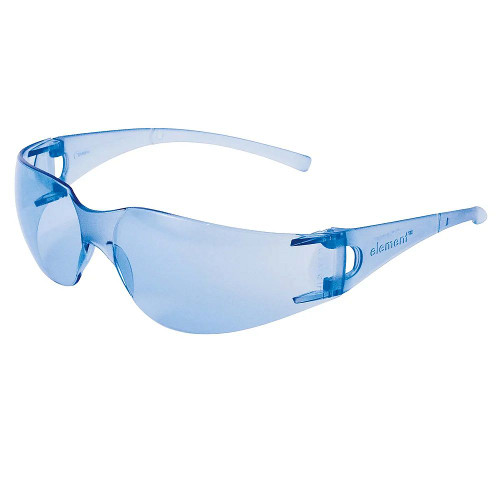
The KleenGuard™ V10 Element™ Visitor Safety Glasses 33072 are lightweight, non-prescription occupational safety glasses designed for economical issue to visitors, contractors, temporary employees, trainees, support personnel, and general industrial workers. This configuration combines a light-blue polycarbonate lens, matching light-blue frame and temples, metal-free construction, screw-less hinges, integral nose-contact surfaces, and pronounced wraparound geometry.
The lens is cataloged as light blue and uncoated, with approximately 55% visible-light transmission. This fixed tint moderates brightness compared with a clear lens while allowing substantially more visible light through than a dark smoke lens. It may be useful in brightly illuminated indoor areas, laboratories, warehouses, gowning corridors, manufacturing-support zones, and controlled-entry programs where open safety glasses are permitted.
The light-blue appearance does not establish certified blue-light filtration, wavelength-specific optical protection, medical eye-strain reduction, or computer-screen protection. The eyewear should be selected according to the employer’s documented hazard assessment, lighting assessment, wearer-specific fit evaluation, and applicable facility procedures.
Technical summary: Economical visitor eyewear with a light-blue uncoated polycarbonate lens, approximately 55% visible-light transmission, matching metal-free frame, screw-less hinges, lightweight three-piece construction, integral nose-contact surfaces, current 10-base-curve wraparound geometry, 99.9% UVA/UVB/UVC filtration, ANSI/ISEA Z87.1-2020 compliance, Z87+ high-velocity impact performance, one-size fit, TAA-compliant legacy procurement records, and RightCycle™ eligibility.
Product Identification:
- Manufacturer: Ansell
- Brand: KleenGuard™
- Series: V10 Element™
- Product designation: Element™ Visitor Safety Glasses
- Manufacturer code: 33072
- SOSCleanroom SKU: 33072
- UPC: 036000330724
- GTIN: 10036000330721 in legacy supply records
- Product type: Reusable or limited-reuse, non-prescription occupational safety glasses
- Program type: Visitor, contractor, temporary-worker, training, support-staff, and general industrial eye protection
- Fit category: One size / universal adult fit
- Lens color: Light Blue
- Lens material: Polycarbonate
- Catalog lens-treatment designation: Uncoated
- Published visible-light transmission: Approximately 55%
- KleenVision™ premium anti-fog: No
- Scratch-resistant hardcoat: Not conclusively assigned to this SKU
- Polarized: No
- Photochromic: No
- Automatically darkening: No
- Blue-light-blocking certification: Not documented
- Mirror treatment: No documented mirror treatment
- Welding-filter shade: No
- Specialized infrared filter: No
- Laser optical-density rating: No
- Frame color: Light Blue
- Temple color: Light Blue
- Frame construction: Metal-free
- Frame style: Lightweight frameless-style three-piece spectacle design
- Hinge construction: Screw-less
- Nose contact: Integral to the lens structure
- Lens geometry: Strongly curved wraparound profile
- Current Element family base curve: 10
- Legacy SKU-specific base curve: 9.5 in some historical records
- Legacy temple terminology: Ratcheted or adjustable may appear in older records
- Ultraviolet filtration: 99.9% UVA, UVB, and UVC
- Current U.S. standard: ANSI/ISEA Z87.1-2020
- Impact designation: Z87+ high-velocity impact rated
- Legacy standard wording: ANSI Z87.1+ 2010 may appear in older SKU-specific records
- TAA compliant: Yes, according to legacy SKU-specific procurement records
- Country of origin: Taiwan in SKU-specific records
- RightCycle™ eligibility: Yes, subject to current program requirements
- SOSCleanroom selling quantity: 12 safety glasses per case
Light-Blue Uncoated Lens Classification
SKU 33072 is the light-blue uncoated configuration of the Element visitor-eyewear platform. The lens has a subtle fixed tint intended to moderate visible brightness without producing the dark viewing environment associated with a smoke lens.
Current Ansell family documentation lists uncoated, scratch-resistant, and KleenVision™ anti-fog treatments across the broader Element range. These family-level options must not be automatically assigned to every individual SKU. The active SKU designation should control unless current packaging or lot-specific documentation states otherwise.
| Lens Attribute |
SKU 33072 Classification |
| Lens tint |
Light Blue |
| Visible-light transmission |
Approximately 55% |
| Catalog coating |
Uncoated |
| KleenVision™ anti-fog |
Not assigned to this SKU |
| Scratch-resistant hardcoat |
Do not claim without current SKU- or lot-specific confirmation |
| Polarization |
No |
| Photochromic response |
No; the tint remains fixed |
| Primary visual environment |
Bright indoor and moderate mixed-lighting environments |
Catalog wording recommendation: Use “light-blue uncoated polycarbonate lens with approximately 55% visible-light transmission.” Do not describe SKU 33072 as KleenVision™ anti-fog, polarized, photochromic, automatically darkening, blue-light blocking, medically therapeutic, welding rated, or scratch-proof.
Visible-Light Transmission
Visible-light transmission, commonly abbreviated as VLT, is the percentage of visible light that passes through a lens. At approximately 55% VLT, the light-blue lens transmits slightly more than half of the available visible light under the published test basis.
- Moderates brightness compared with a clear lens
- Allows substantially more visible light through than a dark smoke lens
- May improve comfort under bright overhead lighting
- May support brightly illuminated laboratories, warehouses, gowning areas, and production spaces
- May be too dark for enclosed equipment, dim rooms, or low-light inspection
- Does not automatically adjust when ambient light changes
- May subtly affect color appearance and contrast
Lighting and Color-Recognition Assessment
| Work Condition |
Selection Consideration |
| Brightly illuminated indoor production area |
May provide useful brightness moderation after task validation |
| Laboratory or gowning corridor with strong overhead lighting |
May be suitable where open safety glasses are permitted |
| Dim warehouse aisle or enclosed equipment area |
May reduce visibility; evaluate a clear lens |
| Color-coded labels, wires, indicators, or inspection criteria |
Validate color recognition and contrast under actual lighting |
| Continuous bright outdoor sunlight |
May not provide enough brightness reduction; evaluate smoke or polarized eyewear |
| Frequent bright-to-dim transitions |
Assess the darkest portion of the route before assigning the lens |
Light Blue Does Not Establish Blue-Light Protection
Lens color alone does not establish wavelength-specific filtration. Although the lens appears light blue, the product should not be represented as blue-light-blocking eyewear unless manufacturer spectral-transmission data, an applicable wavelength range, and a documented test method are available for this exact SKU.
- Do not claim certified protection from computer-screen blue light
- Do not claim prevention or treatment of digital eye strain
- Do not claim retinal, circadian, sleep, or other medical benefits
- Do not assign a wavelength-specific optical-density value
- Do not infer laser protection from the blue lens appearance
- Use only the documented 99.9% UVA/UVB/UVC filtration claim
- Validate color-sensitive tasks under actual workplace illumination
Fixed-Tint Limitations
The light-blue lens uses a fixed tint. It does not become clear in low light or darken further in brighter conditions.
- Not photochromic
- Not electronically variable
- Not automatically darkening
- Not a transition-style lens
- Does not react to ultraviolet exposure by changing tint
- May require exchange for clear eyewear before entering low-light areas
- Eyewear changes must occur only in a safe location where eye protection may be removed
Metal-Free and Screw-Less Construction
The Element frame uses a lightweight metal-free design with screw-less hinges. This eliminates conventional metal hinge screws and reduces the number of separate hardware components within the eyewear assembly.
| Construction Feature |
Operational Benefit |
| Metal-free frame construction |
Reduces metallic hardware within the eyewear assembly |
| Screw-less hinges |
Eliminates small hinge screws that could loosen or separate |
| Three-piece construction |
Supports economical issue, inspection, and replacement |
| Matching light-blue components |
May support rapid visual identification within a visitor-PPE program |
Important distinction: Metal-free construction does not establish electrical insulation, dielectric certification, arc-flash protection, MRI compatibility, metal detectability, X-ray detectability, or suitability for every food-processing application.
Base-Curve Documentation Reconciliation
Current Ansell Element family documentation specifies a 10-base-curve wraparound frame. Some legacy SKU-specific records for 33072 list a 9.5 base curve. Both values describe a pronounced wraparound spectacle profile.
| Reference |
Catalog Treatment |
| 10 base curve |
Use as the current manufacturer family-platform specification |
| 9.5 base curve |
Retain as a legacy SKU-specific reference where dimensional traceability is required |
Wraparound Coverage and Peripheral Vision
The strongly curved lens follows the general contours of the face and extends toward the lateral eye area. This provides broader spectacle-style side coverage than a flatter conventional lens without relying on separately attached side shields.
- Extends spectacle coverage toward the sides of the eyes
- Supports broad peripheral visibility
- Reduces reliance on removable side shields
- Maintains a lightweight, low-bulk profile
- Supports rapid issue to visitors and temporary personnel
- Depends on wearer-specific facial dimensions and correct positioning
- Does not create sealed splash, dust, aerosol, or gas protection
Temple Configuration
Legacy SKU-specific documentation may describe the temples as ratcheted or adjustable. Where that feature is present on the supplied product, it can permit limited lens-angle adjustment. The actual supplied configuration should be inspected before adjustable-temple performance is included in a formal specification.
- Adjust both temples evenly where adjustment is provided
- Keep both eyes centered behind the protective lens area
- Avoid excessive inward pressure at the temples
- Confirm that adjustment does not create large upper or lower openings
- Inspect adjustment points for looseness, cracking, or deformation
- Do not force a non-adjustable temple mechanism
Integral Nose-Contact Surfaces
The nose-contact surfaces are integral to the lens structure. This eliminates separate adjustable nose-pad hardware and supports the lightweight metal-free design.
- Reduces separate components that could loosen or detach
- Supports rapid issue without nose-pad adjustment
- Maintains lightweight construction
- Requires verification of bridge comfort and lens height
- May not fit every facial profile equally well
- Eyewear that slides, tilts, or creates excessive gaps should be replaced with a better-fitting model
Standards and Protective Performance
Current Ansell documentation identifies the Element family as manufactured to comply with ANSI/ISEA Z87.1-2020 and as Z87+ high-velocity impact rated. Legacy SKU-specific documentation may reference ANSI Z87.1+ 2010 or another earlier standard edition.
| Standard or Attribute |
Technical Meaning |
| ANSI/ISEA Z87.1-2020 |
Current U.S. occupational eye and face protection standard referenced by Ansell |
| Z87+ |
High-impact designation under the applicable spectacle requirements |
| ANSI Z87.1+ 2010 |
Legacy standard terminology appearing in older SKU-specific records |
| 99.9% UVA / UVB / UVC filtration |
Polycarbonate filtration intended to reduce occupational ultraviolet exposure |
| TAA-compliant record |
Procurement classification, not a protective-performance rating |
Impact-Rating Interpretation
The Z87+ designation addresses high-impact performance under the applicable spectacle requirements. It does not establish sealed protection or suitability for every occupational eye and face hazard.
- High-impact performance does not make the eyewear chemical-splash goggles
- Wraparound geometry does not make the product dust-tight or gas-tight
- The open upper and lower edges permit environmental entry
- A compatible face shield may be required in addition to primary eye protection
- Hazardous fine dust, aerosols, and multidirectional particles may require goggles
- Welding, cutting, brazing, and torch work require task-specific filter shades
- Laser work requires wavelength-specific optical-density protection
- Damaged eyewear must be removed from service regardless of its original rating
Ultraviolet-Filtration Interpretation
The polycarbonate lens filters 99.9% of UVA, UVB, and UVC radiation. This ultraviolet-filtration function is separate from the light-blue tint and its visible-light-transmission characteristics.
- UV filtration does not make the lens a welding filter
- The light-blue tint does not establish infrared-radiation protection
- The lens is not laser-protective eyewear
- The lens has no wavelength-specific optical-density rating
- The lens is not certified blue-light-blocking eyewear
- Task-specific radiation hazards require correctly rated and marked filters
Fogging Risk and Anti-Fog Selection
SKU 33072 does not include KleenVision™ premium anti-fog treatment. Fogging may occur when warm, moisture-containing air contacts a cooler lens and condenses into droplets that obscure signs, walking surfaces, machinery, labels, instruments, and other task-critical details.
| Operating Condition |
Selection Consideration |
| Short visitor walkthrough under stable indoor conditions |
The uncoated configuration may be appropriate when condensation is unlikely |
| Mask, respirator, or hood use |
Check airflow and evaluate documented anti-fog eyewear if fogging develops |
| High humidity or temperature transitions |
Select a factory anti-fog configuration |
| Repeated removal or wiping |
Change the eyewear configuration rather than permitting repeated face touching |
Do not apply improvised household anti-fog products. Unvalidated sprays, detergent films, waxes, or wipes may leave residue, alter lens tint, create optical distortion, damage polycarbonate, or conflict with controlled-environment procedures.
Fit Verification Procedure
- Inspect the glasses for damage or contamination before issue.
- Place the eyewear on the wearer without excessively spreading the temples.
- Confirm that the integral nose-contact surfaces sit securely and comfortably.
- Verify that the lens is centered in front of both eyes.
- Inspect the upper, side, and lower lens edges for excessive openings.
- Ask the wearer to look upward, downward, and from side to side.
- Ask the wearer to walk, turn, bend, and perform representative movements.
- Confirm that the eyewear remains secure without repeated adjustment.
- Evaluate visibility under the darkest and brightest expected lighting conditions.
- Confirm color recognition where labels or process indicators are color coded.
- Repeat the assessment with required masks, respirators, hard hats, hoods, hearing protectors, and face shields.
Visitor Program Deployment
- Identify the visitor’s complete route and applicable hazards.
- Confirm that open spectacle-style protection is suitable.
- Review the lighting conditions across the entire route.
- Inspect the glasses before issue.
- Show the wearer how to position the temples and integral nose contact.
- Verify secure fit and acceptable peripheral coverage.
- Confirm compatibility with all required visitor PPE.
- Issue another lens color if 55% VLT is too dark or insufficiently tinted.
- Issue another frame style if the universal fit creates slippage or excessive openings.
- Provide instructions for return, cleaning, disposal, or recycling after the visit.
Recommended Users and Applications
- Visitors and facility-tour participants
- Contractors and service personnel
- Temporary employees and trainees
- Laboratory and manufacturing-support personnel
- Brightly illuminated gowning and controlled-entry corridors
- Warehouse, receiving, shipping, and distribution support
- Food-processing support areas where permitted by site procedures
- General inspection-support operations
- Construction and oil-and-gas visitor programs
- Emergency replacement stock for general spectacle protection
- Controlled-area access where open safety glasses are permitted by SOP
Prescription Eyewear Limitations
The Element 33072 is not specifically designed as over-the-glasses eyewear. Visitors who must retain prescription spectacles should be issued a compatible OTG safety-glasses or safety-goggle design.
- Do not force the Element glasses over prescription frames
- Do not permit one frame to displace the other
- Confirm that temple arms sit correctly against the wearer’s head
- Check for excessive side, upper, or lower openings
- Use an OTG protector where prescription eyewear must remain in place
- Prescription spectacles alone are not automatically occupational safety eyewear
PPE Compatibility Assessment
- Ensure temples do not cross tight-fitting respirator sealing surfaces
- Check whether masks direct warm air toward the uncoated lens
- Verify that hard-hat suspension components do not displace the glasses
- Confirm that earmuff cushions remain fully seated
- Check compatibility with hoods, bouffants, and other head coverings
- Verify that face-shield brackets do not move or contact the eyewear
- Confirm secure positioning during walking, bending, and representative movement
- Confirm that 55% VLT does not reduce visibility inside shaded PPE or enclosures
- Issue another frame when the universal fit creates excessive openings or slippage
Hazard Assessment Guidance
| Hazard or Condition |
Selection Consideration |
| General flying particles and impact |
Confirm that Z87+ spectacle protection and wearer-specific coverage are adequate |
| Chemical splash |
Use chemical-splash goggles or another appropriately enclosed protector |
| Fine dust or aerosol |
Evaluate goggles or another protector with greater enclosure |
| Full-face impact or splash |
Add a compatible face shield while retaining required primary eye protection |
| Welding, cutting, or brazing radiation |
Use task-specific filters with the required shade designation |
| Laser radiation |
Use wavelength-specific laser eyewear with verified optical density |
| High humidity or temperature transitions |
Evaluate a documented factory anti-fog configuration |
| Dim or enclosed work |
Evaluate a clear, higher-transmission lens |
| Strong exterior brightness or reflected glare |
Evaluate smoke, mirror, or polarized safety eyewear |
Controlled Environment Considerations
Industrial eye-protection compliance, metal-free construction, and TAA status do not establish sterility, ISO cleanroom classification, low particle release, low outgassing, disinfectant compatibility, or suitability for aseptic processing.
The light-blue lens may be useful in brightly illuminated gowning, laboratory-support, warehouse, receiving, and visitor-access areas. It must be evaluated for adequate task illumination and color recognition before use in controlled production or inspection areas.
- Evaluate the eyewear under the facility’s contamination-control strategy
- Confirm that open safety glasses are permitted in the applicable area
- Use sealed, sterile, or validated goggles where required by SOP
- Validate 55% VLT under the actual lighting system
- Evaluate color-coded labels, indicators, wiring, and process signals
- Assign one pair per visitor or entry when practical
- Stage eyewear on the designated clean side of the gowning process
- Handle the glasses by the temples rather than the lens
- Complete fit adjustments before entering the controlled zone
- Do not place eyewear directly on benches, carts, gowning seats, or critical surfaces
- Use only facility-approved cleaners and compatible low-lint wipes when reuse is permitted
- Replace glasses when scratched, contaminated, distorted, or repeatedly fogged
- Do not describe the product as sterile, autoclavable, or cleanroom certified
Controlled-Area Donning and Handling
- Inspect the eyewear before beginning the gowning sequence.
- Clean or disinfect the product according to the approved site procedure when reuse is allowed.
- Inspect the lens edges, nose-contact surfaces, temples, and hinge interfaces.
- Stage the eyewear in the designated clean-side location.
- Handle the glasses only by approved contact points such as the temples.
- Don the eyewear at the gowning step specified by the facility SOP.
- Confirm the lens is centered and lateral coverage is acceptable.
- Verify color recognition and adequate visibility under the controlled-area lighting.
- Confirm compatibility with masks, hoods, bouffants, respirators, and face shields.
- Avoid touching or readjusting the glasses inside the critical work area.
- Follow the facility deviation procedure if the eyewear is dropped, contaminated, displaced, or fogged.
Cleaning Procedure
- Wash and dry hands or don clean gloves as required by the work area.
- Inspect the lens for loose dust, grit, dried residue, or abrasive contamination.
- Remove loose particles using clean air or a gentle water rinse when permitted.
- Apply mild soap and water, an approved optical cleaner, or another validated cleaning solution.
- Wipe gently using a soft optical tissue, microfiber cloth, or approved low-lint wiper.
- Clean the nose-contact surfaces, temples, lens edges, and screw-less hinge interfaces.
- Avoid excessive pressure and abrasive wiping.
- Rinse where required to remove cleaner residue.
- Dry using a clean, soft, non-abrasive material.
- Inspect the entire product, including tint uniformity and safety markings, before reuse.
Chemical compatibility note: Strong solvents, aggressive disinfectants, high-pH cleaners, abrasive compounds, and incompatible chemicals may craze or cloud polycarbonate, alter light-blue tint uniformity, embrittle frame components, weaken screw-less hinge interfaces, or reduce optical clarity. Validate the exact chemical, concentration, contact time, application method, rinse procedure, and cleaning frequency where repeated disinfection is required.
Aftermarket Treatment Restrictions
Do not assume that aftermarket anti-fog sprays, detergent films, waxes, scratch treatments, or disinfectant coatings are compatible with the light-blue lens. Unvalidated products may leave residue, alter visible-light transmission, change perceived color, create optical distortion, or damage the polycarbonate surface.
- Use only products approved for polycarbonate safety eyewear
- Evaluate haze, residue, color shift, and optical distortion after treatment
- Confirm compatibility with facility cleaning procedures
- Do not obscure required safety markings
- Do not use improvised household products
- Select a factory anti-fog SKU when fog resistance is predictably required
Inspection and Replacement Criteria
Inspect the glasses before each issue and after any impact, chemical contact, abnormal heat exposure, or cleaning process that could affect protection or visibility.
- Cracked, chipped, warped, or deformed lens
- Deep scratches or abrasion that interferes with vision
- Persistent haze, clouding, distortion, or discoloration
- Uneven tint, spotting, or visible surface damage
- Crazing, stress cracking, or chemical attack
- Cracked, loose, stretched, or deformed temples
- Damaged screw-less hinge interfaces
- Broken or deformed integral nose-contact surfaces
- Loss of secure fit during normal movement
- Excessive side, upper, or lower openings
- Illegible required safety markings
- Exposure to a significant impact event
- Residue that cannot be removed through the approved cleaning process
- Recurring fogging that prevents safe movement or task performance
- Insufficient visibility or unacceptable color recognition in an assigned area
Reuse, Shared Use and Hygiene
The product may be used as limited-reuse visitor eyewear where site procedures permit. Shared use requires a documented inspection and cleaning process between wearers.
- Do not reissue visibly contaminated eyewear
- Clean all wearer-contact surfaces between users
- Separate cleaned eyewear from returned or used products
- Use clearly marked clean and used collection containers
- Replace products that cannot be effectively cleaned
- Consider single-visitor assignment where hygiene or contamination risk is elevated
- Follow facility infection-control and contamination-control requirements
Storage and Handling
Store unused or cleaned glasses in a cool, clean, and dry location away from excessive heat, direct sunlight, abrasive materials, heavy objects, and chemical vapors.
- Use a clean dispenser, cabinet, bin, sleeve, or designated storage compartment
- Separate clean eyewear from returned or contaminated products
- Do not store with sharp tools, fasteners, or abrasive materials
- Do not place heavy objects on the lens or temples
- Avoid prolonged storage in hot vehicles or near process heat
- Keep away from solvent, adhesive, fuel, and chemical vapors
- Do not allow the lens to rest directly against rough surfaces
- Do not compress or flatten the frame during storage
RightCycle™ Program Consideration
Ansell identifies the Element product family as eligible for the RightCycle™ Program. Actual eligibility, geographic availability, contamination restrictions, collection methods, minimum quantities, and accepted product conditions should be confirmed with the current program before placing the eyewear into a recycling stream.
Packaging and Selling Unit Clarification
The SOSCleanroom purchase quantity for SKU 33072 is 12 safety glasses per case. Manufacturer and distributor logistics records may separately reference larger master cartons containing multiple 12-pair packages. Larger logistics quantities should not be presented as the SOSCleanroom customer selling unit unless confirmed by the active inventory and purchasing record.
Important Use Limitations
- Uses a fixed light-blue tint that does not automatically change with ambient light
- Approximately 55% VLT may be unsuitable for dim, enclosed, or low-light work
- May subtly affect color recognition and contrast
- Does not include KleenVision™ premium anti-fog treatment
- May fog during humidity, temperature changes, mask use, or physical exertion
- Not certified blue-light-blocking eyewear
- Not polarized
- Not photochromic or automatically darkening
- Not a sealed chemical-splash goggle
- Not dust-tight or gas-tight eyewear
- Wraparound geometry does not create a sealed enclosure
- Not welding, cutting, brazing, or specialized infrared-radiation protection
- Not laser-protective eyewear
- Metal-free construction does not establish electrical insulation
- Not electrical arc-flash protective equipment
- Not intended for molten-metal splash
- Not supplied sterile
- Not represented as autoclavable
- Not represented as cleanroom certified or low shedding
- Not a substitute for a face shield where full-face protection is required
- Not specifically designed as OTG eyewear for prescription glasses
- Universal sizing does not guarantee acceptable fit for every wearer
- Formal hardcoat or coating claims require current SKU-specific confirmation
Current and Legacy Documentation Note
Historical records may identify this product under Kimberly-Clark Professional, Jackson Safety, KleenGuard™ V10 Element™, manufacturer code 33072, light-blue lens, light-blue frame, uncoated, metal-free, screw-less, 9.5 base curve, 10 base curve, ratcheted temples, ANSI Z87.1+ 2010, TAA compliant, or related terminology. Current Ansell family documentation identifies lightweight frameless construction, screw-less hinges, three-piece architecture, integral nose pads, a 10-base-curve wraparound platform, polycarbonate lenses, 99.9% UVA/UVB/UVC filtration, ANSI/ISEA Z87.1-2020 compliance, Z87+ high-velocity impact performance, one-size fit, and RightCycle™ eligibility. Where formal coating, optical, dimensional, certification, origin, or procurement traceability is required, verify the markings and documentation applicable to the supplied production lot.
Brand and Product Documentation Note
KleenGuard™ protective eyewear was historically marketed through Kimberly-Clark Professional and may appear under Kimberly-Clark Professional, Jackson Safety, KleenGuard™, or Ansell in current and legacy documentation. Current product-page content should use the active Ansell portfolio identity while preserving the established KleenGuard™ V10 Element™ name and manufacturer code 33072.
Technical Vault Disclaimer
This Technical Vault entry is intended to support product evaluation, visitor-program planning, procurement, training, optical selection, fit assessment, controlled-environment review, and workplace PPE selection. It does not replace the manufacturer’s instructions, current product markings, wearer-specific fit evaluation, workplace hazard assessment, lighting assessment, visitor-management procedure, contamination-control plan, facility SOP, or regulatory guidance. Verify current certificates, lens treatment, visible-light transmission, country of origin, TAA status, chemical compatibility, packaging, and lot-specific documentation where required by the organization’s safety or quality system.
Technical insight: The Element 33072 is strongest where economical visitor issue, moderate indoor brightness reduction, rapid visual identification, lightweight metal-free construction, screw-less hinges, pronounced wraparound coverage, Z87+ impact performance, ultraviolet filtration, and simple universal sizing must work together. Its primary limitations are the fixed 55% VLT light-blue tint, uncoated lens, open spectacle geometry, non-OTG design, and lack of documented blue-light-filtering or anti-fog performance.
Technical Vault updated: Jul. 2026 (SOS Technical Staff)
© 2026 SOSCleanroom.com