KleenGuard™ V30 Nemesis™ Safety Glasses – Clear Uncoated Lens, Black Frame
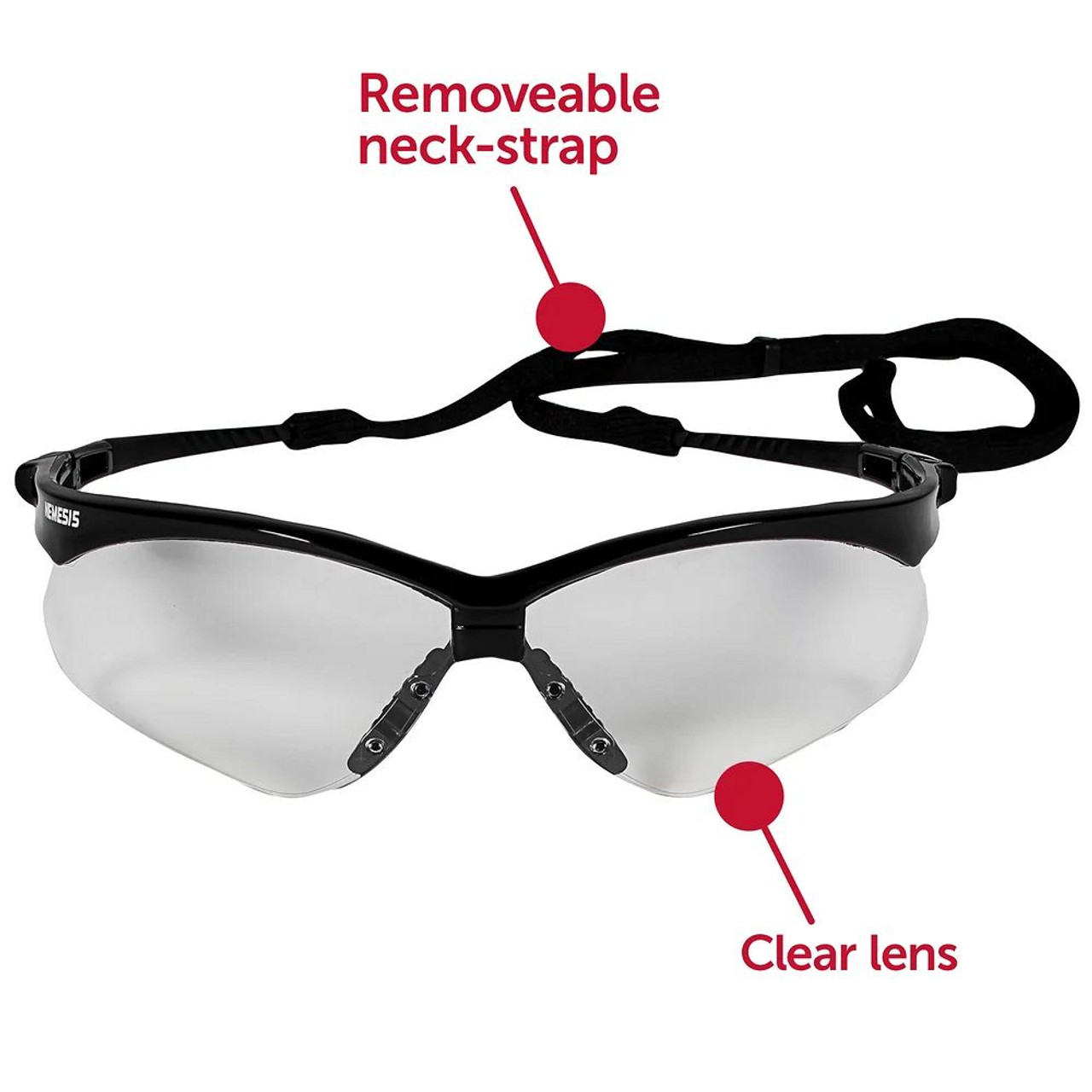
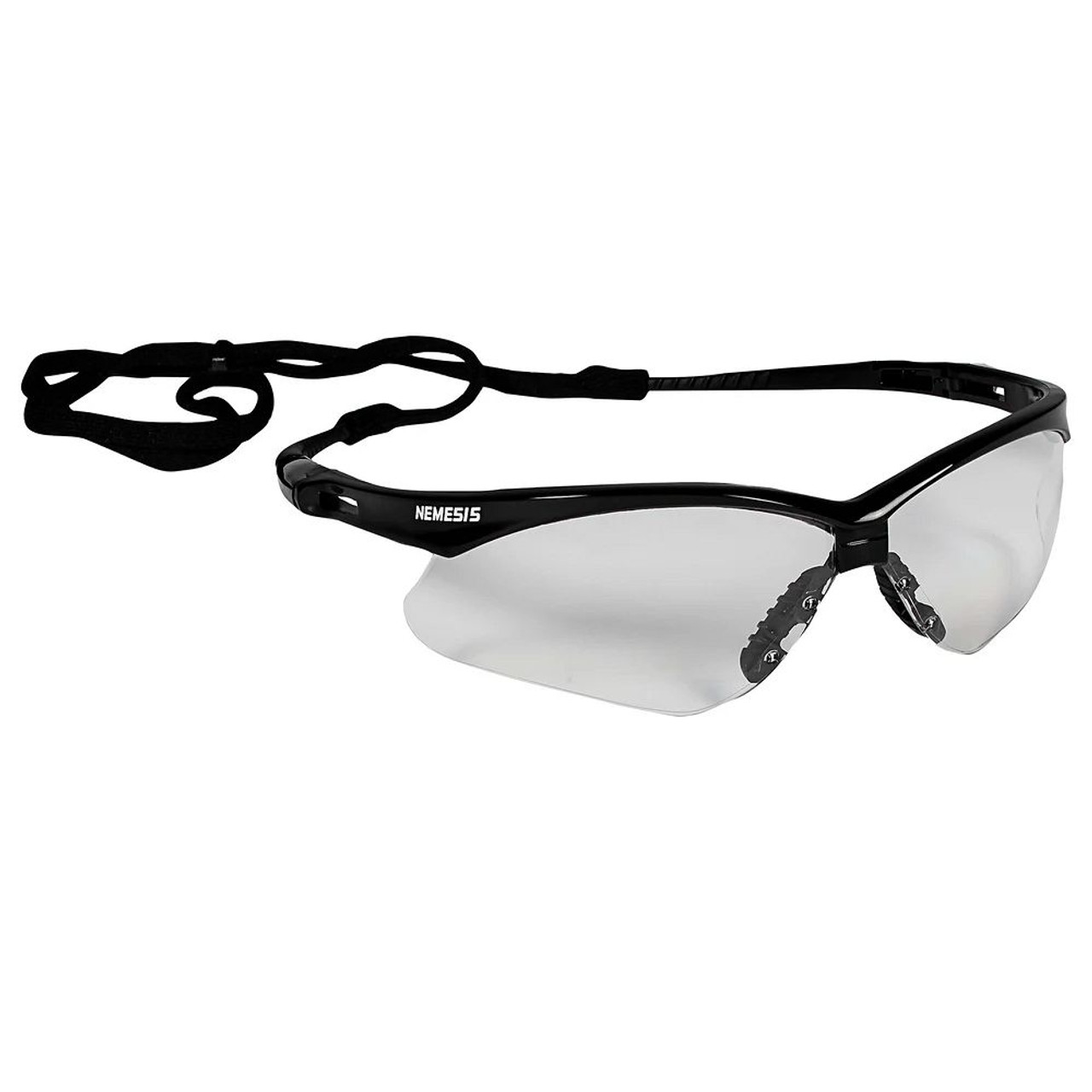
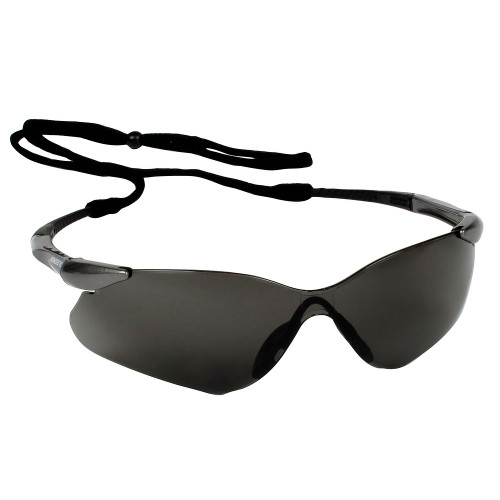
The KleenGuard™ V30 Nemesis™ Safety Glasses 25676 are lightweight, wraparound industrial safety glasses designed for workers who need clear task visibility, high-impact eye protection, ultraviolet filtration, secure retention, and comfortable extended wear. This standard-size configuration combines a clear polycarbonate lens, black sport-style frame, patented Flex-Dry™ nosepiece, flexible temples with Comfort Touch contact points, and an included neck cord.
The clear uncoated lens is intended for normally illuminated indoor and general-purpose environments where natural color recognition and high visible-light transmission are important. Manufacturer product information identifies a visible-light-transmission range of 87–93% for this configuration. Because SKU 25676 does not include KleenVision™ premium anti-fog treatment, it is best suited to stable environments where condensation is not a recurring operational concern.
Key advantage: Standard-size Nemesis™ safety eyewear with a clear uncoated polycarbonate lens, 87–93% published visible-light transmission, ANSI/ISEA Z87.1-2020 compliance, Z87+ high-velocity impact performance, 99.9% UVA/UVB/UVC filtration, 8.25 base-curve wraparound coverage, a sweat-channeling Flex-Dry™ nosepiece, flexible Comfort Touch temples, and an included neck cord.
Specifications:
- Manufacturer: Ansell
- Brand: KleenGuard™
- Series: V30 Nemesis™
- Manufacturer code: 25676
- Former manufacturer code: 3000354
- SOSCleanroom SKU: 25676
- UPC: 036000256765
- Product type: Reusable, non-prescription industrial safety glasses
- Fit category: Regular / standard-size fit
- Protection type: High-impact eye protection, ultraviolet filtration, peripheral coverage, and general occupational eye protection
- Lens color: Clear
- Lens material: Polycarbonate
- Lens-treatment designation: Uncoated
- KleenVision™ anti-fog coating: No
- Published visible-light transmission: 87–93%
- Polarized: No
- Photochromic: No
- Mirror treatment: No
- Frame color: Black
- Frame style: Lightweight sport-style wraparound frame
- Lens geometry: High-base-curve wraparound construction
- Base curve: 8.25
- Nosepiece: Patented flexible Flex-Dry™ nosepiece
- Nosepiece function: Channels perspiration away from the eyes, reduces concentrated pressure, and helps limit slippage
- Temple design: Flexible arms with Comfort Touch soft-grip tips
- Ultraviolet filtration: 99.9% UVA, UVB, and UVC
- Current U.S. standard: ANSI/ISEA Z87.1-2020
- Impact designation: Z87+ high-velocity impact rated
- Included accessory: Neck cord
- Foam-gasket compatibility: Compatible with the optional Nemesis foam gasket kit, subject to exact accessory verification
- RightCycle™ eligibility: Yes, subject to current program availability and acceptance requirements
- Individual packaging: One pair per bag
- SOSCleanroom selling quantity: 12 safety glasses per case
- Typical applications: Manufacturing, assembly, inspection, quality control, warehousing, construction, facility maintenance, transportation, oil and gas, utilities, material handling, and general indoor safety programs
- Primary industries: Manufacturing, Construction, Oil and Gas, Warehousing, Transportation, Utilities, Facility Maintenance, and General Industry
Clear Uncoated Lens Configuration
SKU 25676 is the clear uncoated configuration of the standard-size Nemesis platform. The lens does not include KleenVision™ premium anti-fog technology, a mirror treatment, polarization, or a specialized infrared or ultraviolet shade filter.
This configuration is appropriate where a clear general-purpose lens is required and environmental conditions are sufficiently stable that repeated fogging is not expected. It should not be described as anti-fog unless the supplied product markings or lot-specific manufacturer documentation state otherwise.
| Lens Attribute |
SKU 25676 Configuration |
| Lens color |
Clear |
| Visible-light transmission |
Manufacturer-listed range of 87–93% |
| Anti-fog treatment |
No KleenVision™ premium anti-fog treatment |
| Mirror coating |
No |
| Polarization |
No |
| Best-use environment |
Normally illuminated indoor and general-purpose areas with limited fogging risk |
Clear Lens and Visible-Light Transmission
Visible-light transmission describes the proportion of visible light that passes through the lens. The manufacturer-listed range of 87–93% indicates a high-transmission clear lens intended to preserve task illumination and natural color perception.
- Supports natural color recognition
- Supports reading labels, screens, gauges, and process indicators
- Suitable for normally illuminated manufacturing and assembly areas
- Supports inspection, checking, and quality-control tasks
- Helps preserve visibility in warehouses and facility spaces
- Avoids the brightness reduction associated with smoke or mirror lenses
- Does not provide sunglass-style glare control for intense outdoor light
When to Select an Anti-Fog Nemesis Configuration
Fogging occurs when warm, moisture-containing air contacts a cooler lens surface and condenses into droplets. Because SKU 25676 does not include the KleenVision™ coating, another Nemesis configuration should be evaluated when condensation regularly affects visibility.
- High-humidity production or warehouse areas
- Frequent movement between refrigerated and warm spaces
- Strenuous physical work that produces heavy perspiration
- Use with masks, respirators, hoods, or face coverings
- Operations where workers repeatedly remove eyewear to clear condensation
- Tasks where even temporary vision loss creates a significant safety or quality risk
A factory-applied anti-fog configuration is generally preferable to improvised aftermarket treatments when fog resistance is a predictable operating requirement.
8.25 Base-Curve Wraparound Coverage
The Nemesis platform uses an 8.25 base-curve wraparound design that follows the general contours of the face and extends coverage toward the sides of the eyes. This geometry provides broader peripheral protection than a flatter conventional spectacle lens while maintaining a lightweight sport-style profile.
| Design Feature |
Practical Benefit |
| 8.25 base curve |
Extends lens coverage around the sides of the wearer’s face |
| Wraparound construction |
Supports peripheral protection without separately attached side shields |
| Lightweight sport profile |
Supports extended wear and worker acceptance |
| Regular fit |
Designed for standard adult facial and head dimensions |
Flex-Dry™ Nosepiece
The patented Flex-Dry™ nosepiece is engineered to remain flexible, reduce concentrated contact pressure, channel perspiration away from the eyes, and help limit downward slippage. These functions address common comfort and retention problems associated with prolonged safety-eyewear use.
- Flexible contact helps reduce pressure on the nose
- Integrated channels help direct perspiration away from the eye area
- Anti-slide structure helps maintain lens position
- Stable fit can reduce repeated eyewear adjustment
- Reduced slippage supports more consistent peripheral coverage
- Flexible construction accommodates a range of regular facial profiles
Comfort Touch Temple System
Flexible temple arms with Comfort Touch soft-grip tips help reduce pressure around the sides of the head and maintain eyewear position during extended use. The temple system is designed to balance retention with wearer comfort rather than relying on excessive clamping force.
- Flexible temples accommodate normal head movement
- Soft contact points help reduce side pressure
- Grip-oriented tips help limit forward movement and slippage
- Lightweight construction supports prolonged wear
- Stable positioning can reduce repeated face touching
- Temple compatibility should be checked with earmuffs, hard hats, and respirators
Impact Protection and UV Filtration
Current Ansell documentation identifies the Nemesis platform as manufactured to comply with ANSI/ISEA Z87.1-2020 and as Z87+ high-velocity impact rated. The polycarbonate lens also filters 99.9% of UVA, UVB, and UVC radiation.
The Z87+ designation confirms high-impact performance under the applicable spectacle requirements, but it does not make the glasses suitable for every eye hazard. Chemical splash, hazardous fine dust, aerosols, welding radiation, laser radiation, molten materials, and full-face exposure may require different or additional protection.
UV-Protection Interpretation
The clear polycarbonate lens provides ultraviolet filtration without using a dark visible-light tint. This allows the eyewear to support indoor task visibility while also helping reduce ultraviolet exposure.
- UV filtration does not make the lens a welding filter
- UV filtration does not establish protection against infrared radiation
- The clear lens is not laser-protective eyewear
- The lens does not provide a specialized optical-density rating
- Task-specific radiation hazards require appropriately rated filters
- Outdoor glare may require a suitable smoke, mirror, or polarized configuration
Included Neck Cord
Each pair includes a neck cord to keep the eyewear accessible when temporarily removed. The cord can support visitor programs, maintenance workflows, intermittent tasks, and operations where workers transition between areas with different PPE requirements.
- Helps reduce loss or misplacement
- Keeps eyewear available for immediate reuse
- Supports intermittent on-and-off work patterns
- Reduces the likelihood of placing glasses on contaminated surfaces
- Should be inspected for damage and contamination
- Must be assessed for entanglement risk around moving equipment
- May require removal where the site prohibits cords or loose accessories
Regular Fit Versus Nemesis Small
SKU 25676 uses the regular standard-size Nemesis frame. Workers with slimmer or narrower facial profiles may receive better coverage and retention from a Nemesis Small configuration.
| Fit Consideration |
Selection Guidance |
| Frame sits securely without excessive side gaps |
Regular Nemesis may be appropriate |
| Frame slides or sits too wide |
Evaluate Nemesis Small |
| Lens sits far from the cheeks |
Evaluate a smaller frame or different geometry |
| Temples require excessive spreading |
Evaluate a larger or differently shaped protector |
Recommended Applications
- Manufacturing and production operations
- Assembly, inspection, checking, and quality control
- Packaging, picking, and material handling
- Warehousing, shipping, and receiving
- Construction and general site work
- Facility and equipment maintenance
- Transportation, automotive, and fleet service
- Oil, gas, petrochemical, and energy operations
- Utilities and public-works maintenance
- Indoor work requiring natural color recognition
- Visitor and contractor eye-protection programs
- General occupational eye-protection programs
- Controlled-area support work where open safety glasses are permitted by SOP
PPE Compatibility
The Nemesis glasses should be evaluated with the complete PPE ensemble. Hard hats, masks, respirators, earmuffs, hoods, face shields, and protective garments can alter eyewear position, redirect airflow, create pressure points, or reduce coverage.
- Confirm that temple arms do not interfere with respirator sealing surfaces
- Check whether masks direct warm air toward the uncoated lens
- Verify that earmuff cushions remain fully seated
- Confirm that hard-hat suspension components do not displace the frame
- Check compatibility with hoods, bouffants, and head coverings
- Verify that face-shield brackets do not contact the glasses
- Confirm secure positioning during representative work movement
- Do not force the glasses over prescription eyewear unless specifically evaluated
Controlled Environment Considerations
The lightweight fit, flexible nosepiece, and secure temple system may help reduce repeated eyewear adjustment in controlled work areas. However, industrial safety certification does not establish sterility, ISO cleanroom classification, low particle release, low outgassing, disinfectant compatibility, or suitability for aseptic processing.
Because SKU 25676 does not include premium anti-fog treatment, facilities should evaluate whether masks, respirators, hoods, humidity, or temperature transitions could cause condensation and repeated face-touch behavior.
- Evaluate the glasses under the facility’s contamination-control strategy before use
- Confirm that open safety glasses are permitted for the specific classified area
- Use sealed or sterile goggles when required by the gowning SOP
- Assign eyewear by employee or controlled area when practical
- Handle the glasses by the temples rather than the lens
- Complete fit adjustments before entering the critical work zone
- Do not place eyewear directly on benches, carts, gowning seats, or critical surfaces
- Do not transfer eyewear between uncontrolled and controlled areas without approved cleaning
- Use only facility-approved cleaners and compatible low-lint wipes
- Replace or upgrade the eyewear when recurring fogging causes repeated removal or adjustment
Cleaning, Inspection and Storage
Clean the lens using an approved optical cleaner, mild soap and water, or another validated facility procedure. Remove loose abrasive particles before wiping and use a soft optical tissue, microfiber cloth, or approved cleanroom wiper.
- Do not dry wipe when dust, grit, or metal particles are present
- Do not use abrasive shop towels, scouring materials, or rough paper products
- Avoid unapproved solvents and aggressive disinfectants
- Do not apply aftermarket coatings without validating polycarbonate compatibility
- Inspect the lens, nosepiece, temples, attachment points, cord, and safety markings before use
- Replace glasses with cracks, chips, deep scratches, distortion, haze, or insecure fit
- Remove the eyewear from service after a significant impact
- Store in a cool, clean, and dry location away from direct sunlight
- Use a protective case, sleeve, or designated compartment to reduce abrasion
- Store cleaned eyewear separately from contaminated PPE
Optional Foam Gasket Consideration
Current Ansell documentation identifies the standard Nemesis platform as compatible with an optional foam gasket kit. A compatible gasket may reduce some openings between the frame and face, but it does not automatically convert the glasses into certified chemical-splash, dust-tight, or gas-tight goggles.
- Verify the exact gasket accessory specified for the supplied eyewear
- Repeat the fit assessment after the gasket is installed
- Inspect foam for damage, compression, contamination, and retained residue
- Evaluate whether the gasket increases fogging
- Confirm that the modified assembly remains suitable for the hazard
- Use certified goggles where sealed protection is required
Important Use Limitations
The KleenGuard Nemesis 25676 is designed for regular-fit occupational impact protection, clear indoor visibility, ultraviolet filtration, wraparound peripheral coverage, and general industrial use. It does not include KleenVision™ premium anti-fog treatment and may fog in high humidity, rapid temperature transitions, strenuous work, or mask and respirator use. It is not a sealed chemical-splash goggle, dust-tight goggle, gas-tight protector, polarized lens, welding lens, laser-protective device, electrical arc-flash protector, molten-metal protector, or substitute for a face shield where full-face protection is required. Final selection must be based on the employer’s documented hazard assessment and individual fit verification.
Packaging Clarification
Manufacturer product information identifies SKU 25676 as packaged one pair per bag and 12 bags per case. The SOSCleanroom selling quantity is 12 safety glasses per case. Larger distributor or master-carton quantities should not be presented as the customer purchase unit unless confirmed by the active SOSCleanroom inventory and purchasing record.
Current and Legacy Documentation Note
Historical product records may identify this item under Kimberly-Clark Professional, Jackson Safety, KleenGuard™ V30 Nemesis™, manufacturer code 25676, or former code 3000354. Legacy documentation may reference an earlier ANSI Z87.1 edition or the general ANSI Z87.1+ designation. Current Ansell family documentation identifies ANSI/ISEA Z87.1-2020 compliance and Z87+ high-velocity impact performance. Where certification traceability is required, verify the markings and documentation applicable to the supplied production lot.
About KleenGuard™ Nemesis™
KleenGuard Nemesis safety eyewear combines a lightweight sport-style appearance with wraparound coverage, flexible comfort components, sweat-management features, ultraviolet filtration, and high-impact performance. The 25676 configuration provides a regular-size black frame and clear uncoated lens for normally illuminated workplaces where premium anti-fog treatment is not required.
Technical insight: The Nemesis 25676 is strongest where clear high-transmission visibility, regular-size wraparound coverage, lightweight comfort, sweat-channeling retention, Z87+ impact protection, ultraviolet filtration, and economical non-anti-fog performance must work together.
Product page updated: Oct. 13, 2026 (SOS Technical Staff)
© 2026 SOSCleanroom.com