Why eyewear matters in cleanrooms (beyond "eye safety")
In controlled environments, eyewear is a dual-purpose control: it protects the operator's eyes and reduces workflow disruptions that create contamination risk.
The most common cleanroom failure mode for eyewear is repeated adjusting, lifting, or swapping due to poor fit or fogging.
The Nemesis Small platform is designed to fit smaller heads without constant repositioning, supporting steadier wear behavior across a shift.
What this product is used for
- Impact-rated eye protection for production, maintenance, and material-handling work where ANSI Z87.1+ eyewear is required.
- Gowning anterooms and controlled environments where eye protection is part of site EHS policy.
- Operators who need a smaller frame geometry to reduce slippage and fit-driven "touch events."
- Smoke lens preference for bright indoor/outdoor transitions and glare-prone work zones.
Why customers consider this product
- Small fit improves compliance: fewer comfort complaints and fewer adjustments during work.
- Wraparound coverage: base-8 curve extends peripheral protection.
- UV protection: polycarbonate lens platform supports UVA/UVB/UVC filtering.
- Stability features: FLEX-DRY* temples help reduce slippage in warm/humid work.
Materials, build, and wear platform
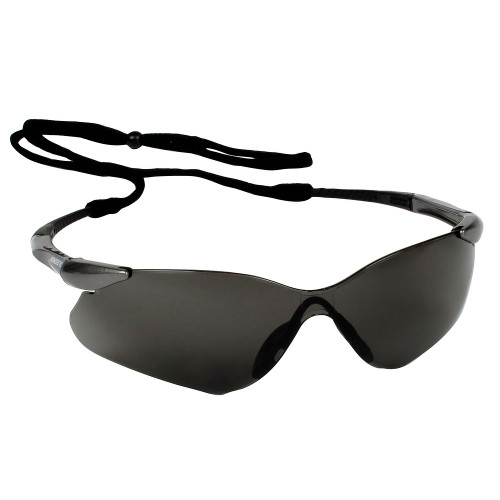
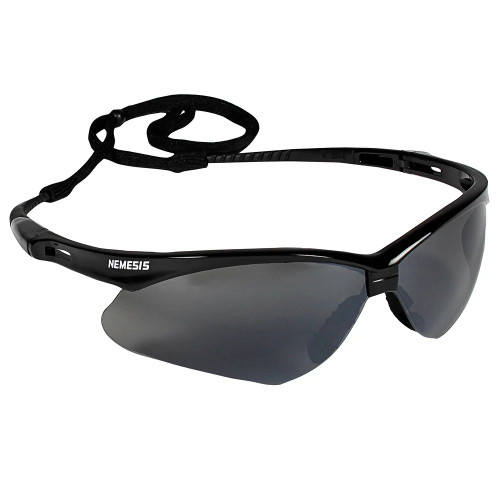
Nemesis Small safety glasses use a polycarbonate lens platform with a wraparound frame geometry for extended peripheral protection and a stable face fit.
The smoke lens option is commonly selected for bright environments and outdoor transitions.
A stable, comfortable fit reduces repeated touch/adjust behaviors that can undermine both safety and contamination-control discipline.
Specifications in context
| Attribute |
SKU 38476 |
| Product | KleenGuard Nemesis Small Safety Glasses |
| Lens color | Smoke |
| Size | Small (S) |
| Frame color | Black |
| Lens material | Polycarbonate |
| Lens coating | Listed as Uncoated on SOSCleanroom; manufacturer family sheet may describe hard-coat variants by SKU — verify coating on delivered unit packaging if required by your program. |
| Standard | ANSI / ISEA Z87.1+ |
| UV protection | 99.9% UVA / UVB / UVC |
| Accessory | Neck cord included |
| Country of origin | Taiwan |
| Pack format | Case of 12 glasses |
| UPC / GTIN | UPC 036000384765 / GTIN 10036000384762 |
Performance and cleanliness considerations
In cleanrooms, eyewear problems almost always show up as behavior problems: fogging drives lifting; poor fit drives repositioning; scratchy lenses drive wiping.
Each of those actions increases face/hood contact events and can disrupt controlled workflow discipline.
If operators routinely wear masks or hoods, consider whether an anti-fog eyewear option is warranted.
Packaging, traceability, and country of origin
Supplied as a case of 12; COO: Taiwan. If your program tracks PPE by lot or shipment, retain the receiving record with SKU/UPC identifiers.
Do not stage opened eyewear cartons on uncontrolled surfaces and then carry them into cleaner zones without a defined handling method.
Best-practice use (donning guidance)
Technique guidance: reduce "touch events" during gowning
- ISO 14644-5 alignment: Treat eyewear as part of your gowning program inside the Operations Control Programme (OCP). Define where eyewear is donned, how it is cleaned, and how it is stored.
- Don before higher-grade entry when possible: Perform fit checks and comfort adjustments in the lower-grade area.
- Handle by the temples: Avoid touching lenses or face-contact points.
- Cleaning method control: Use only site-approved cleaning/disinfection compatible with polycarbonate. Avoid improvised solvents.
- Storage discipline: Store in a clean pouch or designated rack. Do not hang eyewear on hoods, masks, or uncontrolled hooks.
European Annex 1 context: In Grade A/B environments, Annex 1 describes sterile eye coverings (e.g., goggles) as part of the gowning set.
Evaluate whether safety glasses are sufficient for the specific area, or whether sealed/sterile goggles are required by your contamination control strategy.
Common failure modes (and how to prevent them)
- Fogging drives lifting: move to anti-fog options or adjust mask/hood interface.
- Poor fit drives constant repositioning: standardize Small fit where needed.
- Lens wiping scratches lenses: define a cleaning method; avoid dry wiping.
- Uncontrolled storage: designate storage to prevent recontamination.
- Coating mismatch to SOP: verify coating at receiving and document to the program requirement.
Closest competitors (selection logic)
- Small-fit anti-fog safety glasses: when masks/hoods are driving fogging-related adjustments.
- Sealed goggles: when splash, chemical, or higher-grade contamination controls require a more enclosed eye barrier.
- Sterile goggles/eye coverings: when Annex 1 / sterile-grade gowning requires sterile eye coverings as part of the set.
Critical environment fit
Nemesis Small (38476) is a strong fit when your operation needs impact-rated eyewear and you have a meaningful population of smaller head sizes where universal frames reduce compliance.
For sterile manufacturing grades governed by Annex 1, confirm whether your CCS/gowning SOP requires sterile or sealed eye coverings in the specific area.
SOSCleanroom note about SOPs
The Technical Vault is written to help customers make informed contamination-control decisions and improve day-to-day handling technique. It is not your facility's Standard Operating Procedure (SOP), batch record, or validation protocol.
If you adapt any technique guidance from this entry, treat it as a starting template. Your team should review and approve the final method, then qualify it for your specific processes and risk profile.
Source basis
SOSCleanroom is the source for this Technical Vault entry.
Briefed and approved by the SOSCleanroom (SOS) staff.
If you have any questions please email us at Sales@SOSsupply.com
If you need additional information please try our SOSCleanroom specific AI ChatBot which draws from our extensive cleanroom specific libraries.
Last reviewed: May 1, 2026
© 2026 SOSCleanroom