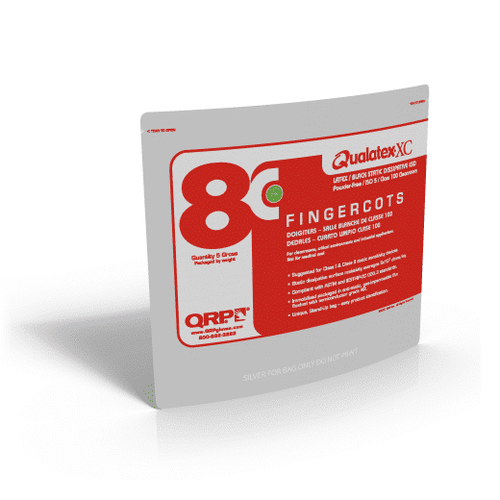
QRP 8C Anti-Static Cleanroom Latex Finger Cots (ISO 5) (Class I ESD) (Black)

$1,008.25
(No reviews yet)
SKU:
8C
Availability:
7 - 10 Business Days
Shipping:
Calculated at Checkout
Quantity Option (Case):
20 Packs of 720 (14,400 Finger Cots)
QRP Qualatex® 8C Anti-Static Cleanroom Latex Finger Cots (Black) — ISO 5 / Class 100 Packaged, Class I ESD Use Case, Static Dissipative (Avg. 107 Ω/□), Powder-Free, 3.5 mil, 2.75" Length, Stand-Up Pouch
ISO 5 / Class 100 packaged Class I ESD use case Static dissipative Natural latex Powder-free Textured tip 5 gross (720) / pack 20 packs / case (14,400)

Overview

QRP 8C Qualatex® finger cots are designed for precision handling where you want fingertip coverage without the bulk of a full glove. They are packaged for ISO 5 (Class 100) use and engineered for ESD-sensitive work where electrostatic control and particulate discipline both matter at the point of touch.

SOSCleanroom focuses on controlled-environment consumables so teams can standardize critical inputs, reduce substitution risk, and support consistent, audit-friendly operations.


Why this finger cot matters in controlled environments
  • ESD control at the fingertip: published average surface resistance of 107 Ω/□ supports static dissipative handling expectations.
  • ISO 5 packaging: supports cleaner staging/dispensing versus general-purpose finger cots.
  • Powder-free + textured tip: helps reduce residue transfer and improves handling confidence during micro-assembly.
  • Fast identification: black color and stand-up pouch simplify workstation control and reduce selection errors.

Typical tasks supported (published examples)
  • Avionics and defense assembly/handling
  • IC industries, electronics assembly, and rework
  • Wire attach, die bonding, and laser diode handling
  • Field repair kits and precision inspection tasks

Key specifications (published)
SKU 8C
Cleanroom packaging Packaged for ISO 5 / Class 100 applications
Material / color Natural rubber latex; black
ESD / resistance (average) Static dissipative; avg. surface resistance 107 Ω/□
ESD program reference ESD safe compliance to ANSI/ESD S20.20-2014 (as stated)
Use case (published guidance) For use with Class I and Class II static sensitive devices
Thickness / length 3.5 mil; 2.75 in length
Finish Rolled finger cots; textured tip; powder coating: none
Available sizes S, M, L, XL
Case pack 5 gross (720) per pack; 20 packs per case (14,400 total)
Country of origin (published) China
Important latex notice

Caution: this product contains natural rubber latex, which may cause allergic reactions. If your facility maintains latex restrictions, select a nitrile finger cot alternative.


Packaging and handling (controlled dispensing)

QRP 8C finger cots are supplied in a stand-up pouch for easier product identification and controlled dispensing at the workstation. Maintain packaging integrity until point of use and dispense using clean technique to protect ISO 5-packaged contents.

Case configuration is published as 20 packs per case, with 5 gross (720) per pack (14,400 finger cots total).


EU GMP Annex 1 alignment notes (practical)

Annex 1 programs manage the operator interface through a documented Contamination Control Strategy (CCS). Finger cots are typically used for precision handling and ESD control (not as a sterile glove substitute). If your CCS requires sterile barrier systems in Grade A/B operations, follow validated sterile glove selection, disinfection, and change-control rules.

  • Use-case clarity: confirm whether the task is aseptic/sterile or ESD/particle-sensitive and select PPE accordingly.
  • Change triggers: define tear/snag, uncontrolled contact, task breaks, and time-based changes; train for rapid, controlled replacement.
  • Change control: treat PPE substitutions as change-controlled events to prevent process drift.

Storage and lifecycle control
  • Store in a cool, dry location, away from sources of light; avoid extremes of heat or cold.
  • Published storage range: 50°F – 86°F (10°C – 30°C).
  • Use FIFO and maintain lot traceability aligned to your ESD and quality program requirements.

Standards and regulatory references (where applicable)

Documentation

Use these documents for ESD program files, qualification packets, and change-control reviews.


If you have any questions please email us at Sales@SOSsupply.com or give us a call at (214)340-8574. OR check out the AI ChatBot powered by SOSCleanroom data libraries - give it a try! THIS IS NEW FOR 2026! © 2026 SOSCleanroom. All rights reserved.
The Technical Vault By SOSCleanroom
ISO-first touch discipline ESD control at the fingertip Latex risk awareness Annex 1 practical notes

Finger cots vs. gloves: selecting the right control

Finger cots are a precision control for tasks where product contact is concentrated at the fingertips and a full glove adds bulk, reduces dexterity, or increases accidental contact. The operational goal is to manage skin oil/salt transfer and reduce uncontrolled touch events without slowing the process.

Key rule

If the hazard requires full-hand protection (chemicals, powders, bio-risk, sharps, or validated sterile barrier systems), move to the correct glove system per EHS/QA requirements.


ESD control: why “static dissipative” must be part of a system
  • ESD damage can be invisible: components can pass inspection and fail later due to latent damage.
  • Finger cots are one control: they work best inside an ESD Control Program (grounding, work surfaces, tools, ionization, training, audits).
  • Workstation discipline matters: the cleanest consumable can be defeated by uncontrolled touching of pouches, benches, or non-ESD-safe packaging.

ISO-first handling: dispensing and donning without recontamination
  1. Start clean and dry: wet skin increases snag risk and reduces fit control.
  2. Stage correctly: keep the outer pouch on the correct side of your gowning/bench line per SOP.
  3. Dispense with clean technique: avoid touching the interior of the pouch and avoid “digging” through product.
  4. Don from the rolled edge: roll down smoothly; overstretching the tip is a common failure mode.
  5. Change triggers: tear/snag, loss of fit, uncontrolled contact, task breaks, and any time-based change rule defined by SOP.

Latex control note (facility policy and worker safety)

QRP 8C finger cots are natural rubber latex. If your facility has latex restrictions or a documented allergy risk management program, use a nitrile finger cot alternative to avoid introducing latex into the area.


ISO-first, then Annex 1: where finger cots fit

Annex 1 environments manage contamination risk through a Contamination Control Strategy (CCS). Finger cots can support precision handling, but they generally do not replace validated sterile glove systems used for Grade A/B aseptic operations.

  • Do not “swap in”: treat PPE substitutions as change-controlled events.
  • Behavior is the control: training and change discipline typically drive performance more than the product spec alone.
  • Escalate when required: if the process requires full barrier coverage, move to the appropriate cleanroom glove system per CCS/SOP.

Recommended pairings (reduce touch-point risk)
  • ESD-safe micro-cleaning: keep ESD-safe pick swabs available for component recovery and micro-detail cleaning.
  • Cleanroom wipers: wipe tools and workstation touchpoints per SOP to reduce recontamination and residue transfer.
  • When latex is restricted: move to nitrile finger cots to avoid introducing latex into the environment.


If you have any questions please email us at Sales@SOSsupply.com or give us a call at (214)340-8574. OR check out the AI ChatBot powered by SOSCleanroom data libraries - give it a try! THIS IS NEW FOR 2026! © 2026 SOSCleanroom. All rights reserved.