The Technical Vault
By SOSCleanroom
ANSI Cut Level A5
EN ISO Cut Level D
EN 388: 4X43D
ANSI Abrasion Level 5
Leather Palm
ANSI Conductive Heat Level 3
10-Gauge Construction
Ansell ActivArmr™ 70-765: advanced cut protection, leather palm durability, and industrial contact-heat performance
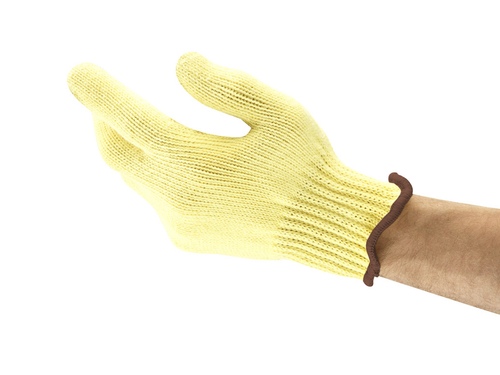
Ansell ActivArmr™ 70-765 is a 10-gauge industrial cut-resistant glove with a premium leather palm and an engineered knitted liner containing nylon, acrylic, and aramid fibers. Previously marketed as Vantage® 70-765, the glove is intended for demanding mechanical handling applications where cut protection, gripping performance, abrasion resistance, and intermittent contact-heat exposure may need to be evaluated together.
Operations takeaway: ActivArmr 70-765 delivers ANSI A5 cut resistance, EN ISO D cut resistance, EN 388 4X43D, and manufacturer-documented conductive-heat protection. Its leather palm and reinforced construction make it a candidate for metal fabrication, automotive press shops, and rough-component handling where these specifications meet the facility's documented hazard assessment.
Industrial safety context: overlapping cut, abrasion, grip, and heat hazards
Industrial material handling can expose workers to several mechanical and thermal hazards during a single task. Sheet metal may have unfinished edges, machined parts may have abrasive surfaces, and recently processed components may retain heat. Oil or residue on workpieces can also affect handling control.
These hazards must be assessed separately. A high cut rating does not automatically provide superior puncture protection, and a heat-test classification does not establish unlimited protection from elevated temperatures.
ActivArmr 70-765 combines protective yarn construction with leather palm reinforcement and aramid stitching. This design helps address demanding handling conditions while retaining the flexibility of a knitted industrial glove.
Control point: Glove selection should be based on documented protective ratings, the workpiece, applied force, gripping conditions, contact time, and the presence of any additional hazards. The glove should not replace engineering controls, safe handling procedures, or required supplementary PPE.
Specifications (SKU controls for RFQs, safety programs, and receiving)
- Manufacturer: Ansell
- Product: ActivArmr™ 70-765
- Former Name: Vantage® 70-765
- Product Category: Cut-resistant leather-palm industrial glove
- Construction: Knitted liner with leather palm
- Gauge: 10-gauge
- Liner Materials: Nylon, acrylic, aramid
- Liner Color: Gray
- Palm Material: Leather
- Palm Color: Gray
- Stitching: Aramid double stitching
- Reinforcement: Reinforced thumb-crotch area
- Seam Position: Relocated toward the back of the fingers
- Cuff: Knitwrist
- ANSI Cut Resistance: ANSI/ISEA 105-2024 Level A5
- ANSI Abrasion Resistance: Level 5
- ANSI Puncture Resistance: Level 4
- EN 388:2016 + A1:2018: 4X43D
- EN ISO 13997 Cut Resistance: Level D
- EN 407:2020: X1XXXX
- EN 407 Contact Heat: Level 1
- ANSI/ISEA Conductive Heat: Level 3
- Thermal Test: ASTM F1060-18
- Reported ASTM Heat Capability: Intermittent contact up to 200°C (392°F) under manufacturer-described test conditions
- General Glove Standard: EN ISO 21420:2020
- European PPE Classification: Category II
- REACH: Manufacturer-listed compliance
- Latex-Free: Yes
- Antistatic: No
- Silicone-Free: No
- Manufacturer-Listed Sizes: 8, 9, 10, 11
- Length: 245-275 mm (9.64-10.82 inches)
- Manufacturer Packaging: 12 pairs/bag; 3 bags/carton
- Case Quantity: 36 pairs
- SOSCleanroom Ordering Configuration: 36-pair case
- Washing Guidance: 40°C (104°F), subject to the current manufacturer instructions
Documentation rule: The manufacturer's current US datasheet lists sizes 8-11, while the SOSCleanroom product page also presents a size 7 selection. Confirm whether size 7 is available or should be removed from the storefront. All size-specific purchasing records should match the actual manufacturer's product identification.
Performance characteristics (manufacturer-published protective ratings)
- ANSI/ISEA 105-2024 Cut Resistance: A5
- ANSI/ISEA 105-2024 Abrasion Resistance: Level 5
- ANSI/ISEA 105-2024 Puncture Resistance: Level 4
- EN 388:2016 + A1:2018: 4X43D
- EN 388 Abrasion Resistance: Level 4
- EN 388 Coupe Blade Cut: X (no numerical result reported)
- EN 388 Tear Resistance: Level 4
- EN 388 Puncture Resistance: Level 3
- EN ISO 13997 Cut Resistance: Level D
- EN 407:2020: X1XXXX
- EN 407 Contact-Heat Resistance: Level 1
- ANSI/ISEA Conductive Heat Resistance: Level 3
- ASTM F1060-18: Manufacturer identifies intermittent contact heat up to 200°C (392°F)
- Protective Liner: Engineered nylon, acrylic, and aramid blend
- Grip Surface: Leather palm
- Mechanical Reinforcement: Aramid double stitching and reinforced thumb crotch
Performance interpretation: ANSI and EN mechanical protection ratings use different standardized testing procedures. ANSI Abrasion Level 5 is not identical to EN 388 Abrasion Level 4, and ANSI Puncture Level 4 is not numerically interchangeable with EN 388 Puncture Level 3. Each result must be interpreted according to its standard and the actual workplace hazard.
Understanding ANSI Cut Level A5 and EN ISO Cut Level D
ANSI/ISEA 105 cut testing evaluates the resistance of glove material to cutting under standardized laboratory conditions. The ANSI A1-A9 system classifies results according to the force required to cut through the tested material.
- ANSI A5: Cutting-force classification of at least 2,200 and less than 3,000 grams-force
- ANSI A4: The preceding classification, with lower cutting-force thresholds
- EN ISO D: A separate cut-resistance classification under EN ISO 13997 testing
- Task suitability: Depends on edge sharpness, applied pressure, workpiece movement, and frequency of contact
- Limitations: Cut resistance does not independently establish chemical, thermal, electrical, or needle-puncture protection
ActivArmr 70-765 is documented as ANSI A5 / EN ISO D. These classifications indicate substantial mechanical cut resistance relative to lower-rated gloves but do not guarantee protection against every sharp edge or powered cutting mechanism.
Safety interpretation: Cut-resistant does not mean cut-proof. Use appropriate material-handling tools, guards, and safe procedures. Evaluate additional protection where severe blade, glass, or sharp-metal hazards exceed the glove's approved application.
Understanding EN 388 4X43D: abrasion, tear, puncture, and cut resistance
The EN 388 marking 4X43D provides a detailed mechanical protection profile through separate positions in the rating code.
- First position - 4: Abrasion resistance, Level 4
- Second position - X: Coupe blade cut test result not reported as a numerical level
- Third position - 4: Tear resistance, Level 4
- Fourth position - 3: Puncture resistance, Level 3
- Fifth position - D: EN ISO 13997 cut resistance, Level D
The accompanying ANSI/ISEA classifications provide additional information about cut, abrasion, and puncture behavior. These ratings should be compared within their respective standards rather than combining them into a single general mechanical-protection score.
Selection takeaway: ActivArmr 70-765 provides documented resistance to several mechanical hazards. Nevertheless, puncture ratings do not establish protection against hypodermic needles, and abrasion or tear ratings cannot be used as substitutes for cut-resistance test results.
Liner construction: engineered aramid, nylon, and acrylic fibers
The knitted liner of ActivArmr 70-765 uses a combination of nylon, acrylic, and aramid fibers. Ansell describes the construction as a mediumweight cut-resistant yarn designed to deliver an effective balance of protection and handling comfort.
Aramid fibers are used in industrial protective textiles because of their strength and thermal stability. Nylon and acrylic contribute to the overall textile construction and handling characteristics. The precise combination of materials, knit construction, and reinforcement determines the product's tested protective performance.
The 10-gauge liner provides a more substantial knit than finer-gauge general-handling gloves. This makes the 70-765 a candidate for demanding material handling while still allowing finger movement and flexibility.
Construction takeaway: Liner materials and gauge are design characteristics, not substitutes for published performance ratings. Always use the ANSI, EN 388, and relevant thermal results as the basis for PPE selection.
Leather palm protection: grip stability, abrasion resistance, and material handling
The defining construction feature of ActivArmr 70-765 is its premium leather palm. This adds a durable gripping surface over the protective knitted structure and provides mechanical wear protection in high-contact handling areas.
Ansell identifies the leather palm as providing strong grip in oily environments. This is valuable for metal fabrication and manufacturing operations where parts may retain lubricants or processing residues.
The leather palm also contributes to abrasion durability during repeated contact with rough materials. However, leather is not inherently an impervious chemical barrier, and its performance can change when saturated with oil, water, cleaners, or other contaminants.
- Grip Function: Provides a leather contact surface for industrial handling
- Documented Application: Oily-environment gripping, according to Ansell
- Abrasion Consideration: Protects high-contact areas during repetitive handling
- Inspection Focus: Palm wear, cracking, hardening, cuts, and grip deterioration
- Limitation: Leather does not establish liquidproof or chemical-resistant construction
Coating limitation: Leather palm protection should not be treated as a chemical-resistant barrier. Where hazardous oils, solvents, chemicals, or other liquids present an exposure risk, use gloves documented for the specific substances and conditions.
Aramid double stitching and thumb-crotch reinforcement: managing high-wear zones
Industrial gloves frequently experience localized stress between the thumb and index finger, along palm contact areas, and near seams that repeatedly flex during handling. These areas can be subjected to friction, pulling, pinching, and contact with sharp or rough components.
ActivArmr 70-765 incorporates aramid double stitching, a reinforced thumb crotch, and seams positioned toward the back of the fingers. Together, these design features help manage mechanical wear and may reduce interference at common handling contact points.
- Aramid Stitching: Reinforces construction at stitched areas
- Thumb-Crotch Reinforcement: Supports durability at a common stress concentration point
- Relocated Seams: Positioned toward the back of the fingers
- Primary Inspection Areas: Thumb crotch, fingertip seams, palm edges, and high-contact leather sections
Inspection point: Reinforced construction improves durability but does not eliminate mechanical wear. Broken stitching, leather separation, or thumb-crotch damage can compromise continued use and should trigger evaluation or replacement.
Contact-heat protection: understanding ANSI/ISEA Level 3 and EN 407 Level 1
Ansell's current US product information identifies ANSI/ISEA 105 conductive heat resistance Level 3 for ActivArmr 70-765, with intermittent heat contact up to 200°C (392°F) under ASTM F1060-18 test conditions.
The product also has a separate EN 407:2020 marking of X1XXXX, indicating Level 1 contact-heat performance under the European test method. These classifications are based on different test procedures and cannot be treated as interchangeable.
- ANSI/ISEA Conductive Heat: Level 3, as identified in current manufacturer documentation
- Referenced ASTM Method: ASTM F1060-18
- Manufacturer-Reported Contact Temperature: Up to 200°C (392°F), intermittent contact under specified conditions
- EN 407:2020: X1XXXX
- EN 407 Contact Heat: Level 1
- EN 407 Flame Protection: No numerical performance level established by the X1XXXX marking
- EN 407 Radiant / Convective Heat: No numerical performance level reported
- Molten-Metal Splash: No numerical performance level reported
Older Ansell product documentation identifies intermittent contact heat up to 100°C (212°F). Because the manufacturer's published literature has changed, industrial safety programs should verify the current rating applicable to their supplied product before approving a thermal application.
Critical safety point: A manufacturer's reported laboratory contact temperature is not an unrestricted safe-use limit. Actual protection depends on contact duration, pressure, moisture, object geometry, material conductivity, glove condition, and the applicable test method. Confirm the required thermal performance for the task.
Why contact-heat resistance is not the same as flame or welding protection
Industrial PPE may be tested for contact heat, flame spread, convective heat, radiant heat, or molten-metal exposure. Each involves a different mechanism of thermal transfer and requires a separate performance assessment.
ActivArmr 70-765 provides documented contact-heat performance, but its published EN 407 X1XXXX marking does not establish performance for every thermal hazard. The glove should not be marketed as a general-purpose welding glove, fire-resistant glove, or arc-flash glove solely because it uses aramid fibers or has a heat rating.
Thermal safety reminder: For welding, direct flame, molten-metal splash, severe radiant heat, or electrical arc-flash hazards, select PPE specifically rated and approved for the expected exposure. Do not rely solely on the 70-765's contact-heat rating.
What ActivArmr 70-765 is designed to do (typical use cases)
- Handle sheet metal and fabricated metal panels
- Handle materials with sharp or rough edges
- Perform automotive press shop handling operations
- Transfer rough machined metal components
- Handle rough blocks, cylinders, and structural parts
- Support glass repair and replacement activities
- Perform selected metal fabrication and manufacturing tasks
- Support industrial assembly involving sharp-edged components
- Handle oily industrial materials where leather grip is appropriate
- Perform qualifying intermittent contact-heat tasks within the approved protective requirements
Application fit: ActivArmr 70-765 is a mechanically protective industrial glove with a leather palm and documented contact-heat ratings. It is not automatically a sterile, cleanroom-qualified, electrically insulating, chemical-resistant, or arc-flash-certified glove.
Best-practice use (reduce cut exposure, thermal injury, and premature glove failure)
- Conduct a hazard assessment: Identify cut, abrasion, puncture, heat, chemical, and machinery hazards.
- Confirm the cut rating: Ensure ANSI A5 / EN ISO D provides adequate protection against the materials and forces involved.
- Verify the applicable heat standard: Determine whether the task requires ANSI/ISEA conductive heat testing, EN 407 contact heat, or additional thermal protection.
- Confirm the correct size: Select a properly fitting glove and verify that the size is listed in current manufacturer documentation.
- Inspect the leather palm: Look for cracks, worn areas, hardening, cuts, and contamination.
- Inspect stitching and reinforcement: Check the thumb crotch and seam areas for breakage or separation.
- Monitor grip: Replace gloves when oil saturation, surface wear, or other contamination reduces handling control.
- Control thermal exposure: Avoid prolonged or unqualified contact with hot workpieces.
- Use proper handling tools: Employ mechanical aids, guards, and appropriate handling procedures when necessary.
- Follow manufacturer care instructions: Confirm permitted cleaning and drying methods for the specific leather-palm construction.
- Replace damaged gloves: Remove gloves from service when the leather, liner, stitching, or thermal condition no longer meets the facility's requirements.
Method standardization tip: Document the approved glove SKU, sizes, cut ratings, heat-test requirements, permissible handling tasks, inspection criteria, and replacement triggers. Confirm thermal documentation for the exact product being supplied before approval.
Misuse controls & when not to use ActivArmr 70-765
- If cut hazards exceed the assessed A5/D protection level: Select higher-rated or more appropriate protection.
- If severe needle-puncture hazards exist: General mechanical puncture ratings do not establish hypodermic needle resistance.
- If prolonged or unqualified heat exposure is expected: Confirm the manufacturer's applicable thermal test data and select suitable additional protection.
- If direct flame, welding, or molten-metal exposure is present: Do not assume the leather palm or contact-heat rating establishes suitability.
- If hazardous chemical exposure requires a barrier: The leather palm and knitted construction do not provide validated chemical permeation protection.
- If electrical shock protection is required: ActivArmr 70-765 is not a voltage-rated electrical insulating glove.
- If formal ESD qualification is required: Ansell identifies the glove as not antistatic; select properly qualified ESD equipment.
- If silicone-sensitive finishing processes are involved: Ansell lists the product as not silicone-free. Confirm suitability before use.
- If sterile or ISO-classified cleanroom use is required: Select gloves with appropriate cleanliness and sterility documentation.
- If rotating machinery creates entanglement risk: Follow equipment-specific operating procedures and restrictions on glove use.
- If the glove becomes damaged or saturated: Remove it from service rather than assuming the original ratings remain unchanged.
Recommended industrial glove pairings (hazard-aligned selection)
Industrial operations may require separate glove configurations for leather-palm handling, uncoated cut-resistant tasks, coated grip applications, and specialized thermal hazards. Use the manufacturer's current ratings to match each glove to its intended workstation.
Why this matters: These gloves are engineered for different hazards. A leather palm does not automatically provide superior chemical protection, and a higher cut rating does not establish equivalent thermal, electrical, or flame protection. Evaluate each model separately.
Wear life, inspection, and replacement considerations
Glove life depends on abrasion, cutting forces, contact pressure, heat exposure, oil contamination, repeated flexing, cleaning practices, and fit. Published laboratory ratings do not provide a universal number of safe handling cycles or shifts.
- Leather palm wear: Inspect for abrasion, thinning, cracking, and loss of grip.
- Thumb-crotch damage: Monitor the reinforced region for cuts and mechanical deterioration.
- Stitching integrity: Inspect aramid seams for loose, broken, or separated stitching.
- Knitted liner: Check for holes, cuts, damaged yarns, or excessive stretching.
- Oil contamination: Excessive oil or grease may affect leather condition and grip reliability.
- Thermal damage: Look for hardening, shrinkage, charring, deformation, or other heat-related changes.
- Fit changes: Replace gloves that no longer fit properly or interfere with secure handling.
- Cleaning: Apply current manufacturer care instructions, especially for leather-containing construction.
- Replacement criteria: Use documented site-specific inspection limits rather than a fixed unsupported service life.
Inspection takeaway: Leather, protective yarns, and reinforced stitching can deteriorate during use. A worn glove should not be assumed to retain its original cut, abrasion, puncture, or thermal performance.
Why buy Ansell ActivArmr™ 70-765 from SOSCleanroom
- Authorized Ansell sourcing: SOSCleanroom supplies Ansell industrial protective gloves with purchasing and product-selection support.
- Correct model selection: Specify ActivArmr 70-765 rather than an unrelated leather or cut-resistant glove.
- Case purchasing: SOSCleanroom lists the 36-pair case configuration consistent with Ansell's packaging.
- Manufacturer documentation: Access ANSI, EN 388, EN 407, and ASTM F1060 information for PPE qualification.
- Application assistance: Compare industrial gloves based on construction, cut resistance, grip, abrasion, and heat performance.
- Centralized procurement: Source multiple industrial glove models and associated consumables for recurring workplace demand.
Manufacturer documentation (authoritative references)
-
SOSCleanroom ActivArmr 70-765 Product Page:
Click Here
-
Current Ansell ActivArmr 70-765 Product Data Sheet:
Click Here
-
Ansell Official ActivArmr 70-765 Product Information:
Click Here
Documentation update notice: Current Ansell technical documentation confirms ANSI A5 cut resistance, EN 388 4X43D, 10-gauge leather-palm construction, and 36 pairs/carton. Current manufacturer literature also lists ANSI/ISEA conductive heat Level 3 under ASTM F1060-18, while older literature references a lower intermittent contact temperature. Confirm the applicable documentation before approving a thermal application. The manufacturer currently lists sizes 8-11; SOSCleanroom's additional size 7 selection requires verification.
If you have any questions please email us at Sales@SOSsupply.com or give us a call at (214)340-8574.
OR check out the AI ChatBot powered by SOSCleanroom data libraries - give it a try! THIS IS NEW FOR 2026!
Last reviewed: Oct. 13, 2026 (SOS Technical Staff)
© 2026 SOSCleanroom. All rights reserved.