
The Technical Vault
By SOSCleanroom
Ansell BioClean™ Advance BASL Sterile Latex Cleanroom Gloves — ISO 4 / Class 10 Control with Double-Donning Stability and EasyTear™ Packaging
ISO 4 / Class 10
Sterile (SAL 10-6)
Natural latex, powder-free
Textured fingers + beaded cuff
SKU: BASL | Pack: Case of 200 pairs | Availability (site): 7–10 business days
1) Practical solutions in a critical environment
In ISO 4 / Class 10 spaces, gloves are not just PPE — they are a controlled interface between people, tools, product-contact surfaces, and validated cleaning. BASL is built for
the common pain points that show up in real operations: stable donning without tearing, grip that stays predictable when handling smooth polymer parts or stainless components,
and packaging that supports contamination-control discipline at the point of use.
Quality posture: SOSCleanroom focuses on best-in-class cleanroom consumables because critical environments cannot be compromised. For Ansell products, SOS Cleanroom Supply
is validated as an Ansell authorized distributor (third-party coverage included in Source basis).
2) What it’s for
BASL is a sterile, powder-free natural rubber latex cleanroom glove designed for ISO 4 / Class 10 operations that require consistent contamination control and controlled packaging.
The product is positioned for activities such as cleanroom cleaning and preparation, pharmaceutical and medical device manufacturing support tasks, transfer of liquids/solids, and
cross-contamination risk reduction in controlled environments.
- Sterile handling where packaging behavior and opening technique matter
- Long, sustained procedures where comfort and tactile sensitivity are prioritized
- General chemical splash context (see chemical permeation summary and limitations)
3) Why should customers consider this glove
- Double-donning stability: Designed to facilitate double-donning and is recommended as an outer glove.
- Grip where it counts: Textured finger surface improves handling confidence on smooth parts, vials, and tools.
- Donning robustness: Beaded cuff adds stability and helps reduce tearing during gowning.
- Sterility controls: Gamma irradiation sterilized with a stated sterility assurance level of 10-6.
- Point-of-use packaging discipline: Non-particulating EasyTear™ packaging supports cleaner openings and cleaner workflow.
- ISO 4 / Class 10 positioning: Specified for Class 10 / ISO 4 environments, aligning with high-sensitivity assembly and processing.
4) Materials and construction
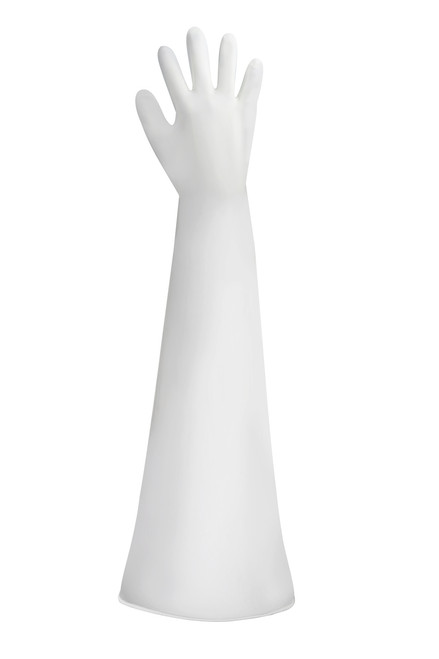
BASL is constructed from natural rubber latex (powder-free) with a hand-specific shape, textured fingers for grip, and a
beaded cuff to stabilize gowning. The internal surface is specified as chlorinated to support smoother donning and reduced tack. The product
includes a manufacturer caution that safe use by latex-sensitized individuals has not been established, and that natural latex may cause allergic reactions.
Latex note for programs: If your site has latex restrictions (healthcare, compounding, or employee sensitivity controls), treat latex as a formal
risk decision — include HR/safety, occupational health, and material-compatibility review as part of your contamination control strategy (CCS).
5) Specifications in context
These specifications are practical selection levers for ISO 4 workflows: thickness impacts tear resistance and tactile feedback; length and cuff design affect gowning success;
and sterility/packaging configuration drives point-of-use behavior and traceability.
| Attribute |
Published value |
Why it matters on the floor |
| Cleanroom class |
Class 10 / ISO 4 |
Supports high-sensitivity operations where glove-derived contamination is a measurable contributor. |
| Sterility assurance level |
10-6 |
A sterile packaging/sterilization posture suited to aseptic-adjacent processes and controlled openings. |
| Sterilization method |
Gamma irradiation (minimum dose 25 kGy) |
Gamma sterilization supports sterile supply with predictable, documented processing. |
| Glove length |
295 mm (11.6 in) |
Helps maintain coverage into the sleeve interface and reduces wrist exposure during reaching. |
| Thickness (single wall) |
Palm: 0.20 mm (7.87 mil) | Finger: 0.24 mm (9.44 mil) | Cuff: 0.18 mm (7.09 mil) |
Balances tactile sensitivity with tear resistance; finger thickness supports gripping and pinch work. |
| Freedom from holes |
1.5 AQL (Performance Level 2) |
Defines baseline integrity expectations for sterile cleanroom handling. |
| Double gloving recommendation |
Yes, as outer glove |
Supports layered protection strategies and controlled change-out without breaking gowning rhythm. |
| Chemotherapy drug testing |
Not tested for use with chemotherapy drugs (No) |
Do not substitute for chemo-rated gloves in USP <800> or HD workflows. |
| Country of origin |
Malaysia |
Supports supplier qualification files and country-of-origin documentation discipline. |
6) Cleanliness metrics
Cleanroom glove selection is often decided by process risk, but the metrics below help translate that risk into measurable controls (particles, ions, and extractables).
Use these values as inputs to your CCS, incoming inspection strategy, and deviation investigations.
| Metric |
Published value |
Reference note |
| Typical particle count ≥0.5 µm |
< 2000 counts/cm2 |
Test method noted as IEST-RP-CC005.4 in the manufacturer PDS |
| Protein level |
50 µg/g or less of total extractable protein |
Not a substitute for site latex-allergy controls; treat as program input |
Typical ionic content (reported as concentration in µg/cm, typical)
| Ion |
Typical |
Ion |
Typical |
| Ammonium | < 0.05 |
Nitrate | < 0.50 |
| Bromide | < 0.01 |
Nitrite | < 0.01 |
| Calcium | < 0.80 |
Phosphate | < 0.01 |
| Chloride | < 1.80 |
Potassium | < 0.08 |
| Fluoride | < 0.01 |
Sodium | < 0.08 |
| Lithium | < 0.01 |
Sulphate | < 0.22 |
| Magnesium | < 0.05 |
Zinc | < 0.60 |
Chemical splash context (summary): A chemical permeation summary is published for BASL with reported breakthrough times of 480 minutes for:
Formaldehyde 37%, Hydrogen peroxide 30%, and Sodium hydroxide 40%. Treat this as a screening input only — always perform a
site-specific hazard assessment, review full test conditions, and follow your EHS program for chemical selection.
7) Packaging, sterility and traceability
Packaging configuration is one of the most important “quiet” controls in an ISO 4 space because it dictates how people open product and what gets exposed to air.
BASL uses a layered presentation built around EasyTear™ behavior:
- 1 pair per inner PE wallet
- 1 wallet per sealed EasyTear PE pouch
- 10 pouches per sealed outer PE bag
- 20 outer bags per lined carton (200 pairs per case)
Sterility is achieved via gamma irradiation (minimum dose 25 kGy) with a stated SAL of 10-6. Maintain carton integrity and lot documentation as part of your incoming
inspection and batch release procedure (especially for sterile manufacturing and sterile-field-adjacent handling).
8) Best-practice use
For ISO 4 / Class 10 work, glove “use” is as much about the opening and the first 30 seconds as it is about the hours that follow. The goal is to keep the glove
sterile/clean at the point of exposure, keep the cuff stable, and prevent accidental contact with non-controlled surfaces.
- Stage your opening: Bring only the next required pouch into the controlled area; keep cartons and outer bags outside the clean zone unless your SOP allows.
- Control the EasyTear opening: Tear smoothly; do not “snap” the pouch open. Avoid generating plastic fragments or abrupt air movement.
- Don without cuff roll: Seat the beaded cuff cleanly; avoid rolling the cuff, which can trap particles and create a shedding edge.
- Double-donning logic: If double-gloving, treat BASL as the outer layer as recommended; change the outer glove at defined intervals or after any suspect contact.
- Touch discipline: In ISO 4 work, assume any unnecessary contact (gown, goggles, cart handles) is a contamination event; pause, re-glove, and re-sanitize per SOP.
- Chemical splash handling: Use chemical compatibility data as a guide, but do not rely on it as a universal protection statement; escalate to EHS when solvents vary.
Complementary cleanroom wiping (same ISO class, published):
For over 35 years, SOS and Texwipe have been close partners, and SOSCleanroom is the authorized Master Distributor of ITW Texwipe for the United States market.
If your glove program is ISO 4 / Class 10, consider pairing BASL with wiping tools published for ISO 4 use:
Swab ISO class is not always published on every swab listing; if you want a swab recommendation matched to ISO 4, provide the process (surface type + solvent/disinfectant + geometry)
and we will align to published manufacturer documentation.
9) Common failure modes
- Donning tears at the cuff: Usually caused by rushing the cuff over a sleeve interface or by pulling at a single point. Use two-handed, even tension and seat the bead.
- Loss of grip on smooth parts: Often an operator behavior issue (handling angle + pinch points). Use the textured fingertips intentionally and keep hands dry/controlled.
- Contamination during opening: Snapping pouches, placing pouches on non-controlled surfaces, or letting the glove contact the outside of the pouch during removal.
- Latex sensitivity events: Latex is a known sensitivity risk. If sensitivity controls exist on-site, do not force-fit latex into the program.
- Misapplication to chemo/HD workflows: BASL is not stated as tested for chemotherapy drugs; do not use for USP <800> hazardous drug handling.
- Overreliance on summary chemical data: Breakthrough times depend on test method and conditions; validate against your chemical profile and exposure scenario.
10) Closest competitors
The most meaningful comparisons are mechanism-based: sterility/packaging discipline, cuff robustness during gowning, and published cleanliness metrics. These alternatives are
often evaluated alongside BASL:
11) Program fit
In the U.S., glove selection and control typically sit under a broader contamination control strategy (CCS) and risk-based quality system practices. BASL can support programs
that need ISO 4 / Class 10 discipline with sterile packaging and published cleanliness metrics.
- U.S. first: Align glove and gowning controls to your FDA-regulated quality system expectations (as applicable) and site aseptic/cleanroom procedures.
- ISO vocabulary: ISO cleanroom classification language (e.g., ISO 14644-1 terminology) is commonly used to standardize expectations and audit communications.
- IEST practices: Particle and contamination-control practices referenced by IEST recommended practices are often used to operationalize measurements and investigations.
- USP context (when applicable): If you operate sterile compounding or HD workflows, confirm material restrictions and chemo/HD requirements (USP <797>/<800>). BASL is not stated as chemo tested.
- EU benchmark (secondary): EU GMP Annex 1 is not a U.S. legal requirement, but it is a useful global benchmark for CCS rigor, documentation discipline, and sterile handling expectations.
Supplier reliability: Cleanrooms run on continuity of supply and consistent documentation. SOSCleanroom supports programs with stable sourcing, responsive service,
and disciplined document availability (PDS, conformity statements, and supporting summaries).
12) Customer SOP disclaimer
The handling and use guidance in this Technical Vault entry is provided as a suggested template to help customers build or refine their own controlled-environment
procedures. It is not a substitute for your site’s approved SOPs, quality system requirements, validation/qualification protocols, or EHS hazard assessments.
Customers are responsible for approving final procedures, training personnel, and verifying that glove selection, change frequency, disinfection approach, and disposal practices are appropriate
for the intended process and regulatory expectations.
SOSCleanroom is the source for this Technical Vault entry.
Briefed and approved by the SOSCleanroom (SOS) staff.
If you have any questions please email us at Sales@SOSsupply.com or give us a call at (214)340-8574.
If you need additional information please try our SOSCleanroom specific AI ChatBot which draws from our extensive cleanroom specific libraries.
Last reviewed: January 10, 2026
© 2026 SOSCleanroom. All rights reserved.