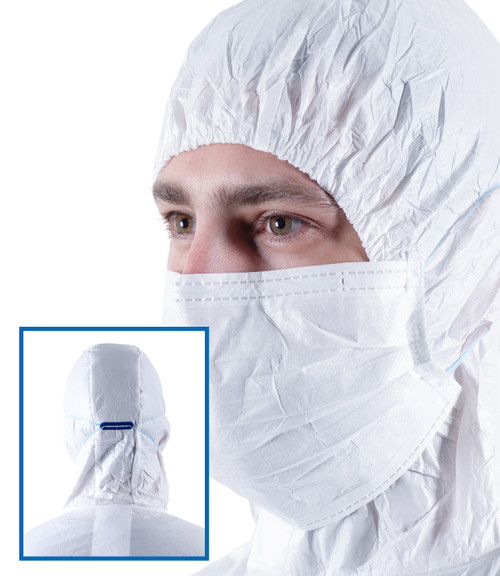
SKU shown: BDBS (sterile pouch/duckbill face mask, 200/case).
Why facemasks matter in cleanrooms
Personnel are one of the largest sources of cleanroom contamination. The BioClean™ BDBS is positioned as a sterile, cleanroom-compatible facemask to help reduce that risk in Class 10 / ISO Class 4 environments and EU GMP Grade A/B operations. The mask's pouch/duckbill geometry creates a large breathing chamber, and the noseband helps improve fit to reduce gaps.
What this product is used for
- Reducing droplet/particle shedding from the nose/mouth region during aseptic and critical cleanroom tasks.
- Supporting sterile gowning sets where mask sterility, packaging integrity, and shelf-life control are required.
- Maintaining standardized PPE selection in ISO Class 4 and EU Grade A/B gowning programs.
- Minimizing contamination risk during entry/exit and movement in controlled environments.
Why customers consider this product
- Sterile, defined processing: gamma irradiated (minimum 25 kGy) with SAL 10-6 and manufacturer-defined shelf life/storage.
- High filtration performance: PFE 97.1% @ 0.1 µm; BFE 94% @ 0.3 µm; VFE 96.4% @ 3.0 µm.
- Comfort supports compliance: large breathing chamber and headloop design can reduce readjustments.
- Cleanroom-focused construction: cleanroom-compatible materials and ultrasonically sealed edges.
Materials, composition, and build
Manufacturer-listed material is Polyester / Polyurethane. Inner facing: non-woven spunbonded polyester (hygroscopic); outer layer: non-woven spunbonded polyester (hydrophobic).
Headloops: tubular knitted polyurethane Spandex yarn. Noseband: plastic coated steel. Dimensions: 301 mm (W) x 100 mm (H) (± 5 mm).
Specifications in context
| Attribute |
BDBS |
| Reorder / part number | BDBS |
| Cleanroom positioning | Class 10 / ISO Class 4 & EU GMP Grade A/B |
| Sterility | Sterile |
| Sterilization / minimum dose | Gamma irradiation / 25 kGy minimum |
| SAL | 10-6 |
| Material | Polyester / Polyurethane |
| Layers (inner / outer) | Spunbonded polyester (hygroscopic) / spunbonded polyester (hydrophobic) |
| Fastening | Headloop (PU Spandex yarn) |
| Noseband | Plastic coated steel |
| Dimensions | 301 mm (W) x 100 mm (H) (± 5 mm) |
| PFE | 97.1% @ 0.1 micron |
| BFE | 94% @ 0.3 micron |
| VFE | 96.4% @ 3.0 micron |
| Differential pressure | 3.1 mm H2O/cm2 |
| Packaging | 1/inner PE bag; 20 inners/outer bag; 10 outers/lined carton (200 pieces) |
| Shelf life | 5 years from date of manufacture |
| Storage | Dry/cool (<40°C), away from direct sunlight and fluorescent light |
| Country of origin | China |
Performance and cleanliness considerations
BDBS publishes filtration performance (PFE/BFE/VFE) and differential pressure to support selection and qualification decisions.
A mask is only as effective as the gowning behavior around it. Touching the mask front, wearing below the nose, or leaving gaps around the noseband can defeat the purpose in high-grade areas.
Gowning (donning) education: ISO first, then EU Annex 1
ISO operations mindset
- Build an Operations Control Program (OCP): include a gowning program, entry/exit controls, cleaning/monitoring, and personnel management.
- Qualify the behavior, not just the garment: train donning sequence, movement discipline, and "no-touch" habits.
- Standardize across shifts: same gowning steps, same checkpoints, same rejection rules.
- Document what "good" looks like: visual checks plus periodic reassessment per your quality system.
Practical donning sequence template
- 1) Hand hygiene: wash/sanitize per SOP; dry fully.
- 2) Open sterile pouch correctly: avoid tearing that can generate particles.
- 3) Handle by headloops: keep fingers off the mask front; position over nose and mouth.
- 4) Form the noseband: pinch/mold to reduce gaps; re-check after hood/eye covering placement.
- 5) Integrate with hood/eye coverings: ensure mask stays sealed and correctly positioned.
- 6) Final check: if you touch the front surface, the mask drops, or the pouch is compromised, discard and replace.
EU GMP Annex 1: For Grade B (supporting Grade A), operators should use sterile facemasks and sterile eye coverings to cover/enclose facial skin and reduce droplet/particle shedding, along with qualified gowning procedures.
Common failure modes
- Touching the mask front: reintroduces contamination and drives face-touching habits.
- Wearing below the nose: defeats the purpose for droplet control.
- Loose noseband / visible gaps: increases leakage and encourages readjusting.
- Compromised pouch integrity: treat as sterile breach; discard.
- Mask contacts the floor or non-controlled surfaces: discard and replace immediately.
Closest alternatives
- BioClean™ BDBS-G (neck guard): added neck coverage where your risk assessment requires it.
- BioClean™ MTA210-1 (tie-on): tension adjustment via ties; confirm compatibility with hood/eye covering configuration.
- BioClean™ MEA210-1 (looped): alternate loop geometry for fit preference; confirm gowning qualification outcomes.
Critical environment fit
BDBS is a strong fit when your gowning program requires a sterile facemask aligned to ISO Class 4 / EU Grade A/B contamination-control expectations, with published filtration and pressure-drop characteristics and defined packaging/shelf-life controls.
SOSCleanroom note about SOP's
The Technical Vault is written to help customers make informed contamination-control decisions and improve day-to-day handling technique. It is not your facility's SOP, batch record, or validation protocol.
If you adapt any technique guidance from this entry, treat it as a starting template. Use these best-practice suggestions to strengthen your SOPs—not to replace them.
Source basis
SOSCleanroom is the source for this Technical Vault entry.
Briefed and approved by the SOSCleanroom (SOS) staff.
If you have any questions please email us at Sales@SOSsupply.com
If you need additional information please try our SOSCleanroom specific AI ChatBot which draws from our extensive cleanroom specific libraries.
Last reviewed: May 1, 2026
© 2026 SOSCleanroom