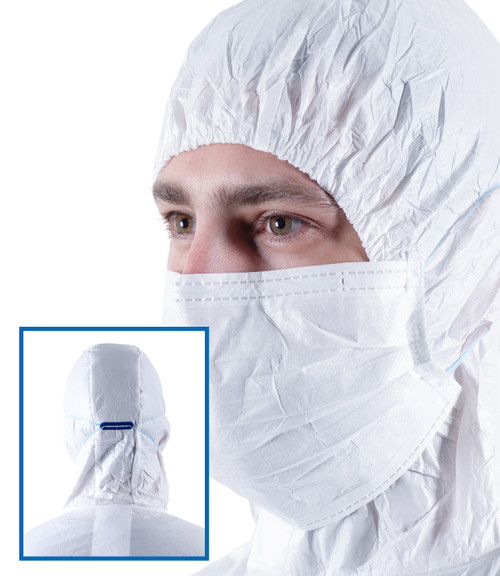
SKU shown: BDBS-G (sterile pouch-style face mask with integrated neck guard).
Why face coverage is a critical contamination-control lever
In cleanrooms, the operator is one of the largest variable contamination sources. Facial skin, breath, and inadvertent mask-touch behaviors can introduce particles and droplets into the work zone.
The BioClean™ BDBS-G is positioned by the manufacturer as a sterile face mask with an integrated, extra-long neck guard to increase coverage at the collar interface and reduce cross-contamination risk.
For performance and acceptance criteria, this entry references the manufacturer Product Data Sheet first.
What this product is used for
- ISO Class 4 / Class 10 cleanroom workflows requiring sterile facial/neck coverage as part of gowning.
- EU GMP Grade A/B aseptic operations where gowning qualification and face/neck controls are emphasized by program expectations.
- Life sciences and critical manufacturing processes where mask integrity and fit help reduce droplet and particle shedding risk.
- Operations that benefit from standardized, sterile packaged PPE with defined storage and shelf-life guidance.
Why customers consider this product
- Coverage at a common gap: the integrated neck guard helps reduce exposed-skin risk at the hood/neckline interface.
- Sterile format: gamma irradiated with published SAL 10-6, supporting sterile area entry requirements where mandated.
- Published filtration performance: PFE/BFE/VFE values and differential pressure published on the manufacturer Product Data Sheet.
- Comfort supports compliance: a larger breathing chamber can reduce frequent adjustments that create contamination risk.
- Audit-friendly standardization: defined packaging configuration and storage/shelf-life guidance support consistent receiving and use.
Materials, composition, and build (manufacturer basis)
Per the manufacturer Product Data Sheet, BDBS-G is built from polyester / polyurethane with a layered non-woven architecture:
spunbond polyester inner (hygroscopic), meltblown polyester filtration layer, spunbond polyester outer (hydrophobic), and a non-woven spunbonded polyester neck guard.
The mask includes polyurethane Spandex headloops and a plastic-coated steel noseband.
This construction is intended to support filtration performance while maintaining usability (fit, breathing comfort) that helps reduce operator adjustment behaviors.
Specifications in context (manufacturer basis first)
The table below consolidates attributes used for cleanroom receiving, gowning program alignment, and day-to-day contamination control.
Values are taken from the manufacturer Product Data Sheet unless otherwise noted.
| Attribute |
BDBS-G |
| Part number / reorder no. |
BDBS-G |
| Cleanroom class (manufacturer statement) |
Class 10 / ISO Class 4 & EU GMP Grade A/B |
| Material |
Polyester / Polyurethane |
| Sterilization / SAL |
Gamma irradiation; SAL 10-6; minimum dose 25 kGy |
| Dimensions (± 5 mm) |
Face mask: 301 mm (W) x 100 mm (H); Neck guard: 245 mm (W) x 210 mm (H) |
| Filtration performance |
PFE 97.1% @ 0.1 µm; BFE 94% @ 0.3 µm; VFE 96.4% @ 3.0 µm
|
| Differential pressure |
3.1 mm H2O/cm² |
| Fastening / noseband |
Headloop; plastic-coated steel noseband |
| Packaging overview |
1 per sealed inner PE bag; 20 inner bags per sealed outer PE bag; 10 outer bags per lined carton (200 pieces) |
| Shelf life / storage |
5 years; store dry/cool (<40°C) away from sunlight and fluorescent light |
| Country of origin |
China |
Performance and cleanliness considerations
In controlled environments, a mask must do two things well: (1) reduce droplets/particles from the wearer, and (2) stay in place without constant adjustment.
The manufacturer publishes filtration efficiency and differential pressure values that can be used for selection comparisons.
For cleanroom program fit, the integrated neck guard is the differentiator: it targets the collar interface where exposed skin and gown seams can become contamination weak points.
Important practical note
Even the best mask becomes a contamination risk if operators repeatedly touch the front/filter area. Comfort, fit, and a stable noseband reduce “adjustment-touch” frequency.
Your SOP should define when to change masks (e.g., if wet, damaged, or repeatedly handled).
Packaging, sterility, and traceability
BDBS-G packaging is structured for controlled entry and staged gowning:
one mask per sealed inner PE bag, bundled into outer bags, and then into a lined carton (200 pieces total).
Sterility is by gamma irradiation with published SAL 10-6 and a stated minimum dose.
Treat packaging integrity checks and shelf-life verification as receiving requirements within your quality system.
Best-practice gowning (donning) education: ISO first, then EU Annex 1
ISO foundation: control the operator through an operations control program
- ISO cleanroom classification context: ISO 14644-1 defines classification of air cleanliness by airborne particle concentration (the “ISO Class” reference).
- Operational control context: ISO 14644-5 describes an operations control program that includes personnel management, entry/exit controls, cleaning/maintenance, monitoring, and a gowning program.
- Practical takeaway: gowning is not “PPE purchasing” — it is a controlled process with training, behavior expectations, and repeatable technique.
EU GMP Annex 1 reinforcement: explicit expectations for Grade A/B aseptic gowning
- Training and qualification: Annex 1 emphasizes regular training and gowning qualification, including assessment and periodic reassessment for personnel accessing Grade A/B areas.
- Grade B (and interventions into Grade A): sterile headgear should enclose all hair (including facial hair) and be tucked into the suit; a sterile facemask and sterile eye coverings should cover/enclose facial skin; sleeves are typically tucked into a second pair of sterile gloves.
- How BDBS-G fits: the integrated neck guard supports the “tucked-in” neckline concept by reducing exposed skin at the hood/neck interface when donned correctly.
Donning technique tips (mask-specific)
- Handle by loops: avoid touching the front/filter surface.
- Set the noseband once: mold gently to reduce gaps and fogging.
- Integrate the neck guard: tuck under the hood/coverall neckline so skin is not exposed at the seam.
- Replace if compromised: wet/damaged masks, or masks repeatedly touched/adjusted, should be replaced per SOP.
Common failure modes (and how to prevent them)
- Front-of-mask touching: train loop-only handling; improve comfort/fit to reduce adjustments.
- Neckline exposure: ensure the neck guard is properly tucked and that hood/suit interfaces overlap consistently.
- Poor nose seal: re-train on noseband setting and eye protection pairing.
- Using expired or compromised packaging: treat packaging integrity and shelf-life as receiving controls.
Closest alternatives
Comparable alternatives are other sterile cleanroom face masks specified for ISO Class 4 / EU Grade A/B use. When comparing, prioritize:
sterilization method/SAL, packaging configuration, comfort/fit behavior, and published filtration/differential pressure values — not just price.
Critical environment fit for this product
BDBS-G is a strong fit when your contamination control strategy requires sterile, high-coverage facial PPE and your gowning system targets the hood/neck seam as a risk point.
It is especially relevant for Grade A/B-style aseptic behaviors and ISO Class 4 operations where facial and neckline shedding must be tightly controlled.
SOSCleanroom note about SOPs
The Technical Vault is written to help customers make informed contamination-control decisions and improve day-to-day handling technique.
It is not your facility’s Standard Operating Procedure (SOP), batch record, or validation protocol.
Customers are responsible for establishing, training, and enforcing SOPs that fit their specific risks, products, equipment, cleanroom classification, and regulatory obligations.
Always confirm suitability using your internal quality system and documented methods.
If you adapt any technique guidance from this entry, treat it as a starting template. Your team should review and approve the final method, then qualify it for your specific risk profile and acceptance criteria.
Source basis (manufacturer-first for product data)
- Manufacturer Product Data Sheet (BioClean™ DB Sterile Pouch-style Face Mask with Neck Guard BDBS-G): https://www.soscleanroom.com/content/Ansell_PDF/bioclean-db-sterile-pouch-style-face-mask-with-neck-guard-bdbs-g_pds_us.pdf
- SOSCleanroom product page (BDBS-G): https://www.soscleanroom.com/product/brands/ansell-bdbs-g-bioclean-sterile-db-pouch-style-face-mask-with-neck-guard-class-10-iso-4/
- ISO 14644-1 (classification context): https://www.iso.org/standard/53394.html
- ISO 14644-5 (operations / gowning program context): https://www.iso.org/standard/88599.html
- EU GMP Annex 1 (personnel gowning expectations for Grade A/B): https://health.ec.europa.eu/system/files/2022-08/20220825_gmp-an1_en_0.pdf
SOSCleanroom is the source for this Technical Vault entry.
Briefed and approved by the SOSCleanroom (SOS) staff.
If you have any questions please email us at Sales@SOSsupply.com
If you need additional information please try our SOSCleanroom specific AI ChatBot which draws from our extensive cleanroom specific libraries.
Last reviewed: Jan. 13, 2026
© 2026 SOSCleanroom