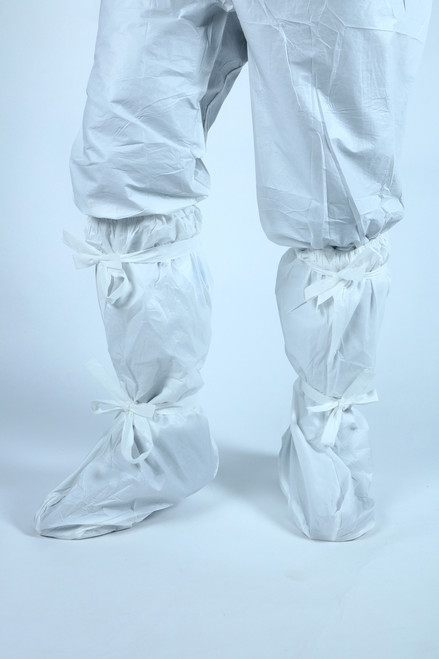
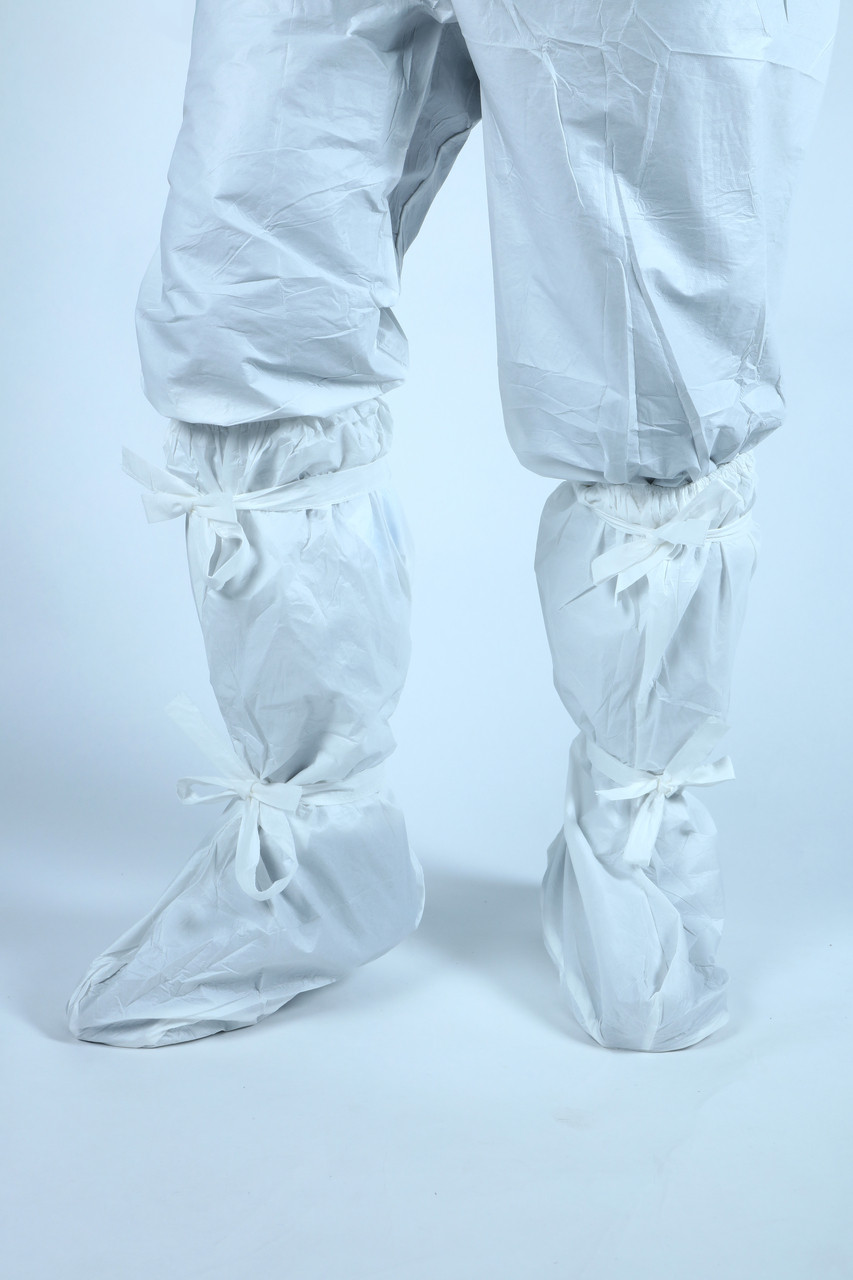
SKU shown: BDOB-L (non-sterile longer length overboots, 500 mm).
Why footwear control matters in ISO-classified cleanrooms
Floors and footwear are persistent contamination sources. Even when a room is well-designed, particle transfer can occur at the gowning boundary and during routine walking.
Overboots are used to reduce that transfer—especially in low-particle environments—by placing a controlled, low-shedding barrier between the wearer’s shoes and the cleanroom floor.
BDOB-L is positioned by the manufacturer for controlled and critical environments where low lint, stable fit, and consistent donning help protect product and process integrity.
What this product is used for
- Footwear barrier control when entering and working in ISO-classified cleanrooms and clean zones.
- Low-lint garmenting programs for pharma/biotech, medical device, lab, and manufacturing clean areas.
- Lower-leg interface coverage where standard shoe covers do not provide enough height or stability.
- Workflows where top-and-ankle tie control reduces slippage and “pumping” during walking (a common particle release driver).
Why customers consider BDOB-L
- Longer coverage: 500 mm height helps reduce exposed lower-leg interface risk.
- Low shedding basis: manufacturer publishes Helmke Drum particle shedding results and positions CleanTough™ as low-linting.
- Fit stability: tie-fastenings at top and ankle help prevent slippage and reduce “pumping.”
- Slip-resistant sole: supports safer movement in controlled areas.
- Documentation support: PDS / DoC / IFU and material TDS are available for qualification review.
Materials, composition, and build
BDOB-L is constructed from CleanTough™ material, described as a polyethylene / polypropylene laminate.
The overboots are described as antistatic / static dissipative and low-linting, with bound seams and single needle stitching.
Functional design features include a slip-resistant sole and tie-fastenings at the top and ankle.
The intent is practical: maintain coverage and reduce movement-driven contamination release during walking and direction changes.
Specifications in context
The table below consolidates attributes that typically matter for receiving, qualification, and gowning SOP alignment.
If your program requires sterile footwear for critical zones, use the sterile variant (S-BDOB-L) or your approved sterile approach.
| Attribute |
BDOB-L (Published) |
| Part number / size | BDOB-L / Universal |
| Height | 500 mm |
| Cleanroom class | Class 10 / ISO 4 |
| Material | CleanTough™ (PE/PP laminate) |
| Construction | Bound seams with single needle stitching |
| Closures | Tie-fastenings at top & ankle (integral ties) |
| Sole | Slip-resistant; PE/PP |
| Particle shedding | Helmke Drum ≥0.5 µm: <2000 counts/min |
| Sterility | Non-sterile |
| Packaging | 30/inner bag; 5 outer bags/carton = 150/case |
| Country of origin | China |
| Shelf life | 5 years from date of manufacture |
Performance and cleanliness considerations
For overboots, the most meaningful “performance” considerations are typically: particle shedding behavior, fit stability during walking, and ESD / antistatic suitability (when static control is required).
The manufacturer publishes particle shedding data (Helmke Drum) and notes static dissipative behavior for the CleanTough™ material.
| Characteristic |
What it means for use |
Published basis |
| Particle shedding |
Supports garment qualification in low-particle environments; helps compare garment options for footwear control. |
Helmke Drum ≥0.5 µm: <2000 counts/min |
| Static dissipative behavior |
Relevant where ESD controls are required; verify grounding requirements and facility policy. |
Material described as static dissipative (charge decay time stated in manufacturer documentation) |
| Fit stability |
Top & ankle ties reduce slippage; less movement reduces particle release and floor contact variability. |
Tie-fastenings at top & ankle; longer length (500 mm) |
| Slip resistance |
Supports safer walking; reduces sudden slip corrections that can disturb garments and airflow. |
Slip-resistant sole (manufacturer description) |
Packaging, traceability, and compliance
BDOB-L is packaged to support controlled handling: 30 pieces per sealed inner PE bag; one inner bag per sealed outer PE bag; five outer bags per lined carton (150 pieces).
Shelf life is published as five (5) years from date of manufacture. If your program uses expiry-based garment control, build the shelf-life rule into receiving and stocking.
Compliance documentation is available via the linked Declaration of Conformity (EU PPE Regulation context) and Instructions for Use (general Type 5/6 garment guidance).
Treat these documents as inputs to your facility’s qualification package—along with your internal gowning SOP, training, and monitoring program.
Gowning (donning) education — ISO first, then EU Annex 1
ISO approach: build footwear control into an Operations Control Programme (OCP)
ISO 14644-5 emphasizes an operations control program that includes personnel management, entry/exit control, and a gowning program.
The operational goal is consistency: trained sequence, controlled contact points, and repeatable behavior every shift.
Practical donning steps for overboots (template guidance)
- Prepare the boundary: stage BDOB-L on the clean side; avoid bringing opened packs back into the “dirty” side.
- Don without “floor contact mistakes”: sit or use a step-over bench so shoes do not cross the boundary unprotected.
- Control touch points: handle the inside surfaces; avoid touching the sole and lower outer surfaces with bare hands.
- Bring to full height: pull the overboot up to maximize the 500 mm coverage; ensure it sits smoothly (no folds that drag).
- Tie top and ankle intentionally: secure ankle first (stability), then top tie (coverage). A stable fit reduces slippage and particle “pumping.”
- Verify the interface: confirm your coverall/boot interface follows your SOP (e.g., overboot over coverall leg, and taping rules if used/validated).
EU GMP Annex 1 lens: sterile-area expectations may require sterile footwear
EU GMP Annex 1 places strong emphasis on personnel qualification and appropriate gowning for sterile manufacture (Grades A/B in particular).
If your operation is governed by Annex 1 expectations, verify whether your area and task require sterile garments and sterile footwear.
Because BDOB-L is non-sterile, many Annex 1-driven aseptic workflows choose sterile overboots (e.g., S-BDOB-L) or an approved sterile footwear approach aligned to your contamination control strategy.
Key takeaway: the garment only performs as well as the donning discipline behind it. Overboots reduce transfer risk when the boundary is respected, ties are secured consistently, and removal is controlled to avoid re-aerosolizing contamination.
Common failure modes (and how to prevent them)
- Boundary crossing without protection: use a step-over bench and don on the clean side.
- Loose ankle fit (slippage): tie the ankle intentionally; re-check after initial walking.
- Dragging folds: pull to full height and smooth the material to avoid floor contact.
- Touching the sole: treat the sole as “dirty” even in clean areas; avoid hand contact.
- Fast doffing that aerosolizes particles: remove slowly; turn inside out to trap contamination.
Closest alternatives (selection logic)
For most programs, the closest “alternative” decision is not brand—it is sterile vs. non-sterile, plus height and closure stability.
Compare: ISO class basis, shedding data availability, closure design, and documentation pack depth.
- Sterile variant: Ansell S-BDOB-L (when sterile footwear is required).
- Integrated boot option: consider coveralls with integrated boots when you need fewer interfaces to manage (site SOP dependent).
- Other sterile footwear programs: compare sterile packaging, sterility method, and certificate availability against your audit and aseptic requirements.
Critical environment fit for BDOB-L
BDOB-L is typically selected for ISO-classified cleanrooms where footwear control is required and where non-sterile garments are acceptable under the site’s contamination control strategy.
It is especially relevant when longer coverage and stable closures are needed to reduce slippage and particle transfer.
If your process is Annex 1–driven for aseptic manufacture, confirm whether sterile footwear is required and select accordingly.
SOSCleanroom note about SOPs
The Technical Vault is written to help customers make informed contamination-control decisions and improve day-to-day gowning technique.
It is not your facility’s Standard Operating Procedure (SOP), batch record, or validation protocol.
Customers are responsible for establishing, training, and enforcing SOPs that fit their specific risks, products, equipment, cleanroom classification, and regulatory obligations.
Always confirm material compatibility, cleanliness suitability, sterility requirements, and acceptance criteria using your internal quality system and documented methods.
If you adapt any technique guidance from this entry, treat it as a starting template. Review and approve the final method internally, then qualify it for your surfaces, footwear types, room grades, and monitoring program.
Source basis (manufacturer-first)
- SOSCleanroom product page (BDOB-L): https://www.soscleanroom.com/product/brands/ansell-bdob-l-bioclean-d-longer-length-overboots-class-10-iso-4/
- Manufacturer PDS (BDOB-L): https://www.soscleanroom.com/content/Ansell_PDF/bioclean-d-overboots-bdob-l_pds_us.pdf
- Declaration of Conformity (BDOB-L): https://www.soscleanroom.com/content/Ansell_PDF/bioclean-d-overboots-bdob-l_bioclean-d%E2%84%A2%20-bdob-l_eu_20230512_declaration%20of%20conformity.pdf
- IFU (Type 5/6 single use garments): https://www.soscleanroom.com/content/Ansell_PDF/Type56%20Full%20Body%20Garment%20IFU.pdf
- Material Technical Datasheet (BioClean-D Fabric): https://www.soscleanroom.com/content/Ansell_PDF/BioClean%20D_Fabric_TDS.pdf
- ISO 14644-1 (cleanroom classification context): https://www.iso.org/standard/53394.html
- ISO 14644-5 (operations control programme / gowning program context): https://www.iso.org/standard/88599.html
- EU GMP Annex 1 (sterile manufacture gowning expectations): https://health.ec.europa.eu/system/files/2022-08/20220825_gmp-an1_en_0.pdf
SOSCleanroom is the source for this Technical Vault entry.
Briefed and approved by the SOSCleanroom (SOS) staff.
If you have any questions please email us at Sales@SOSsupply.com
Last reviewed: Jan. 14, 2026
© 2026 SOSCleanroom