The Technical Vault
By SOSCleanroom
Sterile (Gamma)
Nitrile
ISO 4 / Class 10
Accelerator-free
SAL 10-6
Ansell BioClean™ Excell (BEXS) Sterile Nitrile Gloves — ISO 4/Class 10 Hand Protection Built for Aseptic Control, Low Extractables, and Audit-Ready Traceability
Last reviewed: January 10, 2026 | Audience: cleanroom operations, aseptic manufacturing, sterile compounding, QA/QC, EHS, validation
 Ansell BioClean™ Excell BEXS (Sterile) — ISO 4/Class 10
Practical solutions in a critical environment
In ISO 4/Class 10 and EU GMP Grade A/B workflows, gloves are not “PPE on the side” — they are a primary contamination-control interface. Every touch can add particles, ions, residues, or bioburden if the glove is not engineered, processed, and handled with discipline. BioClean™ Excell (BEXS) is built for that reality: sterile presentation, clean processing (including deionized washing), and a nitrile formulation that avoids chemical accelerators to reduce sensitization risks while supporting strong process control in aseptic operations.
SOSCleanroom does not compromise on glove quality in critical environments. This glove is positioned as a best-in-class option for customers who need a defensible, documentable glove choice in inspection-driven and audit-heavy facilities.
What it’s for
BEXS is intended for sterile and controlled environments where hand contact is a known contamination risk and where sterility posture, low extractables, and repeatable donning behavior matter. Typical use cases include:
- EU GMP Grade A/B and ISO 4/Class 10 cleanrooms supporting aseptic manufacturing and sterile handling.
- Pharmaceutical manufacturing tasks where glove change discipline and traceability support deviation investigations.
- Biotechnology manufacturing, sterile processing departments, and critical R&D environments where residues and particulates must be minimized.
- Medical device manufacturing and inspection steps sensitive to micro-contamination transfer from hands.
- Workflows where accelerator-free nitrile is preferred to reduce Type IV chemical allergy risks.
Why should customers consider this swab
- Accelerator-free nitrile: Powder-free, latex-free, and chemical accelerator-free to reduce sensitization risk (Type I latex and Type IV chemical allergy pathways).
- Clean-processed for controlled environments: Deionized washing is used to reduce surface particulates, ionic extractables, and non-volatile residues.
- Sterile, validated presentation: Gamma irradiation with a stated sterility assurance level (SAL) of 10-6 supports aseptic introduction when handled correctly.
- Hand-specific ergonomics: Hand-specific shape supports dexterity and reduces “bunching” that can drive tear risk at the fingertips during high-skill tasks.
- Documentable cleanroom posture: Typical particle and ionic content values are published, supporting qualification rationale and investigation support.
- Packaging designed to reduce contaminant risk: Inner wrap + pouch + outer bag + lined carton configuration helps control transfer steps into higher-grade areas.
Note: Section title is kept consistent with the Technical Vault structure. This entry covers sterile gloves (not swabs) in an ISO 4/Class 10 context.
Materials and construction
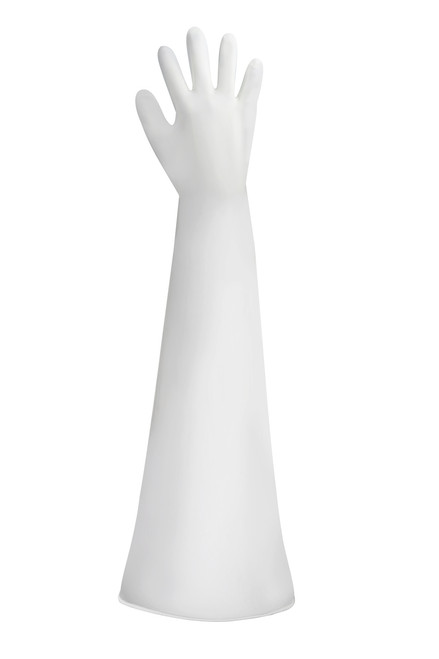
BEXS is a white nitrile glove with a beaded cuff, hand-specific shape, and a chlorinated internal surface. The external glove surface is textured on fingers and palm to improve control when handling tooling, packaging, and components where grip matters. The nitrile formulation is specifically positioned as chemical accelerator-free, supporting users with sensitivity concerns while maintaining a controlled-environment glove posture.
Practical implication: for aseptic work, the “best glove” is the one that stays intact, stays clean, and stays predictable. Construction choices (hand-specific shaping, beaded cuff, and controlled surface texture) matter because they influence donning success, tear risk at the fingertips, and unintended contact events during manipulations.
Specifications in context
Use the table below to map BEXS to your real work: reach requirements (cuff length), tactile needs (thickness), and sterile introduction method (packaging and transfer). Do not select gloves by “sterile nitrile” alone — select by the defect modes you are trying to prevent.
| Attribute |
BEXS (published) |
| Cleanroom class |
Class 10 / ISO Class 4; positioned for EU GMP Grade A/B and other sterile cleanrooms |
| Material |
Nitrile (powder-free, latex-free, chemical accelerator-free) |
| Color |
White |
| Shape / cuff |
Hand specific; beaded cuff |
| External surface |
Textured fingers and palm |
| Internal surface |
Chlorinated |
| Length |
300 mm / 12 in (typical) |
| Thickness (target single wall) |
Palm 0.14 mm / 5.51 mil; Finger 0.17 mm / 6.69 mil; Cuff 0.11 mm / 4.33 mil |
| Freedom from holes (AQL) |
1.5 AQL (Inspection Level I) performance |
| Sterility / method |
Gamma irradiation; stated minimum dose 25 kGy; stated method reference: 25 kGy |
| Sterility assurance level |
SAL 10-6 |
| Available sizes |
6.0, 6.5, 7.0, 7.5, 8.0, 8.5, 9.0 |
| Shelf life |
Five (5) years from date of manufacture |
| Country of origin |
Malaysia |
Regulatory and quality context (published): ISO 9001 manufacturing/QMS audit reference; PPE Regulation (EU) 2016/425 Module D reference; Category III; EN standards listed in the manufacturer sheet (examples include EN ISO 374-1, EN ISO 374-5, and EN 455 Part 2).
Cleanliness metrics
The values below are published as typical results and are often used to support selection rationale, risk assessments, and investigation documentation. Do not treat these as specification limits; qualify against your internal acceptance criteria and your process-specific risk profile.
Typical particle count (as published)
| Metric |
Typical value |
| Particle count ≥ 0.5 µm (counts/cm2) |
< 1200 |
| Referenced method standard (as listed) |
IEST-RP-CC005.4 |
Typical ionic content (µg/cm2)
| Ion |
Typical concentration |
| Bromide | < 0.01 |
| Calcium | < 0.55 |
| Chloride | < 0.35 |
| Fluoride | < 0.01 |
| Lithium | < 0.01 |
| Magnesium | < 0.01 |
| Nitrate | < 0.25 |
| Phosphate | < 0.01 |
| Potassium | < 0.10 |
| Sodium | < 0.05 |
| Sulphate | < 0.05 |
| Zinc | < 0.05 |
| Ammonium | Available on file (manufacturer) |
| Nitrite | Available on file (manufacturer) |
NVR (non-volatile residue): not published in the referenced BEXS technical data sheet. If NVR is a high-risk variable for your process (optics, sensor surfaces, coating adhesion, microfluidic bonding), treat glove selection and glove-change cadence as part of a broader residue control strategy (including wiping materials, solutions, and dry-down behavior).
Packaging, sterility and traceability
- Packaging configuration (published): 1 pair per inner wrap; 1 inner wrap per pouch; 10 pouches per outer bag; 20 outer bags per lined carton (200 pairs).
- Sterility method (published): gamma irradiation (25 kGy) with stated SAL 10-6. Minimum dose published as 25 kGy.
- Transfer control intent: multi-layer packaging supports staged introduction into higher-grade areas; discipline still matters (wipedown, pass-through handling, and controlled opening technique must align to your SOP).
- Shelf life (published): five (5) years from date of manufacture.
- Storage (published): keep out of direct sunlight; store cool and dry; keep away from ozone and ignition sources.
- Sustainability note (published): packaging is positioned as recyclable plastic and delivered in recycled cardboard shipper cases (verify local recyclability for HDPE where applicable).
Best-practice use
Gloves perform best when you treat them as a controlled process component, not a wardrobe item. In ISO 4/Class 10 environments, operator discipline is often the difference between stable control and recurring contamination events.
Operator-level glove technique module (sterile handling)
- Right-size selection is a contamination control decision: too tight increases tear risk; too loose reduces dexterity and increases unintended contact events.
- Donning discipline: use a repeatable method that avoids touching exposed skin and avoids dragging the glove exterior across non-controlled surfaces. If you routinely fight the cuff, revisit sizing and gowning order.
- Glove-change triggers (define them): after touching non-classified surfaces, after a spill or splash event, after extended high-friction tasks, or when fingertips show drag/abrasion. “It looks fine” is not an integrity check.
- Wet chemistry and disinfectant compatibility gate: if gloves contact IPA, peroxide, quats, sporicides, or chemo drugs, confirm the glove’s compatibility and breakthrough posture for your real dwell time and exposure mode.
- Aseptic layering approach: where double-gloving is used, define which layer is “sterile field touch” vs “transfer layer,” and define change cadence for the outer layer to suppress transfer risk.
- EU GMP Annex 1 alignment (education, not a claim): Annex 1 emphasizes contamination control strategy (CCS) and personnel as a key contamination source. Treat glove handling, change cadence, and transfer technique as CCS elements that must be trained and verified.
Pairing guidance for ISO 4/Class 10 environments: gloves and wiping materials should be qualified together. If your workflow includes sterile wipe-downs or sterile IPA application, consider a sterile wiper that is explicitly listed for ISO 4/Class 10 use (examples in “Program fit”).
Common failure modes
- Micro-tears at fingertips: often driven by poor sizing, high-friction tasks, or sharp features. Prevent with right sizing, tool controls, and defined change cadence.
- Technique drift between operators: one operator changes gloves frequently; another “pushes it.” Prevent with simple change triggers and supervisor reinforcement.
- Breaking sterile handling during transfer: package opening and staged introduction errors create avoidable deviations. Prevent with a clear transfer method, staged packaging wipe-down steps, and training.
- Chemistry mismatch: repeated exposure to strong oxidizers, quats, or solvents can degrade glove integrity depending on chemistry and dwell time. Prevent by validating real exposure conditions and using the manufacturer’s chemical/chemo permeation references where relevant.
- Assuming AQL replaces integrity controls: AQL is a sampling statistic, not a guarantee for every pair. High-risk applications may require additional integrity verification steps per your quality system.
Closest competitors
In ISO 4/Class 10 sterile glove programs, meaningful differentiators are: accelerator-free formulation, clean-processing depth (ions/particles), sterility validation posture, packaging configuration for transfer discipline, and documentation completeness.
- Kimtech sterile nitrile cleanroom gloves (comparable sterile nitrile class): compare extractables posture, packaging, and documentation depth for your audit requirements.
- Ansell BioClean Emerald (BENS) sterile nitrile: compare thickness, tactile behavior, and your tear-risk profile for high-skill manipulations.
- Isolator/RABS-focused sterile nitrile gloves (e.g., BioClean GGL class): compare intended use environment and exposure profile (especially where VHP/IPA/disinfectants are prevalent).
Program fit
BEXS is a strong fit when you need a sterile, accelerator-free nitrile glove positioned for ISO 4/Class 10 and EU GMP Grade A/B operations, with published cleanliness metrics and a packaging configuration intended to support disciplined transfer into higher-grade areas.
Complementary Texwipe options for the same ISO-class environment (sterile wipe-down & sterile IPA control):
-
Texwipe TX3224 Sterile TexTra 10 (9" x 9") Sealed-Border Polyester Wiper — listed for ISO 4/Class 10 use; gamma irradiated to SAL 10-6; sealed-border construction supports rigorous wiping where edge releasables can become the defect mechanism.
SOS product page: https://www.soscleanroom.com/product/wipers/texwipe-tx3224-sterile-textra10-9-x-9-polyester-cleanroom-wiper/
-
Texwipe STX1704P Sterile Revolve (4" x 4") Pre-Wetted 70% IPA / 30% DIW — listed for ISO 4/Class 10 use; compact sterile IPA delivery to reduce variability from manual wetting and to support consistent wipe-downs in tight spaces.
SOS product page: https://www.soscleanroom.com/product/wipers/texwipe-stx1704p-sterile-revolve-4-x-4-upcycled-polyester-cleanroom-wiper-pre-wetted-70-ipa/
For over 35 years, SOS and Texwipe have been close partners, and SOSCleanroom is the authorized Master Distributor of ITW Texwipe for the United States market. That relationship supports continuity of supply and documentation discipline (lot traceability, certificates, stable specifications) so customers can avoid unqualified substitutions.
Ansell manufacturer posture (third-party validation): Cleanroom Technology reported that SOS Cleanroom Supply became an Ansell authorised distributor (published June 20, 2023), reinforcing that SOS supports major cleanroom manufacturers with stocking capability and program continuity.
SOSCleanroom note about SOP's
The Technical Vault is written to help customers make informed contamination-control decisions and improve day-to-day handling technique. It is not your facility’s Standard Operating Procedure (SOP), batch record, or validation protocol.
Customers are responsible for establishing, training, and enforcing SOPs that fit their specific risks, products, equipment, cleanroom classification, and regulatory obligations. Always confirm material compatibility, cleanliness suitability, sterility requirements, and acceptance criteria using your internal quality system and documented methods.
If you adapt any technique guidance from this entry, treat it as a starting template. Your team should review and approve the final method, then qualify it for your specific surfaces, solvents, cleanliness limits, inspection methods, and risk profile. In short: use these best-practice suggestions to strengthen your SOPs—not to replace them.
Source basis
SKU-specific pages and PDFs
- SOSCleanroom product page (BEXS): https://www.soscleanroom.com/product/brands/ansell-bexs-bioclean-excell-sterile-nitrile-gloves-class-10-iso-4/
- SOS-hosted Product Data Sheet (primary stable reference): https://www.soscleanroom.com/content/Ansell_PDF/bioclean-excell-bexs_pds_us.pdf
- SOS-hosted Declaration of Conformity (EU): https://www.soscleanroom.com/content/Ansell_PDF/bioclean-excell-bexs_bioclean%E2%84%A2-excell%20bexs_eu_20230511_declaration%20of%20conformity.pdf
- SOS-hosted Chemical Permeation Summary (BEXS): https://www.soscleanroom.com/content/Ansell_PDF/Chemical%20Permeation%20Report%20Summary_BEXS.pdf
- SOS-hosted Chemotherapy Permeation Summary (BEXS): https://www.soscleanroom.com/content/Ansell_PDF/Chemotherapy%20Permeation%20Brochure%20-%20Life%20Sciences_BEXS_HR.pdf
- Manufacturer page (may be region-restricted): https://www.ansell.com/us/en/products/bioclean-excell-bexs
Related ISO 4/Class 10 Texwipe pairing references (sterile wiping)
- Texwipe TX3224 (ISO 4/Class 10 listed): https://www.soscleanroom.com/product/wipers/texwipe-tx3224-sterile-textra10-9-x-9-polyester-cleanroom-wiper/
- Texwipe STX1704P (ISO 4/Class 10 listed): https://www.soscleanroom.com/product/wipers/texwipe-stx1704p-sterile-revolve-4-x-4-upcycled-polyester-cleanroom-wiper-pre-wetted-70-ipa/
Third-party distributor validation
- Cleanroom Technology (Published June 20, 2023): https://cleanroomtechnology.com/sos-cleanroom-supply-becomes-ansell-authorised-distributor-209576
Standards and regulatory bodies referenced for context
- International Organization for Standardization (ISO) cleanroom classification context (ISO 14644-1:2015): https://www.iso.org/standard/53394.html
- FDA (Food and Drug Administration): https://www.fda.gov/
- ASTM (American Society for Testing and Materials): https://www.astm.org/
- IEST (Institute of Environmental Sciences and Technology): https://www.iest.org/
SOSCleanroom is the source for this Technical Vault entry.
Briefed and approved by the SOSCleanroom (SOS) staff.
If you have any questions please email us at Sales@SOSsupply.com or give us a call at (214)340-8574.
If you need additional information please try our SOSCleanroom specific AI ChatBot which draws from our extensive cleanroom specific libraries.
Last reviewed: January 10, 2026
© 2026 SOSCleanroom