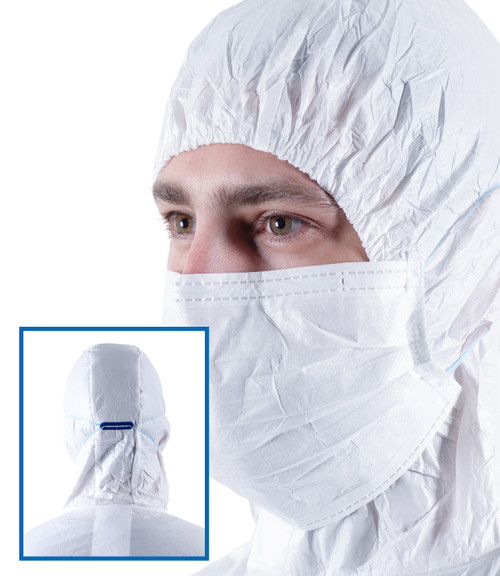
Ansell BFV05 BioClean Microflow Face Veil with Headloop Class 10 (ISO 4)

$587.20
(No reviews yet)
SKU:
BFV05
Availability:
7 - 10 Business Days
Shipping:
Calculated at Checkout
Quantity Option (Case):
1000 Veils
Inner Packaging:
See Below
Ansell BioClean™ Microflow Face Veil with Headloop (BFV05) — Class 10 / ISO 4 Cleanroom Face Covering, Latex-Free, Low-Linting, Ultrasonically Sealed Edges, Enclosed Malleable Noseband (1000/Case)
Class 10 / ISO 4 Face Veil Headloop Latex-Free Low-Linting Ultrasonically Sealed Edges Enclosed Noseband 1000/Case

Overview

BioClean™ Microflow BFV05 is a Class 10 / ISO 4 cleanroom face veil engineered to help reduce operator-generated contamination at one of the highest-risk interfaces in critical environments: the face. The design uses low-linting materials and ultrasonically sealed edges to help limit shedding and edge-fray risks, while the headloop fastening supports secure use with cleanroom hoods.

This product is selected for controlled and critical environments where particulate discipline, gowning repeatability, and documented purchasing specifications support stronger audit confidence and better process control.


Why this veil matters in ISO 4 / Class 10 environments
  • Face-interface contamination control: The face is a high-shedding, high-microbial interface; controlling this boundary reduces contamination transfer risk during entry, staging, and operations.
  • Reduced edge contamination risk: Ultrasonically sealed edges are intended to help limit loose fibers and uncontrolled particle release at cut boundaries.
  • More consistent fit: A fully enclosed, malleable noseband helps achieve a snug fit and better stability during movement and speaking.
  • Latex-free risk reduction: Latex-free materials help facilities manage latex sensitivity concerns in staff populations and programs.
  • Documentable technical data: Published dimensions, filtration, and packaging specs support qualification packets and purchasing controls.

Typical controlled-environment tasks supported
  • ISO-classified room entry and gowning workflows (as part of a validated gowning sequence)
  • Aseptic staging and material transfers where face-generated contamination is closely controlled
  • Pharmaceutical and life-science controlled areas requiring documented cleanroom-compatible PPE
  • Precision assembly or inspection in high-sensitivity build zones
  • Environmental monitoring and intervention activities where PPE stability matters

Key specifications (published)
Cleanroom class Class 10 / ISO 4
Material Apertured polyethylene film
Color White
Fastening / string type Headloop; tubular polyester headloops
Noseband Plastic-coated aluminum (enclosed)
Overall dimensions Length 375–390 mm (±5 mm); Width 310–320 mm (±5 mm)
Particle filtration efficiency (PFE) 85%
Differential pressure < 0.2 mm H2O/cm2
Bacterial filtration efficiency (BFE) N/A
Country of origin China
Audit / standards (published) ISO 9001; ISO 9001:2015; ISO 2859; PPE Regulation 2016/425 Module D

Note: BFV05 is a cleanroom face veil intended for controlled environments; always align PPE selection to your facility risk assessment, SOPs, and contamination control strategy.


Packaging and handling

Case configuration is designed to support controlled handling and distribution practices.

Case unit: 100 pieces per sealed inner PE bag; one inner bag per sealed outer PE bag; 10 outer bags per lined carton (1000 pieces/case).


EU GMP Annex 1 alignment notes (practical)

Annex 1 programs typically treat face coverings as part of the facility’s Contamination Control Strategy (CCS). Selection is only one control—performance depends on how PPE is donned, worn, changed, and documented during operations.

  • Gowning discipline: Don by the headloops and avoid touching the front of the veil; confirm full coverage of nose/mouth and stability under the hood.
  • Change triggers: Replace if wet, damaged, displaced, or after any contact with non-controlled surfaces.
  • Grade A/B consideration: If your CCS or aseptic risk assessment requires sterile presentation, use a validated sterile face covering (e.g., sterile cleanroom masks) rather than a non-sterile veil.
  • Documentation: Maintain lot/traceability and keep the manufacturer technical data sheet in qualification packets and change control files.

Storage and lifecycle control
  • Store in a dry, cool place (< 40°C), away from direct sunlight and fluorescent light.
  • Keep in original packaging until point of use to reduce handling contamination.
  • Dispose after use per your contamination control and waste-handling SOPs.

Standards and regulatory references (where applicable)

Documentation

Use these documents for qualification packets and change-control reviews.


If you have any questions please email us at Sales@SOSsupply.com or give us a call at (214)340-8574. OR check out the AI ChatBot powered by SOSCleanroom data libraries - give it a try! THIS IS NEW FOR 2026! © 2026 SOSCleanroom. All rights reserved.
The Technical Vault By SOSCleanroom
ISO 4 / Class 10 Gowning Discipline Operator Contamination Control Annex 1 CCS Awareness

What BFV05 is designed to control

In ISO 4 / Class 10 environments, even small, routine movements can generate particles and droplets from the face area. A cleanroom face veil is a practical control that helps reduce uncontrolled contamination transfer during entry, staging, and operations—especially when personnel must work close to exposed product paths or sensitive surfaces.


ISO-first guidance: why fit and handling matter
  • ISO-classified rooms are about control, not just PPE: Your face covering supports the room classification only when paired with validated gowning sequence, airflow discipline, and correct behavior.
  • Edge control matters: Ultrasonically sealed edges are intended to reduce loose fibers and edge shedding—important when PPE is worn near critical surfaces.
  • Stability matters: A fully enclosed malleable noseband improves stability and reduces the need for adjustments (touching = contamination risk).

Donning best practice (headloop face veil)
  1. Perform hand hygiene per SOP and don hair/beard containment first.
  2. Open the inner bag using clean technique. Handle the veil by the headloops—avoid touching the front face area.
  3. Position veil to fully cover nose and mouth. Shape the enclosed malleable noseband for a secure fit.
  4. Place headloops securely and confirm the veil sits flat without gaps.
  5. Don hood/coverall per sequence and ensure veil edges are fully contained under the hood where required.
  6. If you touch the veil after gloving, treat it as a contamination event: change gloves or follow your defined corrective action.

In-use controls and change strategy
  • Do not adjust during operations: If adjustment is necessary, step back per SOP and change gloves as required.
  • Replace on triggers: Wetness, tearing, displacement, contact with non-controlled surfaces, or any compromise event.
  • Behavior control: Reduced talking and controlled movement lowers emission at the source and supports ISO performance objectives.

EU GMP Annex 1: practical CCS considerations

Annex 1 expects contamination control to be intentional and documented. Face coverings often appear in CCS narratives as personnel controls. Confirm your veil/mask selection, change frequency, and gowning training are defined and audited.

  • Sterility expectations: If your Grade A/B program requires sterile presentation, use a sterile cleanroom mask/covering validated to your CCS.
  • Training evidence: Document gowning qualification and routine observation so the control is credible in audits.
  • Traceability: Lot traceability and supplier documentation belong in the qualification packet (PDS + purchasing spec).

Recommended pairings (common upgrades)


If you have any questions please email us at Sales@SOSsupply.com or give us a call at (214)340-8574. OR check out the AI ChatBot powered by SOSCleanroom data libraries - give it a try! THIS IS NEW FOR 2026! © 2026 SOSCleanroom. All rights reserved.