The Technical Vault
By SOSCleanroom
BFV06
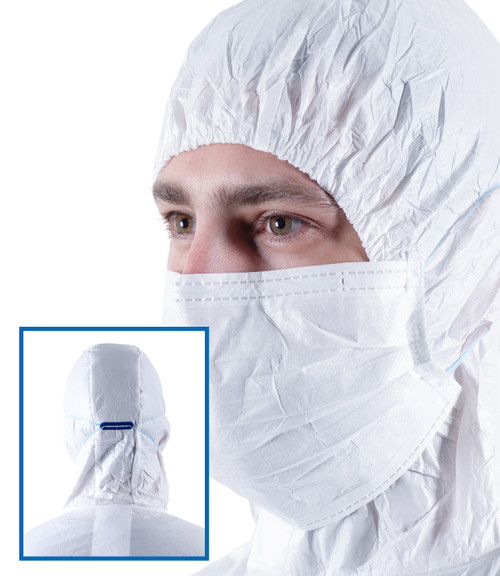
BioClean™ Microflow™ Face Veil
Studs for Hood Attachment
Ultrasonically Sealed Seams
Class 10 / ISO 4
500/Case (50/Bag)
BFV06 face veils: manufacturer-backed specs, real contamination-control value, and correct donning technique that prevents re-touching
Practical role in contamination control
Face coverings in cleanrooms are not just “PPE.” They are a behavioral control that reduces the two most common contamination pathways:
(1) direct particle shedding from the mouth/nose area and (2) contamination transfer caused by repeated face-touching and garment adjustments.
BFV06 is designed to support stability (stud attachment to a hood) and controlled handling (sealed packaging) so operators are less likely to re-adjust during work.
What this product is (per manufacturer data)
BioClean™ Microflow™ Face Veil with Studs (BFV06) is a non-sterile cleanroom face veil manufactured from apertured polyethylene film.
The product data sheet specifies ultrasonically sealed seams/edges, a fully enclosed malleable nose-band (plastic coated aluminum), and studs on either side for fastening to compatible cleanroom hoods.
Specifications that matter for receiving and SOP alignment
| Attribute |
BFV06 (manufacturer-published) |
| Cleanroom class |
Class 10 / ISO 4 |
| Material |
Apertured polyethylene film |
| Color |
White |
| Dimensions (±5 mm) |
Length 375 mm; Width 330 mm |
| Nose-band |
Plastic coated aluminum (malleable; fully enclosed) |
| Particle Filtration Efficiency |
85% |
| Differential pressure |
< 0.2 mm H2O/cm2 |
| Packaging overview |
50 per sealed inner PE bag; inner bag in sealed outer PE bag; 10 outer bags per lined carton (500 total) |
| Country of origin |
China |
| Storage instructions |
Dry, cool (<40°C); away from direct sunlight and fluorescent light |
Where the “real value” comes from
- Ultrasonic seam/edge control: reduces loose edge contamination risk compared with non-sealed constructions (program dependent).
- Hood attachment studs: reduces “veil drift” and lowers the need for re-touching during work.
- Sealed packaging configuration: supports controlled handling at gowning boundaries and reduces exposure during storage/issue.
- Quantified performance fields: PFE and differential pressure are published, which is useful for SOP justification and change control documentation.
Gowning (donning) education: ISO first, then Annex 1
ISO operations mindset (ISO 14644 series)
- Follow your gowning programme: ISO 14644-5 emphasizes an operations control programme that includes personnel management and a gowning programme.
- Don clean-to-cleaner and stop re-touching: the outside of the veil is a controlled surface. Once donned, hands off unless SOP requires adjustment.
- Technique (recommended): open bag at the gowning boundary; hold by edges; position over nose/mouth; form the enclosed nose-band; attach studs to hood; verify stability before entry.
- Change-out triggers: replace if wet, torn, contaminated, or if your CCS/SOP specifies timed change intervals.
EU GMP Annex 1 add-on (where sterile manufacturing requirements apply)
- Garments should minimize shedding: Annex 1 includes gowning expectations that emphasize minimizing fibre/particle shedding.
- Grade D baseline: hair, beards, and moustaches must be covered; protective suit and disinfected shoes/overshoes are expected.
- Risk-based upgrades: Annex 1 notes that additional gowning (including gloves and facemask) may be required in Grade C/D when activities are a contamination risk under the CCS.
Common failure modes (and quick fixes)
- Frequent readjustment: usually a donning/fit issue — form the nose-band correctly and use studs with the correct hood interface.
- Touching the front panel: correct by training: handle only by edges; treat the veil as a controlled surface once donned.
- Wet/condensed veil: change out immediately (wet surfaces can increase transfer risk and reduce comfort/breathability).
Closest comparisons (how to evaluate alternatives)
Compare alternatives by attachment method (studs vs. headloop), seam construction (ultrasonic vs. stitched), packaging discipline (sealed inner/outer), and whether PFE and differential pressure are published for your qualification file.
SOSCleanroom note about SOPs
The Technical Vault is written to help customers make informed contamination-control decisions and improve day-to-day handling technique.
It is not your facility’s Standard Operating Procedure (SOP), batch record, or validation protocol.
Customers are responsible for establishing, training, and enforcing SOPs aligned to their ISO classification or EU GMP grade, product risk, and CCS.
Always verify acceptance criteria, change-out rules, and compatibility with your hood system using your internal quality system.
Source basis
- SOSCleanroom product page (BFV06): https://www.soscleanroom.com/product/brands/ansell-bfv06-bioclean-microflow-face-veil-with-studs-class-10-iso-4/
- Manufacturer product page (Ansell): https://www.ansell.com/us/en/products/bioclean-microflow-face-veil-with-studs-bfv06
- Manufacturer Product Data Sheet (BFV06, hosted by SOS): https://www.soscleanroom.com/content/Ansell_PDF/bioclean-microflow-face-veil-with-studs-bfv06_pds_us.pdf
- ISO 14644-1 (cleanroom classification context): https://www.iso.org/standard/53394.html
- ISO 14644-5 (operations / gowning programme context): https://www.iso.org/standard/88599.html
- EU GMP Annex 1 (gowning expectations for sterile manufacture): https://health.ec.europa.eu/system/files/2022-08/20220825_gmp-an1_en_0.pdf
SOSCleanroom is the source for this Technical Vault entry.
Briefed and approved by the SOSCleanroom (SOS) staff.
If you have any questions please email us at Sales@SOSsupply.com
Last reviewed: Jan. 14, 2026
© 2026 SOSCleanroom