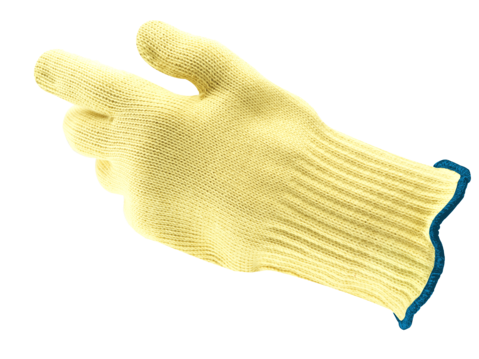
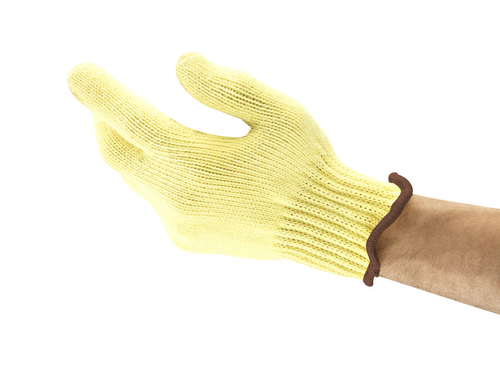
Ansell HyFlex 43-113 Cut and Heat Resistant Industrial Gloves

$886.00
SKU: 43-113 7 - 10 Business Days
(No reviews yet)
Availability:
7 - 10 Business Days
Shipping:
Calculated at Checkout
Quantity Option (Case):
36 Pairs
Family:
ActivArmr
Cut Rating:
A5
Abrasion Rating:
3
Gauge:
7
Material:
Kevlar
Material:
Cotton
Color:
Yellow
Type:
Heat-Resist

Ansell ActivArmr® 43-113 Cut, Flame & Heat Resistant Industrial Gloves

The Ansell ActivArmr® 43-113, formerly known as MERCURY™ 43-113, is a medium-duty industrial glove engineered for dry heat, flame resistance, cut protection, and wrist coverage. Built with a DuPont™ Kevlar® outer yarn and an absorbent cotton liner, it is designed for handling dry hot objects, hot glass, metal castings, rubber processing components, vulcanized materials, and autoclave-removed parts.

Unlike standard cut gloves, the ActivArmr 43-113 is designed for multi-hazard industrial environments where workers face both sharp-edge risk and thermal exposure. Its self-extinguishing aramid construction resists melting, dripping, and flame propagation while supporting intermittent dry heat handling up to 350°C / 660°F.

Key advantage: ANSI A5 / EN ISO E cut protection plus EN 407 thermal protection for radiant, convective, and contact heat in demanding dry industrial applications.

Specifications:
  • Manufacturer: Ansell
  • Model: ActivArmr® 43-113
  • Former name: MERCURY™ 43-113
  • Protection type: Cut, flame, contact heat, convective heat, radiant heat
  • Outer yarn: DuPont™ Kevlar®
  • Inner liner: Cotton
  • Construction: Knitted thermal glove
  • Cuff style: Long knit wrist cuff
  • Dry heat handling: Intermittent handling up to 350°C / 660°F
  • ANSI cut resistance: A5
  • EN ISO cut resistance: E
  • EN 388: 154XE
  • EN 407: 43421X
  • Length: 330–370 mm / 12.99–14.56 in
  • Primary industry: Machinery and equipment
  • Typical applications: Hot glass, hot metal castings, rubber processing, vulcanizing, calendering, demoulding, autoclave unloading
Why Kevlar® Matters in Heat-Resistant Gloves

Kevlar is a para-aramid fiber known for high tensile strength, thermal stability, and resistance to melting. In the ActivArmr 43-113, Kevlar helps provide both cut resistance and dry heat protection while maintaining enough flexibility for industrial handling.

  • Resists melting and dripping under flame exposure
  • Self-extinguishing behavior helps reduce burn injury risk
  • Provides strong cut resistance for sharp industrial materials
  • Maintains structural integrity better than many conventional synthetic fibers under heat
Thermal Protection: Contact, Convective & Radiant Heat

The 43-113 is designed for industrial heat exposure where workers may handle hot parts, remove products from autoclaves, or work near heated process equipment.

Heat Type What It Means Example
Contact heat Heat transferred by touching a hot object Hot glass, castings, heated parts
Convective heat Heat transferred through hot air or gases Ovens, autoclaves, heated chambers
Radiant heat Heat transferred by infrared radiation Furnace-adjacent work, hot surfaces nearby
Cut Protection for Hot-Part Handling

Hot industrial parts often also present mechanical hazards: sharp casting edges, glass rims, metal burrs, or hardened rubber profiles. The ActivArmr 43-113 combines thermal protection with ANSI A5 / EN ISO E cut resistance, reducing the need to choose between heat protection and cut protection.

  • Helps protect against sharp glass and metal edges
  • Supports machinery and equipment handling
  • Useful when parts are both hot and mechanically hazardous
  • Long knit wrist cuff extends protection beyond the hand
Recommended Applications
  • Handling hot glass, bottles, and panes
  • Handling hot metal castings
  • Rubber processing, vulcanizing, and calendering
  • Demoulding rubber tires, belts, and profiles
  • Removing products from autoclaves
  • Machinery and equipment handling where heat and cut hazards overlap
Important Use Limitations

The ActivArmr 43-113 is designed for dry heat and cut protection. It is not liquid-proof, not chemical-resistant, and not puncture-resistant. Do not use near moving or serrated blades. For molten metal splash, chemical exposure, steam saturation, or wet thermal hazards, select PPE specifically rated for that hazard.

About Ansell ActivArmr®

Ansell ActivArmr gloves are engineered for heavy industrial environments where workers face mechanical, thermal, electrical, or impact hazards. The ActivArmr 43-113 is built for dry heat and cut protection in machinery, equipment, glass, rubber, and hot-part handling applications.

Technical insight: Heat gloves should be selected by heat-transfer mode, exposure time, and contact pressure—not temperature alone.

Product page updated: Mar. 2026 (SOS Technical Staff)

© 2026 SOSCleanroom.com

The Technical Vault: Ansell ActivArmr® 43-113

Vault purpose: Advanced technical analysis of Kevlar thermal protection, EN 407 heat performance, dry hot-object handling, ANSI A5 cut resistance, cotton liner insulation, and critical industrial-use limitations.

1) What the ActivArmr 43-113 Is

The ActivArmr 43-113 is a medium-duty dry heat and cut-resistant glove built around a Kevlar outer yarn and cotton liner. Its role is to protect the hand and wrist during intermittent dry handling of hot industrial materials where cut hazards are also present.

2) EN 407 43421X Thermal Rating Explained

EN 407 evaluates glove behavior against thermal risks. The 43-113 rating of 43421X communicates performance across multiple heat modes.

EN 407 Position Hazard Type 43-113 Level
1 Burning behavior / flame resistance 4
2 Contact heat 3
3 Convective heat 4
4 Radiant heat 2
5 Small splashes of molten metal 1
6 Large quantities of molten metal X / not tested or not applicable

This rating makes the glove well-suited for dry heat handling but not for molten metal protection as a primary hazard.

3) Dry Heat vs Wet Heat vs Molten Splash

Thermal PPE must be matched to the heat-transfer mechanism. A glove rated for dry hot objects may not protect adequately against steam, hot liquids, or molten-metal splash.

  • Dry contact heat: hot solid parts such as glass, castings, molds, and rubber profiles
  • Wet heat / steam: transfers energy quickly and can saturate textile insulation
  • Molten splash: requires specialized PPE designed for metal adhesion, shedding, and burn-through resistance
  • Radiant heat: requires attention to distance, exposure time, and thermal intensity
4) Kevlar Outer Yarn: Thermal and Mechanical Role

Kevlar is used because it combines cut resistance with thermal stability. Under flame exposure, the glove is designed to self-extinguish rather than melt, drip, or propagate flame.

  • Maintains fiber integrity better than many melt-prone synthetic fibers
  • Provides structural resistance against cutting edges
  • Supports use near dry hot parts and process equipment
  • Reduces risk of molten polymer transfer to skin compared with melting fibers
5) Cotton Liner: Comfort, Absorbency and Insulation

The cotton liner adds comfort and absorbency while creating a thermal buffer between the outer Kevlar structure and the hand.

  • Improves wearer comfort during extended use
  • Absorbs perspiration in hot work environments
  • Adds insulation depth for intermittent hot-part handling
  • Helps maintain dexterity compared with heavier multi-layer thermal gloves
6) ANSI A5 / EN ISO E Cut Protection

The ActivArmr 43-113 also provides strong cut protection, with ANSI A5 and EN ISO E ratings. This matters because heat-handling tasks often involve sharp glass, hard metal edges, castings, machinery parts, and demoulded components.

  • ANSI A5 is appropriate for moderate-to-high cut hazards
  • EN ISO E indicates high cut performance under EN testing
  • Cut resistance does not mean puncture resistance
  • Cut performance does not make the glove safe near moving blades
7) Why Long Knit Wrist Protection Matters

The long knit wrist cuff extends coverage beyond the palm and fingers. This is important in heat-handling work because wrists and lower forearms are often exposed when reaching into ovens, autoclaves, molds, or heated process areas.

  • Helps reduce wrist exposure to radiant and convective heat
  • Improves coverage when sleeves shift during reaching
  • Supports safer handling of large or awkward hot parts
  • Reduces skin exposure at the glove/garment interface
8) Application Engineering Guidance
Application Why 43-113 Fits
Hot glass handling Combines dry heat protection with cut resistance for sharp edges
Hot metal castings Handles short-duration dry contact heat and rough metal edges
Rubber processing Useful for vulcanizing, calendering, and demoulding warm rubber components
Autoclave unloading Supports dry hot-object handling after process removal
9) Critical Use Limitations
Do Not Use For Reason
Chemical handling Glove is not liquid-proof or chemical-resistant
Steam or hot liquid saturation Wet heat transfers energy quickly and can overwhelm textile insulation
Moving or serrated blades Mechanical entanglement and active cutting hazards exceed intended use
Needle or point puncture hazards Cut resistance is not puncture resistance
Large molten-metal splash EN 407 final position is X; use molten-metal PPE where required
10) Best-Practice Deployment
  • Validate against actual part temperature, contact time, and handling pressure
  • Use only for dry hot-object handling within the intended exposure range
  • Inspect before each use for thinning, holes, charring, cuts, or fiber damage
  • Replace gloves after thermal degradation, contamination, or visible structural damage
  • Pair with sleeves, aprons, or face protection when radiant heat or splash hazards extend beyond the hand
  • Store away from ignition sources, ozone, sunlight, and excessive humidity
11) Source Basis
  • Ansell ActivArmr 43-113 product documentation
  • Ansell ActivArmr 43-113 product data sheet
  • EN 407 thermal glove performance framework
  • EN 388 / ANSI-ISEA 105 cut protection framework
  • SOSCleanroom industrial PPE application analysis