The Technical Vault
By SOSCleanroom
ANSI A2 / EN ISO B
18-Gauge Uncoated
Dyneema Diamond Technology
Antistatic
Silicone Free
Touchscreen Compatible
Ansell HyFlex 11-318: Understanding Lightweight Cut Protection, Uncoated Dexterity, Antistatic Behavior, and Precision Industrial Glove Selection
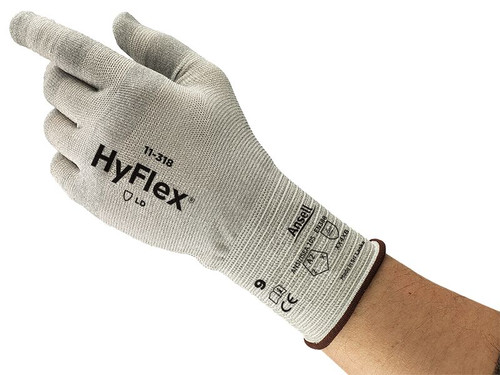
The Ansell HyFlex® 11-318
is a lightweight, 18-gauge,
uncoated industrial safety glove
engineered for tasks requiring
light cut protection
without sacrificing fingertip sensitivity.
It combines Dyneema® Diamond
Technology fibers with a flexible
knitted construction to provide
ANSI A2 / EN ISO B cut resistance
while maintaining a thin,
tactile handling surface.
Unlike palm-coated industrial gloves,
the 11-318 does not use a nitrile,
polyurethane, or latex gripping layer.
This construction is especially
relevant to inspection, finishing,
marking, and precision component
handling applications.
The glove also offers
silicone-free construction,
antistatic characteristics,
touchscreen compatibility,
and manufacturer-listed
OEKO-TEX certification.
These features support
specific industrial requirements
but do not eliminate the need
for a task-specific protective
glove assessment.
Technical Takeaway:
HyFlex 11-318 is designed to
balance tactility,
comfort, light cut protection,
and contamination-sensitive handling.
It is not intended to replace
liquid-barrier gloves,
heavy-duty cut-resistant gloves,
or certified cleanroom gloves.
1. What Makes HyFlex 11-318 Different?
Many industrial cut-resistant
gloves prioritize mechanical
durability, grip, or high
cut ratings at the expense
of glove thickness and
tactile feedback.
HyFlex 11-318 is designed
around a different objective:
delivering sufficient protection
for qualifying light cut hazards
while maintaining a lightweight,
flexible feel suitable for
precision work.
- 18-Gauge Knit: Fine-gauge construction for lightweight handling.
- Uncoated Surface: Preserves textile contact and tactile sensitivity.
- Dyneema Diamond Technology: Provides engineered cut resistance.
- ANSI A2 / EN ISO B: Light cut protection classification.
- Antistatic: Designed with static-control characteristics.
- Silicone Free: Helps address silicone-transfer concerns.
- Touchscreen Compatible: Supports compatible digital production interfaces.
2. Complete HyFlex 11-318 Technical Specifications
- Manufacturer: Ansell
- Product Family: HyFlex
- Model: 11-318
- Primary Function: Light cut protection and precision industrial handling
- Construction: Knitted, uncoated
- Gauge: 18
- Liner Technology: Dyneema® Diamond Technology
- Coating: None
- Cuff: Knit wrist
- Color: Grey
- Cut Resistance, ANSI/ISEA 105-2024: A2
- Cut Resistance, EN ISO: B
- EN 388:2016 + A1:2018: XX4XB
- EN ISO 21420:2020: Listed by Ansell
- EN 16350:2014: Listed by Ansell
- CE Category: II
- Antistatic: Yes
- Silicone Free: Yes
- Latex Free: Yes
- Touchscreen Compatibility: Yes
- OEKO-TEX®: Certification 1408033
- REACH: Compliant
- Available Sizes: 6, 7, 8, 9, 10, 11
- Length: 212-260 mm
- Washing Temperature: 40°C / 104°F
- Packaging: 12 pairs per bag
- Carton: 12 bags
- Total Case Quantity: 144 pairs
Manufacturer Source:
These product characteristics
are based on Ansell's published
HyFlex 11-318 specifications.
Confirm current standards,
sizing, and packaging
documentation when qualifying
gloves for controlled
procurement programs.
3. Understanding 18-Gauge Glove Construction
Knitted industrial gloves
are commonly described
using a gauge designation.
Gauge relates to the
knitting construction and
the fineness of the knit.
A high-gauge construction
generally enables a
thinner, finer textile
compared with many
lower-gauge alternatives,
although yarn type
and glove design
also influence thickness.
In HyFlex 11-318,
the 18-gauge
construction supports
a close fit and
high tactile sensitivity
for tasks involving
small components,
inspection, or marking.
- Fine knit supports fingertip sensitivity.
- Lightweight construction helps maintain flexibility.
- Reduced bulk supports detailed handling.
- Flexible textile helps the glove conform to the hand.
- Thin construction provides less cushioning than some heavier gloves.
- Wear resistance remains dependent on the materials and task.
Selection Principle:
A higher glove gauge
does not automatically
indicate better cut
resistance or longer
service life. Gauge
and protective performance
must be evaluated separately.
4. ANSI/ISEA 105 Cut A2 and EN ISO Cut B Explained
The HyFlex 11-318 is rated
ANSI/ISEA 105 Cut A2
and EN ISO Cut B.
Both standards evaluate
material cut resistance,
but use different
classification frameworks.
ANSI A2 corresponds
to a cut-resistance
classification based
on a standardized
force-to-cut evaluation.
EN ISO B is an
ISO 13997-based
cut-resistance level
reported through
EN 388.
|
Standard
|
Rating
|
Meaning
|
|
ANSI/ISEA 105
|
A2
|
Light cut resistance for qualifying industrial tasks
|
|
EN ISO 13997 / EN 388
|
B
|
Cut classification under the European mechanical glove framework
|
These ratings support use
in qualifying light
mechanical hazards,
including handling parts
with mildly sharp
or rough edges.
They do not establish
suitability for every
sharp object, high-force
cutting operation, or
heavy metal fabrication task.
Safety Interpretation:
Cut resistance is not
cut immunity. Standardized
material testing cannot
reproduce every workplace
sharp-edge hazard or
predict protection
against powered blades.
5. Decoding the EN 388 XX4XB Rating
Ansell lists
EN 388:2016 + A1:2018
XX4XB for
HyFlex 11-318.
The code identifies
the manufacturer's
reported mechanical
performance classification.
|
Position
|
Rating
|
Performance Area
|
|
First
|
X
|
Abrasion performance not reported in this position
|
|
Second
|
X
|
Circular blade cut performance not reported in this position
|
|
Third
|
4
|
Tear resistance classification
|
|
Fourth
|
X
|
Puncture performance not reported in this position
|
|
Letter
|
B
|
ISO cut resistance classification
|
The manufacturer does
not provide a numeric
EN 388 abrasion or
puncture level in
this marking. Those
X positions should
not be assigned
invented values.
Similarly, the EN ISO
cut letter B should
not be confused
with the ANSI A2
designation; they
come from distinct
test and
classification systems.
6. Dyneema Diamond Technology and Lightweight Cut Resistance
HyFlex 11-318 uses
Dyneema® Diamond
Technology in
its knitted liner.
This engineered fiber
technology supports
cut resistance while
allowing the glove
to retain a
thin construction.
Cut-resistant yarns
are selected to
resist damage from
contact with sharp
edges under
controlled conditions.
Fiber properties,
yarn construction,
and knitting design
collectively influence
glove performance.
- High-performance fibers support cut resistance without heavy construction.
- Fine knit helps preserve hand movement and flexibility.
- Engineered yarn strength contributes to cut performance.
- Lightweight material supports repetitive precision tasks.
- Textile integrity must be maintained throughout glove use.
Material Note:
Dyneema Diamond Technology
identifies a featured
liner technology.
It should not
be interpreted
as a complete
quantitative formulation
or proof that
every size contains
identical material proportions.
7. Why an Uncoated Palm Changes Glove Performance
Coated industrial gloves
often use nitrile,
polyurethane, or
other polymers to
improve gripping
characteristics and
contact durability.
An uncoated glove
uses the textile
itself as the
contact surface.
This can improve
tactile feel,
flexibility,
and breathability
for appropriate
dry handling tasks.
|
Uncoated Design Benefit
|
Associated Tradeoff
|
|
High fingertip sensitivity
|
Less coating-assisted grip on wet or oily surfaces
|
|
Lightweight textile construction
|
Less cushioning against contact forces
|
|
Breathable knitted structure
|
No continuous liquid barrier
|
|
No polymer palm coating to shed coating fragments
|
Textile fibers and particles may still be released
|
This design is
therefore best suited
for tasks where
a flexible contact
surface is more
important than
wet grip or
a chemical barrier.
8. Antistatic Properties, EN 16350, and ESD Control
Ansell identifies
HyFlex 11-318 as
antistatic
and lists
EN 16350:2014
among the applicable
glove standards.
Antistatic properties
can be useful
in work areas
concerned with
static charge
accumulation, although
actual electrostatic
protection depends
on the entire
handling environment.
- Verify glove suitability for the facility's ESD control requirements.
- Maintain approved personnel grounding where necessary.
- Use compatible grounded work surfaces and equipment.
- Follow documented handling procedures for sensitive components.
- Do not assume all antistatic gloves provide identical electrical performance.
- Review manufacturer documentation when quantified resistance measurements are required.
ESD Qualification:
Antistatic classification
does not replace
a complete ESD
protection program,
establish universal
compatibility with
every electronic
component, or
provide protection
against electrical
shock.
9. Silicone-Free Construction and Surface Quality
Silicone contamination
can interfere with
certain surface
finishing, painting,
coating, and
bonding procedures.
Ansell highlights
the silicone-free
construction of
HyFlex 11-318
as an advantage
for sensitive
manufacturing environments.
Where silicone-related
surface defects
are a concern,
avoiding an
intentional silicone
component in
the glove may
reduce one possible
contamination source.
- Automotive painted-surface inspection
- Pre-finishing handling
- Component marking and touch-up
- Assembly before selected surface-treatment operations
- Quality inspection of sensitive manufactured parts
Contamination Control:
Silicone-free does
not mean completely
contamination-free.
Glove cleanliness
still depends on
packaging, storage,
handling, environment,
and the manufacturing
process requirements.
10. Low-Lint Considerations vs. Cleanroom Qualification
Low-lint performance
is a practical
consideration when
handling sensitive
parts or performing
final inspection.
Visible fibers
and particles
can affect
product appearance
or process quality.
The uncoated
HyFlex 11-318
avoids polymer
palm-coating fragments,
but it remains
a knitted textile
and may release
fibers and particles
during use.
Neither the standard
manufacturer product
page nor the
published specifications
establish a quantitative
cleanroom particle
release limit
for this glove.
- Evaluate glove cleanliness against the actual production requirement.
- Do not assume uncoated textiles are particle-free.
- Do not substitute industrial gloves for cleanroom-certified gloves without process approval.
- Protect gloves from handling contamination before use.
- Inspect for shedding, visible lint, wear, or damage.
- Use application-specific cleanliness validation when required.
Important Distinction:
HyFlex 11-318
is not identified
by Ansell as
a sterile or
ISO-classified cleanroom
glove. Its industrial
suitability should
not be interpreted
as a cleanroom
qualification.
11. Touchscreen Compatibility and Production Workflow
Touchscreens have
become common
across production
areas, inspection
stations, and
manufacturing
quality systems.
HyFlex 11-318
is designed for
touchscreen compatibility,
helping operators
interact with
supported devices
without repeatedly
removing gloves.
- Production tablets
- Touchscreen manufacturing terminals
- Digital inspection systems
- Electronic work instructions
- Quality documentation interfaces
- Compatible warehouse and production devices
Touchscreen performance
can vary by
device, screen
technology, glove
fit, and operating
conditions. Test
the glove with
the equipment
used at
the workstation.
12. OEKO-TEX, REACH, and General PPE Compliance
Ansell identifies
HyFlex 11-318
as OEKO-TEX
certified and
REACH compliant.
The manufacturer's
OEKO-TEX reference
is 1408033.
Ansell also lists
EN ISO
21420:2020
and CE
Category II
for the glove.
-
OEKO-TEX:
Supports evaluation
of regulated and
potentially harmful
substances in
textile products.
-
REACH:
Addresses applicable
European chemical
substance requirements.
-
EN ISO 21420:
General requirements
for protective gloves.
-
CE Category II:
PPE category
appropriate to
the manufacturer's
declared protection
scope.
Certification Scope:
General PPE and
textile certifications
do not establish
chemical barrier
performance, sterile
packaging, medical
glove status,
or an ISO
cleanroom classification.
13. Sizing, Fit, and Glove Length
HyFlex 11-318
is manufactured
in numeric sizes
6 through 11,
with length ranging
from approximately
212 to
260 mm
depending on
the glove size.
Fit influences
fingertip control,
mobility, comfort,
and how the glove
performs during
repetitive handling.
- Oversized: May reduce precise fingertip control.
- Undersized: May restrict movement and cause discomfort.
- Correct Fit: Should permit comfortable finger articulation without excessive material.
- Size Selection: Use the current Ansell sizing instructions.
- Length: Verify required wrist coverage for the work task.
For industrial
precision tasks,
workers should
evaluate actual
fit and dexterity
rather than selecting
a glove solely
from an approximate
letter-size conversion.
14. Packaging, Receiving, and Inventory Control
Ansell specifies
12 pairs
per bag
and 12 bags
per carton
for HyFlex 11-318.
This equals
144 pairs
per case,
matching the
SOSCleanroom case
configuration.
- Manufacturer Model: 11-318
- Bag Quantity: 12 pairs
- Bags Per Carton: 12
- Total Case Quantity: 144 pairs
- Sizes: 6, 7, 8, 9, 10, 11
- Receiving Check: Confirm product, selected size, and case quantity.
- Storage: Protect from damage, contamination, and conditions outside manufacturer guidance.
Purchasing Note:
Always specify
the correct
glove size
when ordering
a 144-pair case.
The case quantity
does not indicate
an assortment
of sizes.
15. Washing, Inspection, and Replacement
Ansell lists a
washing temperature
of 40°C
(104°F)
for HyFlex 11-318.
Cleaning and reuse
should follow
the current
manufacturer instructions
and the workplace
hygiene program.
Washing temperature
alone does not
establish an
unlimited number
of wash cycles
or guarantee
that a glove
retains its
original performance
after repeated use.
- Inspect for holes, tears, thinning, or broken yarns.
- Check fingertips and high-contact areas for wear.
- Replace gloves contaminated by substances they are not designed to resist.
- Do not continue use when protective integrity is in doubt.
- Follow manufacturer washing and drying guidance.
- Requalify reusable gloves where the work process requires documented performance.
- Never assume visually clean gloves remain suitable for contamination-sensitive operations.
16. Critical Use Limitations and Hazard Matching
HyFlex 11-318
is designed for
light mechanical
cut hazards and
precision handling.
Its construction
imposes important
limits when
hazards involve
chemical contact,
wet gripping,
severe sharp edges,
or moving machinery.
|
Hazard or Task
|
Limitation
|
|
Chemical Handling
|
Uncoated textile has no continuous liquid barrier.
|
|
Wet or Oily Grip
|
No specialized polymer grip coating.
|
|
Severe Cut Hazards
|
ANSI A2 / EN ISO B may be insufficient for higher-risk exposure.
|
|
Needles or Sharp Puncture Hazards
|
No quantified puncture protection established in the listed EN 388 marking.
|
|
High Heat and Flame
|
Not a thermal-protective glove.
|
|
Moving Blades or Rotating Equipment
|
Cut resistance does not protect against powered cutting or entanglement.
|
|
Sterile or Critical Cleanroom Use
|
No sterile or ISO cleanroom glove qualification established.
|
Safety Principle:
Select gloves
for the actual
hazard and required
task performance.
An ANSI A2
designation does
not guarantee
protection from
every cutting
injury or
powered blade.
17. Selecting HyFlex 11-318 vs. Other Ansell Models
HyFlex 11-318
is particularly
useful when
the primary
requirement is
light cut
protection with
excellent tactile
sensitivity.
Other gloves
may be more
suitable when
grip, coating
durability, or
higher cut
protection is
required.
-
HyFlex 11-318:
18-gauge uncoated
ANSI A2 / EN ISO B
glove for
precision handling.
-
HyFlex 11-819:
Foam-nitrile-coated
alternative for
selected precision
handling and
ESD-oriented workflows.
-
HyFlex 11-561:
Nitrile-coated
cut-resistant glove
with ANSI A3
protection for
qualifying higher-cut
mechanical tasks.
-
HyFlex 11-735:
Polyurethane-coated
cut-resistant glove
for applications
requiring a
different grip
and protection
profile.
-
HyFlex 11-550:
Nitrile-foam-coated
industrial glove
for abrasion-focused
handling applications.
Selection Takeaway:
The optimal glove
is not always
the model with
the highest
cut rating.
Tactility, coating,
grip, protection,
process cleanliness,
and user comfort
must all be
matched to
the application.
18. Frequently Asked Questions
What is the Ansell HyFlex 11-318?
An uncoated
18-gauge industrial
cut-resistant glove
designed for
lightweight precision
handling and inspection.
What cut rating does the 11-318 have?
ANSI/ISEA 105
Cut A2 and
EN ISO Cut B.
Is HyFlex 11-318 coated?
No. It is
a knitted,
uncoated glove.
What gauge is the glove?
18 gauge.
What is the primary cut-resistant fiber technology?
Dyneema®
Diamond Technology.
What does EN 388 XX4XB mean?
The code lists
a tear-resistance
level of 4
and an ISO
cut level B.
The three X
positions represent
performance values
not reported
in those positions.
Is the glove touchscreen compatible?
Yes, according
to Ansell.
Device performance
may vary.
Is HyFlex 11-318 silicone free?
Yes. Ansell
lists silicone-free
construction.
Is HyFlex 11-318 antistatic?
Yes. Ansell
lists antistatic
performance and
EN 16350:2014.
The glove must
still be assessed
against site
ESD requirements.
Is HyFlex 11-318 latex free?
Yes, according
to Ansell's
product specifications.
Is the glove OEKO-TEX certified?
Yes. Ansell
lists OEKO-TEX
certification 1408033.
Is the glove sterile?
No sterile
product designation
is established
by the manufacturer's
industrial glove
listing.
Is HyFlex 11-318 ISO cleanroom classified?
No ISO cleanroom
suitability classification
is established
by the manufacturer's
published product
specifications.
Can HyFlex 11-318 protect against chemicals?
It is not
designed as
a chemical-barrier
glove. Select
certified chemical
protection for
chemical exposure.
Is HyFlex 11-318 suitable for oily handling?
It does not
have a specialized
oil-grip coating.
Select a
suitable coated
glove where
oily gripping
performance is
required.
What sizes are available?
Numeric sizes
6, 7, 8,
9, 10, and 11.
What is the glove length?
Approximately
212-260 mm,
depending on size.
Can the glove be washed?
Ansell lists
a washing temperature
of 40°C.
Follow the
manufacturer instructions
for cleaning,
reuse, and
performance assessment.
How many pairs are in a case?
144 pairs,
packaged as
12 bags of
12 pairs each.
What industries commonly use this glove?
Ansell lists
automotive and
machinery/equipment
manufacturing,
particularly
inspection, assembly,
handling sharp-edged
components, and
maintenance.
19. Manufacturer Documentation and Technical References
-
Ansell HyFlex 11-318 Official Product Page:
View Manufacturer Specifications
-
Ansell HyFlex 11-318 Product Data Sheet:
View Manufacturer Datasheet
-
SOSCleanroom HyFlex 11-318 Product Listing:
View SOSCleanroom Product
-
EN 388:2016 + A1:2018:
Mechanical protective glove
performance framework.
-
ANSI/ISEA 105-2024:
Industrial hand-protection
performance classification.
-
EN ISO 21420:2020:
General protective
glove requirements.
-
EN 16350:2014:
Electrostatic properties
of protective gloves.
Documentation Note:
Manufacturer standards
and classifications
should be reviewed
using current product
documentation. Do
not infer unreported
abrasion, puncture,
chemical, or
cleanroom ratings
from other protective
characteristics.
Why Source Ansell HyFlex Gloves Through SOSCleanroom?
-
Ansell Product Selection:
Support identifying
the proper model
for industrial
hand-protection needs.
-
Technical Documentation:
Assistance locating
manufacturer product
and standards
information.
-
Size Selection:
Product configurations
available across
manufacturer-listed sizes.
-
Case Purchasing:
Standard 144-pair
packaging supports
recurring industrial
glove supply.
-
Application Comparison:
Assistance comparing
uncoated, nitrile-coated,
and polyurethane-coated
industrial gloves.
-
Direct Support:
SOSCleanroom can
assist with
ordering and
product questions.
Questions? Email Sales@SOSsupply.com
or call (214) 340-8574.
For additional product guidance,
explore the SOSCleanroom product
catalog and contact our team
for manufacturer documentation.
Safety Disclaimer:
Industrial glove ratings
describe standardized
laboratory performance.
They do not
eliminate workplace
hazards or replace
a task-specific
PPE assessment.
Refer to current
Ansell instructions
and employer
safety procedures.
Content updated:
October 2026
© 2026 Specialty Optical Systems, Inc.
(dba SOSCleanroom). All rights reserved.