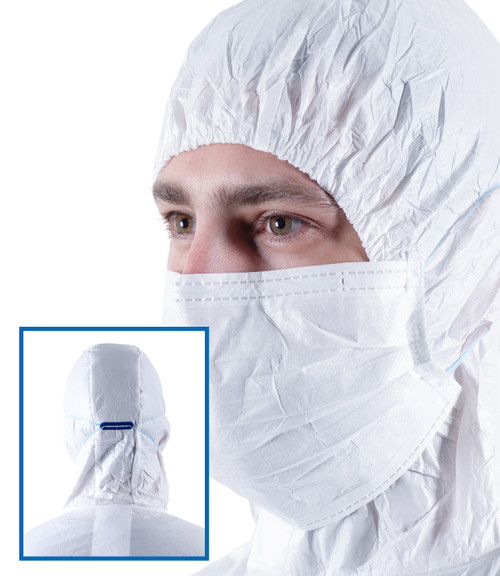
SKU shown: MTA210-1 (sterile tie-on facemask; 500/case).
Why cleanroom masks matter more than most teams admit
In critical environments, the facemask is not “just PPE.” It is a contamination-control barrier intended to reduce droplet and particle shedding from the operator into sensitive zones.
Mask performance depends on two factors: (1) a product that is engineered, processed, and supplied with the documentation your program expects, and (2) a gowning method that prevents the operator from contaminating the mask (and the clean area) during donning and use.
Ansell BioClean™ MTA210-1 is positioned for that reality: sterile supply via gamma irradiation (SAL 10-6), cleanroom-processed manufacturing, and a tie-on format that supports secure, repeatable fit when trained correctly.
What this product is used for
- Sterile and aseptic environments where a sterile facemask is specified by SOP and gowning qualification.
- ISO Class 4 / Class 10 cleanrooms and critical work zones that limit operator droplet/particle contribution.
- EU GMP Annex 1 programs (sterile medicinal products) where gowning expectations include sterile facemask use in Grade A/B contexts.
- Laboratory and research controlled environments seeking standardized packaging and documented sterility.
Why customers select MTA210-1
- Sterile, documented supply: gamma irradiation with stated minimum dose (25 kGy) and SAL 10-6, plus shelf life and storage guidance.
- Controlled processing: processed in a NEBB-certified ISO Class 4 cleanroom (manufacturer stated) to reduce contamination risk.
- Tie-on fit control: head ties support secure placement and can reduce ear/loop variability in some users.
- Cleanroom-compatible build: ultrasonically sealed edges and enclosed noseband are intended to support integrity and consistent fit.
- Program continuity: SOSCleanroom’s long-standing distributor relationship with Ansell supports stable supply. Our record includes multiple distribution awards, including 11 Texas Instruments Supplier Excellence Awards.
Materials, composition, and build
Manufacturer-stated material is polypropylene / polyethylene, with a layered construction:
inner facing layer (non-woven PP/PE; hygroscopic), filtration layer (meltblown polyester), and outer layer (non-woven spunbonded polyester; hydrophobic).
The noseband is plastic coated steel and is described as fully enclosed and malleable for fit control.
The edges are ultrasonically sealed and the fastening system uses non-woven polypropylene ties, supporting a tie-on gowning approach.
Packaging is 1 mask per sealed inner PE bag, supporting controlled dispensing and reduced handling exposure during entry.
Specifications in context (manufacturer datasheet basis)
The table below consolidates attributes that typically matter for cleanroom receiving, SOP alignment, and gowning consistency.
| Attribute |
MTA210-1 |
| Part / reorder number | MTA210-1 |
| Type | Sterile tie-on face mask |
| Cleanroom class (stated) | Class 10 / ISO 4 & EU GMP Grade A |
| Sterilization | Gamma irradiation; minimum dose 25 kGy |
| SAL | 10-6 |
| Standards (stated) | ASTM F2101, ISO 2859 |
| Dimensions | 210 mm (W) x 95 mm (H) ± 5 mm |
| Fastening | Ties (head-tie) |
| PFE | 89.3% @ 0.1 micron |
| BFE | 92.3% @ 0.3 micron |
| VFE | 93.8% @ 3.0 micron |
| Differential pressure | 3.8 mm H2O/cm2 |
| Packaging | 1/inner PE bag; 50 inner/outer PE bag; 10 outer/lined carton (500) |
| Shelf life | 5 years from date of manufacture |
| Storage | Dry, cool (<40°C), away from sunlight/fluorescent light |
| Country of origin | China |
Performance and cleanliness considerations
For facemasks in cleanrooms, “performance” is not only filtration values. It also includes: packaging discipline, sterilization documentation, fit repeatability, and operator technique.
A highly specified mask can still fail contamination control if users touch the mask body while donning, wear it under the nose, or repeatedly adjust it mid-task.
The manufacturer lists filtration performance values (PFE/BFE/VFE) and differential pressure as a breathability indicator.
Treat these values as product-specific test outcomes under the stated test basis; your facility SOP and risk assessment determine suitability for your exact process.
Packaging, sterility, traceability, and receiving checks
- Sterility basis: gamma irradiation; SAL 10-6; minimum dose 25 kGy (manufacturer stated).
- Packaging discipline: 1 mask per sealed inner PE bag supports controlled dispensing; verify inner/outer packaging integrity at receiving and at point-of-use.
- Storage alignment: maintain dry/cool storage (<40°C) away from sunlight and fluorescent light as stated.
- Shelf-life control: confirm expiry/lot controls using your internal receiving procedure and documentation requirements.
Cleanroom gowning (donning) education — ISO first, then EU GMP Annex 1
ISO context (ISO 14644 series)
- ISO 14644-1: defines cleanroom classification by airborne particle concentration (your “ISO Class” language lives here).
- ISO 14644-5: addresses cleanroom operations and reinforces that behaviors, gowning, and movement control are core contamination-control tools.
- Practical translation: the mask must be donned in a way that avoids contaminating the mask and prevents repeated adjustments that shed particles into airflow paths.
EU GMP Annex 1 context (sterile medicinal products)
Annex 1 adds explicit gowning expectations for sterile manufacturing. In Grade B (including access/interventions into Grade A), Annex 1 specifies sterile headgear to enclose all hair and states that a sterile facemask and sterile eye coverings should be worn to cover and enclose all facial skin to prevent shedding of droplets and particles.
This is why mask selection and mask donning discipline are treated as process controls, not personal preferences.
Always apply your site CCS/SOP, gowning qualification rules, and replacement frequency requirements.
Technique guidance: tie-on mask donning that reduces contamination risk
- Hand hygiene: sanitize/wash hands per SOP; don required under-garments as specified.
- Open sterile packaging cleanly: avoid dragging the mask over benches or clothing; keep inner surface protected.
- Handle only by ties: do not touch the mask body. Position over nose and under chin.
- Tie correctly: upper ties first (crown), lower ties second (neck). Confirm even tension and full coverage.
- Mold the noseband: shape the enclosed noseband to minimize gaps and reduce fogging of goggles.
- Avoid adjustments in the clean zone: repeated mask touches are a common contamination failure mode.
- Replace when compromised: if wet, damaged, or touched/adjusted excessively, replace per SOP.
This mask supports contamination control only when the entire gowning system is controlled: correct change-room sequencing, validated garments, qualified operators, and disciplined movement.
Treat the mask as a critical component of your personnel contamination barrier.
Common failure modes (what drives contamination despite “good products”)
- Touching the mask body during donning: handle by ties only.
- Wearing below the nose / incomplete chin coverage: defeats droplet containment intent.
- Loose ties or poor nose fit: increases leakage and prompts repeated adjustments.
- Reusing single-use masks: increases contamination risk and breaks documentation discipline.
- Ignoring “wet mask” replacement: moisture changes barrier behavior and promotes handling.
Closest alternatives (same program family)
Closest alternatives are typically other sterile cleanroom mask formats that match your gowning method (ties vs loops) and documentation needs.
Compare packaging discipline, sterility method/SAL basis, and operational fit (fogging, comfort, adjustment frequency).
- Ansell MEA210-1 (looped): same general program with ear-loop format for faster donning in some workflows.
- Ansell BDBS (DB pouch-style): alternate sterile mask format used in Class 10 / ISO 4 programs.
- Ansell BDBS-G (neck guard): adds neck coverage in applications that require broader facial/neck barrier control.
Critical environment fit
MTA210-1 is best suited for controlled environments where sterile mask supply and documented processing are part of the contamination control strategy.
It is commonly selected when the operation wants repeatable packaging, defined storage/shelf-life controls, and a tie-on fit method aligned to gowning qualification.
SOSCleanroom note about SOPs
The Technical Vault is written to help customers make informed contamination-control decisions and improve day-to-day handling technique.
It is not your facility’s Standard Operating Procedure (SOP), Contamination Control Strategy (CCS), batch record, or validation protocol.
Customers are responsible for establishing, training, and enforcing SOPs that fit their specific risks, products, equipment, cleanroom classification, and regulatory obligations.
Always confirm material suitability, sterility requirements, acceptance criteria, and replacement frequency using your internal quality system and documented methods.
If you adapt any technique guidance from this entry, treat it as a starting template. Your team should review and approve the final method, then qualify it for your specific cleanroom grade,
airflow patterns, process risks, and contamination limits. Use best-practice suggestions to strengthen SOPs—not to replace them.
Source basis (priority: manufacturer datasheets)
- Manufacturer Product Data Sheet (Ansell BioClean MTA210-1): https://www.soscleanroom.com/content/Ansell_PDF/bioclean-sterile-tie-on-face-mask-mta210-1_pds_us.pdf
- SOSCleanroom product page (MTA210-1): https://www.soscleanroom.com/product/brands/ansell-mta210-1-bioclean-sterile-tie-on-face-mask-class-10-iso-4/
- ISO 14644-1 (classification context): https://www.iso.org/standard/53394.html
- ISO 14644-5 (operations context): https://www.iso.org/standard/33445.html
- EU GMP Annex 1 (sterile manufacturing gowning context): https://health.ec.europa.eu/system/files/2022-08/20220825_gmp-an1_en_0.pdf
SOSCleanroom is the source for this Technical Vault entry.
Briefed and approved by the SOSCleanroom (SOS) staff.
If you have any questions please email us at Sales@SOSsupply.com
If you need additional information please try our SOSCleanroom specific AI ChatBot which draws from our extensive cleanroom specific libraries.
Last reviewed: Jan. 13, 2026
© 2026 SOSCleanroom