Why garments matter in ISO 4 / Grade A/B environments
In high-grade cleanrooms, people are a dominant contamination source: particles and fibers from skin, hair, clothing, and movement.
A coverall is not just “PPE” — it is a core contamination-control barrier intended to reduce shedding, limit exposed surfaces, and stabilize day-to-day behavior in the gowning program.
S-BDCHT is positioned for sterile operations where consistency, packaging discipline, and documented sterility matter as much as comfort.
What S-BDCHT is used for
- Sterile change-room gowning for EU GMP Grade A/B and ISO Class 4 cleanrooms.
- Aseptic processing, sterile manufacturing, and critical interventions where sterile garments are required by SOP/CCS.
- Controlled environments seeking a disposable, low-linting, antistatic coverall platform with published test basis.
- Programs that need double-bagged sterile packaging and a defined shelf life for receiving and audit readiness.
Why customers consider this garment
- Sterile and documented: gamma irradiated (25 kGy) with SAL 10-6 and defined shelf life to support sterile gowning programs.
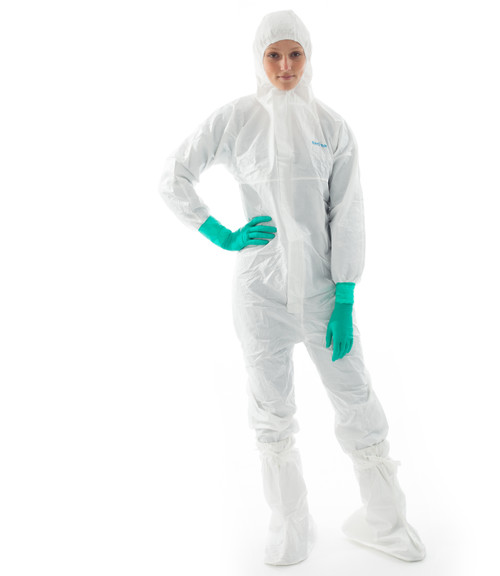
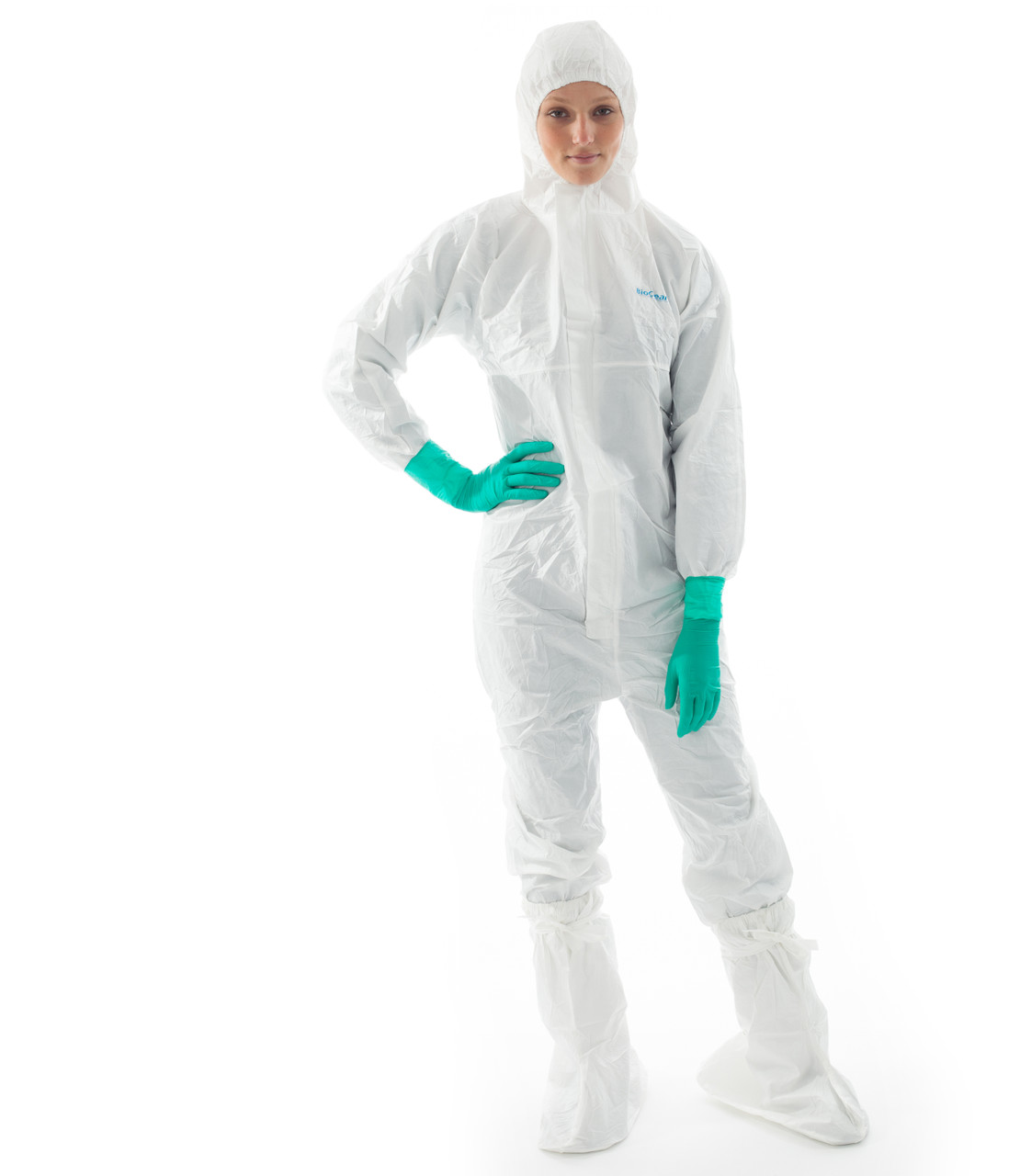
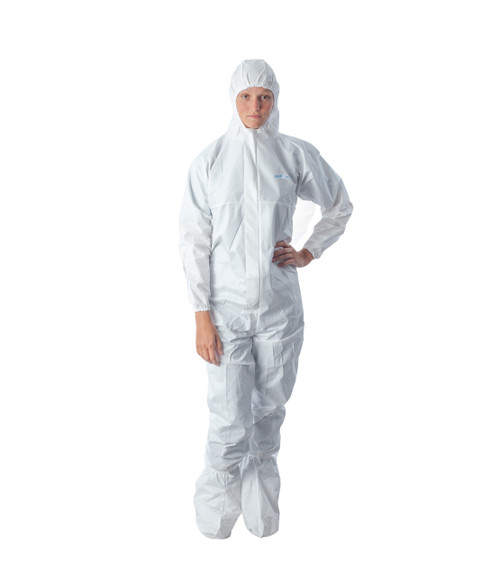
- Interface control features: thumb loops and elasticated hood/cuffs/ankles help reduce exposed gaps as operators move.
- Reduced leakage pathways: zip with sealable cover plus a protective flap is designed to help reduce seam/closure leakage risks.
- Low-linting + antistatic platform: CleanTough™ material and published test basis support controlled-environment use.
- Cleanroom-ready packaging: double-bag sterile presentation supports controlled entry and staged gowning workflows.
Materials and construction
The BioClean-D™ CleanTough™ fabric is a laminate with a polyethylene film outer layer and a
non-woven polypropylene inner layer, published at 60 gsm.
The garment is described with bound seams with single needle stitching and a closure design that includes a
zip with sealable cover plus a protective flap.
Fit and retention features include an elasticated hood, back, cuffs, and ankles plus thumb loops.
In practice, these features aim to stabilize coverage and reduce sleeve ride-up at the glove interface — a common weak point in gowning discipline.
Specifications in context
The table below consolidates manufacturer-published attributes most relevant to cleanroom receiving, gowning SOP alignment, and sterile entry discipline.
| Attribute |
S-BDCHT (Sterile) |
| Product |
BioClean-D™ Coverall with Hood — Sterile |
| Material |
CleanTough™ (PE film outer / PP non-woven inner) |
| Cleanroom class |
Class 10 / ISO Class 4; EU GMP Grade A/B |
| Sterilization / sterility assurance |
Gamma irradiation (25 kGy minimum dose); SAL 10-6 |
| Packaging (sterile) |
1 per sealed inner PE bag; inner bag in sealed outer PE bag; 20 per lined carton (some sizes 15/carton) |
| Shelf life |
Three (3) years from date of manufacture |
| Country of origin |
China |
| Construction |
Bound seams with single needle stitching |
| Coverage/fit features |
Elasticated hood/back/cuffs/ankles; thumb loops; zip with sealable cover; protective flap |
Cleanliness, static, and barrier considerations
For cleanrooms, two garment behaviors drive outcomes: (1) how much it sheds when the operator moves, and (2) how well it maintains coverage at interfaces (hood/neck, wrists/gloves, ankles/footwear, and zipper/closure).
Manufacturer-published test basis for the platform includes a Helmke Drum particle shedding result of < 2000 counts/min (≥ 0.5 µm) and static-dissipative performance with a published charge half decay time of 0.07 seconds.
Important limitation (always true in cleanrooms)
Fabric test results are achieved under controlled laboratory conditions. Seams, closures, and real-world wear can change performance.
For chemical or cytotoxic exposure risks, garments must be selected specifically for the chemicals used and the validated method in your facility.
Sterility, packaging integrity, and receiving discipline
Sterile garments only remain “sterile” if packaging and handling discipline stay intact. For S-BDCHT, the sterile presentation is one piece per sealed inner PE bag, with that inner bag sealed inside an outer PE bag.
At receiving and prior to gowning, visually confirm that packaging is intact and that the garment is within shelf life. Treat any compromised package as nonconforming per your quality system.
For sterile change-room workflows, double-bag packaging supports staged opening: remove the outer bag in a lower-grade step, then introduce the inner sterile bag to the higher-grade gowning stage per SOP.
Gowning (donning) education — ISO first, then EU Annex 1
ISO baseline: what “good gowning” is trying to accomplish
- ISO 14644-1 (classification): defines air cleanliness classes by airborne particle concentration — the target you are protecting during operations.
- ISO 14644-5 (operations): expects an Operations Control Programme (OCP) that includes personnel management and a gowning program, plus entry/exit control, cleaning, maintenance, and monitoring.
- Practical takeaway: gowning is not a wardrobe step; it is an operational control that stabilizes people-driven contamination so your ISO class stays defensible.
Sterile coverall donning checklist (operator-focused)
- Stage your entry: move from lower to higher cleanliness steps (airlocks/change rooms) without backtracking.
- Control personal items: remove jewelry/watches; avoid cosmetics and personal electronics in clean areas unless your program explicitly qualifies them.
- Don “inside-out” where possible: handle the garment by interior surfaces and avoid touching the exterior.
- Close, lock, and seal: zip fully, lock the zipper, and apply the sealable zip cover per the manufacturer IFU and your SOP.
- Protect interfaces: keep cuffs under gloves and use thumb loops to reduce sleeve ride-up. Ensure ankles remain covered by approved footwear/boot covers.
- Final check: confirm hood fit (no hair exposure), zipper fully covered, and no tears/defects before entering the higher-grade zone.
EU GMP Annex 1 overlay: what sterile manufacturers are expected to enforce
- Training + gowning qualification: personnel entering Grade A/B should be trained for aseptic gowning and behavior, with assessment and periodic reassessment.
- Written procedure: gowning and handwashing should follow a written procedure designed to minimize contamination transfer to clean areas.
- Garment integrity checks: garments should be visually checked for cleanliness and integrity immediately prior to and after gowning; sterile garment packaging should be visually inspected for integrity before use.
- Change-room design: staged personnel airlocks of increasing cleanliness and (ideally) separate change rooms for entering/leaving Grade B are recommended where risk is high.
Manufacturer handling note (always applicable): follow the published IFU for closure sealing and removal technique. IFU guidance for the platform includes fully zipping, locking the zipper, sealing the zip cover, and removing garments carefully (often turning inside-out) to trap contamination.
Common gowning failure modes (and how to prevent them)
- Exposed zipper/closure: always seal the zip cover fully; do not enter higher-grade space with a partially covered closure.
- Sleeve ride-up at gloves: use thumb loops and verify glove overlap; apply taping only per SOP.
- Hood gaps/hair exposure: confirm hood fit before final entry; avoid adjusting hood once gloved in higher-grade areas.
- Touching exterior surfaces: don from interior contact points and avoid “patting down” the garment in the clean zone.
- Compromised sterile packaging: treat damaged bags as nonconforming; do not “use anyway.”
Closest alternatives (comparison logic)
Comparable products are other sterile, low-linting coveralls with hood intended for ISO 4 / Grade A/B programs.
When comparing, prioritize: sterility method + SAL, double-bag discipline, particle shedding basis, static performance, interface control features, size availability, and documentation sets (PDS/IFU/DoC).
Critical environment fit for S-BDCHT
S-BDCHT is best suited for sterile environments where the gowning program is treated as an operational control — with staged entry, trained operators, documented garment handling, and routine integrity checks.
If your cleanroom classification, risk profile, and CCS require sterile garments with double-bag entry and published test basis, S-BDCHT aligns well with those expectations.
SOSCleanroom note about SOPs
The Technical Vault is written to help customers make informed contamination-control decisions and improve day-to-day handling technique.
It is not your facility’s Standard Operating Procedure (SOP), batch record, or validation protocol.
Customers are responsible for establishing, training, and enforcing SOPs that fit their specific risks, products, equipment, cleanroom classification, and regulatory obligations.
Always confirm suitability, sterility requirements, compatibility, and acceptance criteria using your internal quality system and documented methods.
If you adapt any technique guidance from this entry, treat it as a starting template. Your team should review and approve the final method, then qualify it for your specific process and risk profile.
Source basis (manufacturer + standards)
- SOSCleanroom product page (S-BDCHT): https://www.soscleanroom.com/product/brands/ansell-s-bdcht-bioclean-d-sterile-coverall-with-hood-class-10-iso-4/
- Ansell Product Data Sheet (PDS) — S-BDCHT: https://www.soscleanroom.com/content/Ansell_PDF/bioclean-d-coverall-with-hood-sterile-s-bdcht_pds_us.pdf
- BioClean-D Fabric TDS: https://www.soscleanroom.com/content/Ansell_PDF/BioClean%20D_Fabric_TDS.pdf
- Garment IFU (Type 5/6): https://www.soscleanroom.com/content/Ansell_PDF/Type56%20Full%20Body%20Garment%20IFU.pdf
- EU Declaration of Conformity (Single Use Garments): https://www.soscleanroom.com/content/Ansell_PDF/Ansell_BioClean_Single%20Use%20Garments_DoC.pdf
- ISO 14644-1 (classification context): https://www.iso.org/standard/53394.html
- ISO 14644-5 (operations context): https://www.iso.org/standard/88599.html
- EU GMP Annex 1 (sterile manufacturing expectations): https://health.ec.europa.eu/system/files/2022-08/20220825_gmp-an1_en_0.pdf
SOSCleanroom is the source for this Technical Vault entry.
Briefed and approved by the SOSCleanroom (SOS) staff.
If you have any questions please email us at Sales@SOSsupply.com
If you need additional information please try our SOSCleanroom specific AI ChatBot which draws from our extensive cleanroom specific libraries.
Last reviewed: Jan. 13, 2026
© 2026 SOSCleanroom