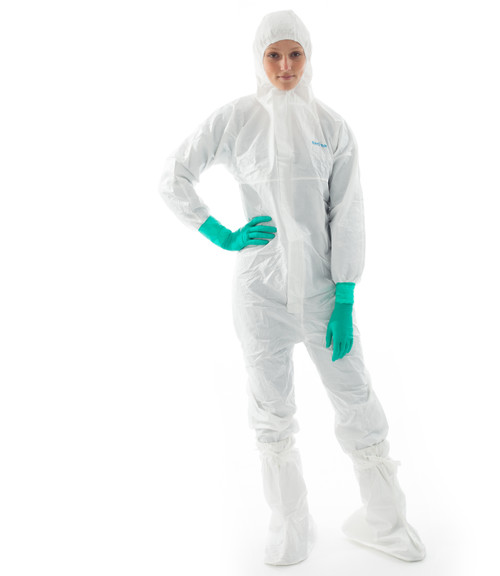
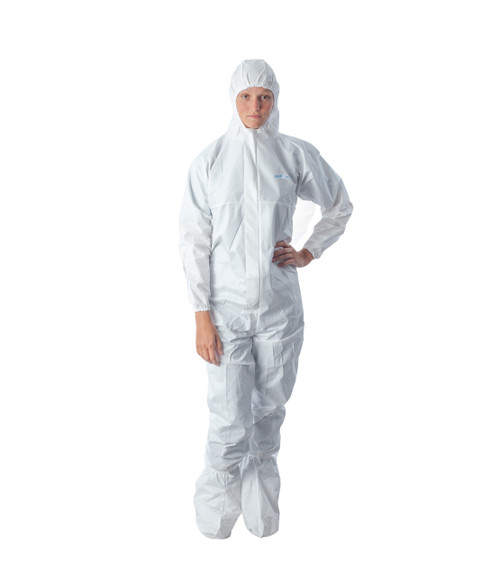
SKU shown: S-BDSH (sterile drop-down coverall with hood; “safe-touch” tabs highlighted in blue).
Why gowning matters more than people think
In controlled environments, the largest moving contamination source is usually the operator. Cleanroom garments exist to reduce the release and transfer of particles
from skin, hair, and clothing into critical zones. However, garment selection is only half the battle: gowning technique (donning),
touch-point discipline, and entry/exit control often determine whether the garment helps or becomes a contamination vector.
S-BDSH is built around this reality: its drop-down design and internal “safe-touch” cues are engineered to make aseptic donning easier to execute consistently.
What S-BDSH is (and what makes it different)
BioClean-D™ S-BDSH is a sterile, disposable cleanroom coverall with hood designed for ISO Class 4 / EU GMP Grade A/B and similar sterile environments.
Ansell’s manufacturer sheet emphasizes three aseptic-donning controls:
- Drop-down design technology: intended to prevent needless external surface contact during gowning.
- Internal colored tabs: indicate safe touch points so hands can avoid the garment exterior.
- Quick-release press-stud tabs: help facilitate controlled donning steps without “grabbing” the garment body.
ISO standards first: how ISO cleanrooms frame gowning
ISO cleanrooms are classified by airborne particle concentration (ISO 14644-1), and then maintained through an operations control programme (ISO 14644-5).
ISO 14644-5 explicitly calls for a personnel management programme that includes a gowning programme, along with training, controlled entry/exit,
cleaning, and monitoring — because “wearing the right suit” does not compensate for inconsistent technique.
ISO-aligned donning principles (practical, high-impact)
- Reduce touch points: treat the garment exterior as “dirty until proven otherwise” during donning. Use safe-touch tabs where provided.
- Sequence is a control: standardize the order of hair cover/hood, coverall, gloves, and interface sealing so every operator repeats the same method.
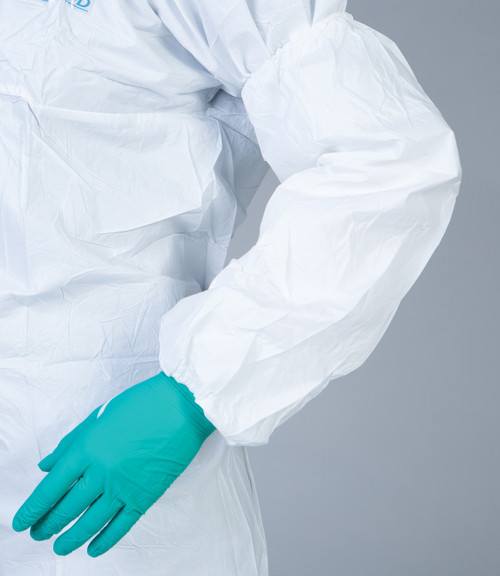
- Interfaces are the leak paths: wrist/glove and ankle/footwear joins are common particle escape zones if overlap is poor or movement exposes skin.
- Move like a cleanroom operator: slow, deliberate motions reduce pumping of particles and prevent fabric snagging against benches or doors.
EU Annex 1 next: what changes for Grade A/B operations
In EU GMP sterile manufacturing (Annex 1), expectations increase around personnel qualification and demonstrated aseptic technique.
Annex 1 emphasizes restricting unsupervised access to Grade A/B aseptic areas to appropriately qualified personnel who have passed a gowning assessment
and have participated in a successful aseptic process simulation (APS). This makes gowning competency a formal control, not an informal “training topic.”
Materials, sterility, and ESD considerations
S-BDSH is manufactured from CleanTough™ material (polyethylene/polypropylene laminate) and supplied sterile via gamma irradiation (minimum 25 kGy).
The IFU for Type 5/6 garments highlights closure discipline: zip fully, lock the zipper, and seal the zipper cover per the instructions.
For full protection, compatible gloves/facemask/footwear are used per SOP; the IFU also notes taping joins where required by the protective system or process.
Antistatic/ESD note: the garment is described as static dissipative, and the IFU warns that electrostatic protective clothing requires proper grounding and must not be removed
in flammable/explosive atmospheres. In cleanrooms, ESD controls should be aligned to your facility’s ESD program (flooring, footwear, wrist straps, grounding checks) and risk assessment.
Specifications (manufacturer consolidated)
| Attribute |
S-BDSH |
| Garment type | Sterile drop-down cleanroom coverall with hood |
| Material | CleanTough™ (PE/PP laminate) |
| Cleanroom suitability | Class 10 / ISO 4 & EU GMP Grade A/B (and other sterile cleanrooms) |
| Sterilization | Gamma irradiation; minimum dose 25 kGy |
| Sterility assurance | SAL 10-6 |
| Shelf life | Three (3) years from date of manufacture |
| Particle shedding (Helmke Drum) | ≥ 0.5 µm < 2000 counts/min |
| Construction | Bound seams; single needle stitching |
| Fit controls | Elasticated back/hood/cuffs/ankles; thumb loops |
| Country of origin | Malaysia |
| Packaging |
1 piece per sealed inner PE bag; 1 inner bag per sealed outer PE bag; 20 pieces per lined carton (standard).
Sizes XXXL–8XL: 15 pieces per carton (manufacturer note).
|
Donning (gowning) technique — practical steps that reduce contamination
Aseptic donning checklist (adapt to your SOP)
- Pre-gown: remove jewelry and personal items; confirm you are in the correct gowning zone and traffic flow direction.
- Hand hygiene: perform per site method; dry fully before touching sterile packaging.
- Open without contaminating: open the outer bag first; present the inner sterile bag per your sterile transfer practice.
- Use safe-touch points: on S-BDSH, prioritize the internal colored tabs and quick-release tabs to control the garment without grabbing the exterior.
- Legs first, controlled motion: step into legs carefully; avoid sweeping the garment against the floor or benches; stand slowly to reduce pumping.
- Arms, then hood: insert arms while keeping hands on safe-touch points; pull hood into position without contacting face/skin.
- Close and seal: zip fully, lock the zipper, and seal the zipper cover per the IFU (do not leave gaps at the closure).
- Interface control: ensure glove/garment overlap remains intact; use thumb loops as intended; tape joins only if required by your SOP / risk assessment.
- Final check: confirm no exposed skin at wrists/neckline; confirm mobility without pulling cuffs/ankles up.
Doffing (removal) discipline: remove carefully and turn the garment inside out to trap contamination, then dispose per facility waste rules.
Never “snap” the garment off; rapid motion aerosolizes particles and can spread contamination into the gowning area.
Common failure modes (what to coach and audit)
- Touching the exterior during donning: defeats the point of sterile packaging — use safe-touch tabs and slow movements.
- Unsealed front closure: zipper not fully closed/locked or flap not sealed per IFU creates a direct particle pathway.
- Poor glove interface: wrists exposed during reach/bend; correct sizing and thumb-loop use reduce this risk.
- Incorrect size selection: too tight stresses seams; too loose increases drag, snag, and incidental contact.
SOSCleanroom note about SOPs
The Technical Vault is written to help customers make informed contamination-control decisions and strengthen day-to-day handling technique.
It is not your facility’s Standard Operating Procedure (SOP), batch record, or validation protocol.
Customers are responsible for establishing, training, and enforcing SOPs that fit their specific risks, products, equipment, cleanroom classification, and regulatory obligations.
Always confirm suitability, sterility requirements, acceptance criteria, and interfaces (gloves/boots/masks) using your internal quality system.
If you adapt any technique guidance from this entry, treat it as a starting template. Your team should review and approve the final method, then qualify it for your specific
surfaces, limits, monitoring plan, and risk profile. Use these best-practice suggestions to strengthen your SOPs — not to replace them.
Source basis
- SOSCleanroom product page (S-BDSH): https://www.soscleanroom.com/product/brands/ansell-s-bdsh-bioclean-d-sterile-drop-down-coverall-with-hood-class-10-iso-4/
- Manufacturer PDS (Ansell BioClean-D S-BDSH): https://www.soscleanroom.com/content/Ansell_PDF/bioclean-d-drop-down-sterile-garment-with-hood-s-bdsh_pds_us.pdf
- Manufacturer size chart (BioClean-D garments): https://www.soscleanroom.com/content/Ansell_PDF/BioClean%20D%20Garment%20Size%20Chart.pdf
- Manufacturer IFU (Type 5/6 full body garment): https://www.soscleanroom.com/content/Ansell_PDF/Type56%20Full%20Body%20Garment%20IFU.pdf
- ISO 14644-1 (classification context): https://www.iso.org/standard/53394.html
- ISO 14644-5 (operations / gowning programme context): https://www.iso.org/standard/88599.html
- EU GMP Annex 1 (Grade A/B gowning assessment & qualification expectations): https://health.ec.europa.eu/system/files/2022-08/20220825_gmp-an1_en_0.pdf
SOSCleanroom is the source for this Technical Vault entry.
Briefed and approved by the SOSCleanroom (SOS) staff.
If you have any questions please email us at Sales@SOSsupply.com
If you need additional information please try our SOSCleanroom specific AI ChatBot which draws from our extensive cleanroom specific libraries.
Last reviewed: Jan. 13, 2026
© 2026 SOSCleanroom