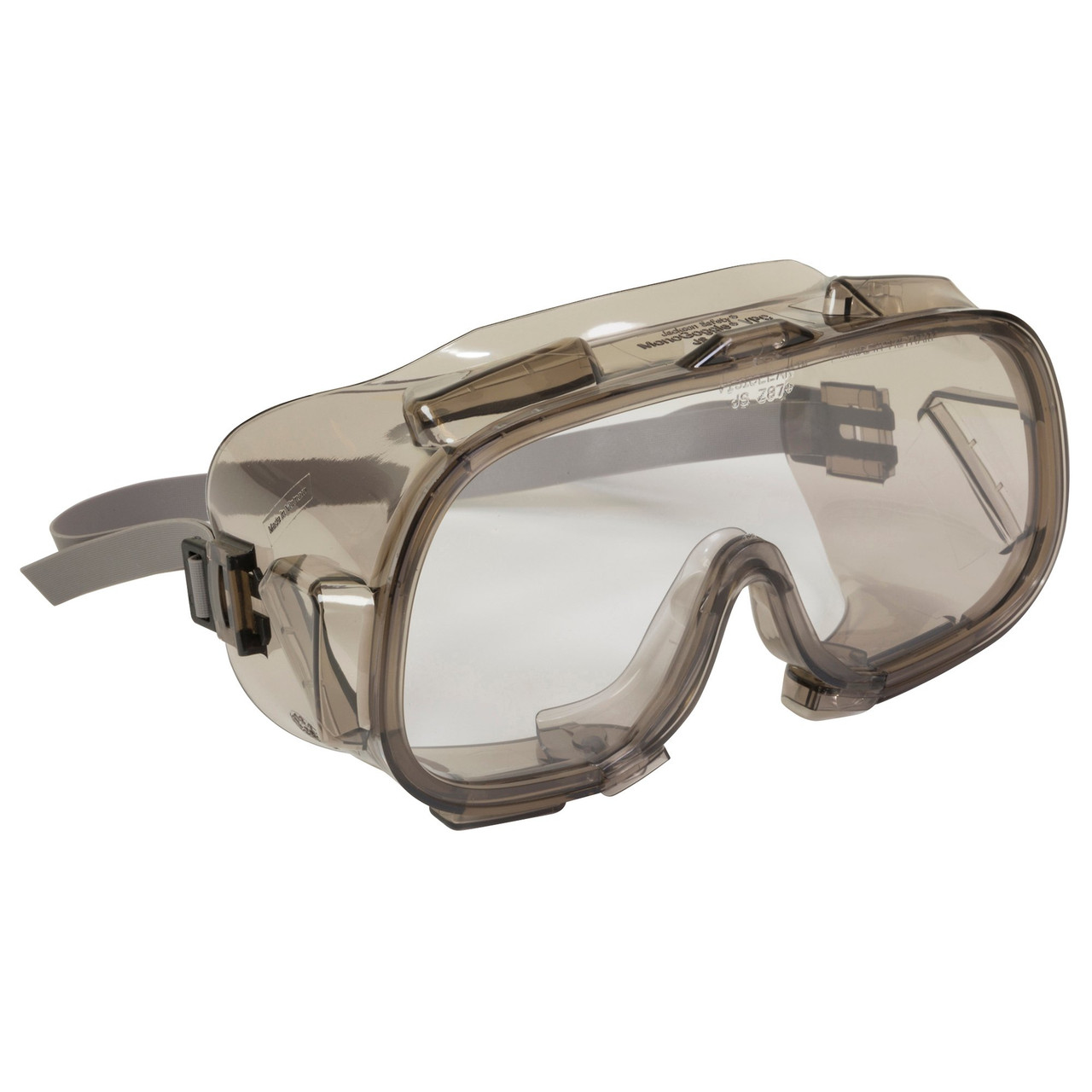
KleenGuard Monogoggle VPC Goggles

$409.90
(No reviews yet)
SKU:
‭16361‬
Availability:
7 - 10 Business Days
Shipping:
Calculated at Checkout
Quantity Option (Case):
36 Goggles


KleenGuard™ Monogoggle™ VPC Goggles (SKU 16361) — OTG Splash/Droplet + Z87+ Impact with KleenVision™ Anti-Fog

The KleenGuard™ Monogoggle™ VPC is designed for operators who need comfortable, full-coverage goggle protection that fits over larger prescription eyewear (OTG) while reducing fogging during long wear. The VPC platform combines a large lens/frame geometry, a wide nosepiece that can accommodate many half-face respirators, baffled ports for increased airflow, and a pliable frame gasket with a silicone rubber head strap for a secure, comfortable seal.

Cleanroom / controlled-entry note: Eye protection is part of your facility’s gowning (donning) program. Always follow your SOP for cleaning/disinfection, approved introduction method, and inspection/handling controls before use in ISO-classified spaces.

Specifications:
  • Product name: KleenGuard™ Monogoggle™ VPC Goggles
  • SKU: 16361
  • Available size: One Size
  • Lens material: Polycarbonate
  • UV protection: 99.9% UVA/UVB/UVC protection
  • Lens coating: KleenVision™ Anti-Fog / Scratch Resistant
  • Frame color: Bronze
  • Lens color: Clear
  • Nose pad / face seal: Soft Face Seal
  • Fit characteristics: OTG (fits over larger prescription eyewear than standard goggles); wide nosepiece for many half-face respirators; baffled ports for airflow; rear-positioned headband buckles to reduce peripheral-vision interference
  • Performance standards: Manufactured to comply with ANSI/ISEA Z87.1-2020; D3 splash/droplet rated; Z87+ high-velocity impact rated
  • RightCycle™ program: Eligible
  • Quantity option: Case
  • Case unit: 36 goggles per case
About the Manufacturer:

KleenGuard™ is an Ansell brand focused on enabling PPE performance without sacrificing comfort and usability. For eyewear, Ansell emphasizes fit geometry, fog-management coatings, and standards-based performance claims (impact and splash/droplet ratings) to support consistent wear time and fewer “adjustment touches” during work.

In contamination-control programs, the goal is simple: reduce the chances that operators introduce particles or microbes through unnecessary handling. Proper eyewear selection supports that goal by staying comfortable, staying clear, and staying in place.

Key Features:
  • OTG-friendly geometry: Large lens and frame design fits over larger prescription eyewear than standard goggles.
  • Respirator-aware fit: Wide nosepiece design intended to fit over many half-face respirators and improve comfort.
  • Fog reduction by design: Additional baffled ports increase airflow and help reduce condensation-driven fogging.
  • Comfortable sealing: Pliable frame gasket and silicone rubber head strap support fit and comfort.
  • KleenVision™ coating: Anti-fog / scratch resistant coating engineered for high anti-fog performance (manufacturer-stated).
  • Standards-based performance: ANSI/ISEA Z87.1-2020 compliance statement; D3 splash/droplet rating; Z87+ impact rating.
Benefits in Controlled Environments:
  • Fewer interruptions: Anti-fog design and coating help reduce lens clearing pauses (process- and environment-dependent).
  • Reduced face/eyewear touching: A stable, comfortable fit can reduce “adjustment touches,” supporting better contamination discipline.
  • OTG compatibility: Designed to fit over larger prescription eyewear, reducing the need for alternative eyewear workarounds.
  • Splash/droplet protection: Standards-based performance claims support hazard assessment and PPE selection documentation.
Best-Practice Use (Donning / Handling):
  • Don eyewear after primary head/face coverage: Follow your SOP sequence (commonly hood/cover, mask/veil, then goggles) to avoid re-touching earlier layers.
  • Handle by the strap/frame edges: Avoid touching the lens surfaces to reduce smears and re-cleaning cycles.
  • Confirm seal and comfort quickly: Adjust once, then avoid repeated strap changes inside controlled areas.
  • De-fog strategy: Validate approved cleaning agents and techniques; do not improvise solvents or wipes that can haze coatings or shed particles.
  • Exit discipline: Remove goggles per SOP to avoid contact between the goggle exterior and face/hood.

Important: This guidance supports technique awareness but does not replace your facility SOP, ISO program controls, or (where applicable) EU GMP Annex 1 gowning requirements.

Selection Notes:
  • OTG vs. standard goggles: Choose VPC when you need added internal volume for larger prescription eyewear and want to minimize fit compromises.
  • Fog management matters: If your operators frequently experience fogging, prioritize baffled airflow features and validated anti-fog coatings.
  • Controlled environments: Confirm your site’s approved introduction method (wipe-down, quarantine, packaging controls) and eyewear cleaning chemistry compatibility.

Link to Manufacturer Product Data Sheet:
Click Here

Other Similar Products Available From SOSCleanroom.com

OTG / Safety Goggle Options

Notes: Need help aligning eyewear selection with your ISO cleanroom classification, your gowning (donning) SOP, and your contamination-control strategy? Contact SOSCleanroom for practical selection guidance.

Product page updated: Jan. 14, 2026 (SOS Technical Staff)

© 2026 SOS Supply. All rights reserved.

The Technical Vault By SOSCleanroom
ISO 14644 Operations Control USP <800> PPE Context OTG Goggle (Over-Glasses) ANSI/ISEA Z87.1-2020 (Z87+) D3 Splash/Droplet Rated KleenVision™ Anti-Fog 36 / Case Lot/Configuration Control (Receiving)

KleenGuard™ Monogoggle™ VPC Goggles (SKU 16361) — OTG splash/droplet eye protection with Z87+ impact and anti-fog performance for controlled environments and HD-facing workflows

KleenGuard™ Monogoggle™ VPC is an OTG (over-glasses) goggle platform designed for operators who need full-coverage eye protection that stays comfortable during long wear and reduces fog-driven “adjustment touches.” The platform is commonly positioned around a large lens/frame geometry that fits over larger prescription eyewear, a wide nosepiece intended to accommodate many half-face respirators, baffled ports to increase airflow and reduce condensation, and a pliable frame gasket with a silicone rubber head strap for a secure seal. In cleanroom and controlled-entry programs, eyewear is part of the gowning (donning) system: it must be introduced, cleaned/disinfected, and handled per SOP to avoid becoming a contamination-transfer surface. For USP <800> hazardous drug (HD) programs, goggles are a practical control where there is credible splash/droplet exposure risk during handling, deactivation/decontamination, and spill response (task-based PPE). Always confirm final PPE selection and task triggers against your facility risk assessment, SOPs, and current authoritative references.

Operations takeaway: If fogging drives repeated lens/strap/face touching, you are creating a controllable contamination and exposure pathway. Anti-fog eyewear plus a written “set-once” donning approach (fit, strap tension, and no mid-task adjustments) can materially reduce operator touches—provided cleaning chemistry and wipe methods are SOP-controlled.


ISO-first context: where eyewear fits in cleanroom operations control

ISO 14644-5 frames cleanroom performance around documented operations controls (personnel practices, gowning, material transfer, cleaning, maintenance, and monitoring). Eye protection sits directly in that system because it is worn close to the face (a major shedding source), it is frequently touched when fogging occurs, and it must be cleaned and stored without introducing fibers, residues, or cross-contamination. A disciplined eyewear program defines introduction method, approved cleaning/disinfection chemistry, wiping materials, inspection criteria, and replacement triggers—then trains operators to follow it consistently.

Control point: “Eyewear failures” are often technique failures—fog-driven adjustments, improvised cleaning wipes/solvents, and uncontrolled storage that allows lenses and face seals to contact non-controlled surfaces.


Specifications (SKU controls for RFQs, SOPs, and receiving)
  • Product: KleenGuard™ Monogoggle™ VPC Goggles
  • SOSCleanroom SKU: 16361
  • Form factor: OTG (fits over many prescription eyewear frames); adjustable head strap; sealed goggle interface (verify fit on-user)
  • Performance markings (verify per PDS): ANSI/ISEA Z87.1-2020 (Z87+); D3 splash/droplet performance rating
  • Lens / coating (verify per PDS): Polycarbonate lens; anti-fog / scratch-resistant coating as specified by manufacturer
  • Vent / airflow design (verify per PDS): Indirect/baffled porting intended to reduce condensation while maintaining splash control
  • Packaging: Case quantity 36 goggles (confirm current pack configuration at receiving)

Documentation rule: For controlled/validated programs, base acceptance criteria on current manufacturer documentation and receiving records (not web summaries). Confirm markings, ratings, coating limitations, and cleaning compatibility from the manufacturer PDS before writing the SOP.


What these goggles are designed to do (typical use cases)
  • Full-coverage eye protection in controlled environments where eyewear touch discipline and fog reduction matter for contamination control.
  • OTG use where operators wear prescription eyewear and require a sealed goggle interface rather than open-frame safety glasses.
  • Tasks with credible splash/droplet potential where a D3-rated goggle provides more robust droplet control than standard safety glasses (task- and risk-assessment dependent).
  • USP <800> HD-facing workflows where eye/face protection is triggered by risk of splash/spray/spill during handling, deactivation/decontamination, and spill response (per SOP and risk assessment).
  • Situations involving masks/respirators and humidity shifts where anti-fog performance can reduce mid-task adjustments and rework.

USP <800> PPE logic (task-based): USP <800> establishes standards to minimize HD exposure risk; employers must select PPE appropriate to the hazard. In practice, when there is credible risk of splash/droplet exposure, goggles are a primary eye protection control. For elevated splash potential, a face shield may be layered over goggles to protect the full face while maintaining sealed eye protection. (Implement per your SOP and risk assessment.)


Best-practice use (reduce touches, residues, and cross-contamination)
  1. Fit first, then stop touching: set strap tension and nose/respirator interface before entering controlled zones; do not “micro-adjust” during work.
  2. Clean/disinfect per SOP only: use only approved chemistry and approved low-lint wiping materials; avoid paper products and unknown wipes.
  3. Protect lens coatings: validate compatibility of your cleaners/disinfectants with the lens coating to avoid haze, crazing, or reduced anti-fog performance.
  4. Control storage: store eyewear in a clean, designated location (bag/container) to prevent face seal and lens contact with non-controlled surfaces.
  5. Inspect before each use: check seal condition, strap integrity, lens clarity, and coating performance; replace when degraded.
  6. HD-facing work: if your USP <800> risk assessment triggers goggles for a task, treat eyewear as contaminated after the task until it is cleaned/decontaminated per SOP.

Method standardization tip: If different operators produce different results (fogging, lens streaking, repeated touches), lock four variables in the SOP: pre-fit sequence, cleaning chemistry, wiping material, and storage method.


Misuse controls & when not to use
  • Do not substitute eyewear types: if the task requires sealed splash protection, do not replace goggles with open-frame safety glasses.
  • Do not improvise chemistry: unapproved solvents/disinfectants can damage lens coatings and create residues that worsen fogging or compromise visibility.
  • Do not rely on comfort alone: verify compatibility with respirators and other PPE to avoid seal interference and pressure points.
  • Do not use past replacement triggers: scratched/hazy lenses, degraded gaskets, and poor anti-fog performance are operational failures—replace rather than “work through it.”

Recommended cleanroom glove pairing (ISO-aligned)

For controlled-entry eyewear handling and cleaning, pair goggles with a cleanroom-appropriate, low-particle glove to reduce contamination transfer. For USP <800> HD-facing tasks, glove selection must follow your HD risk assessment (often including chemo-tested gloves and double-gloving where required by SOP).

Glove discipline: Change gloves when contaminated, torn, or after contacting non-controlled surfaces. During eyewear cleaning, treat gloves as part of the contamination-control system and avoid touching face seals and lenses with bare hands.

Recommended sterile swab pairing (detail cleaning & confined geometries)

For tight edges, gasket channels, vent features, and small interfaces where a wipe cannot maintain contact control, use a sterile cleanroom swab to keep cleaning localized and to avoid dragging residues across the lens. Always validate compatibility with lens coatings and approved chemistry in your SOP.

Swab discipline: Use a strict “one swab, one area” approach for controlled environments. Do not re-dip. Discard immediately if overloaded or if the swab contacts non-controlled surfaces.


Why buy these goggles from SOSCleanroom
  • Configuration control: PPE selection is task- and marking-sensitive; ordering by exact SKU supports receiving controls and prevents unintended substitutions.
  • SOP alignment support: We help customers align eyewear selection to cleanroom operations control, PPE matrices, and training expectations.
  • One-cart procurement: Pair eyewear with compatible gloves, swabs/wipers, and facility consumables to keep cleaning and handling methods consistent.

Manufacturer documentation (authoritative references)
  • SOSCleanroom product page (SKU 16361): Click Here
  • Manufacturer Product Data Sheet (KleenGuard™ Monogoggle™ VPC): Click Here
  • USP <800> overview (hazardous drugs handling in healthcare): Click Here
  • OSHA Hospitals eTool (Pharmacy PPE for hazardous drugs): Click Here
  • NIOSH Alert 2004-165 (preventing occupational exposure to hazardous drugs): Click Here
  • ISO 14644-1 (classification context): Click Here
  • ISO 14644-5 (operations; gowning programme context): Click Here

Questions? Email Sales@SOSsupply.com or call (214) 340-8574. You can also explore the SOSCleanroom AI ChatBot, powered by SOSCleanroom data libraries, for product guidance and technical education. Disclaimer: This Technical Vault content is provided by SOSCleanroom for general educational and operational reference only. It does not constitute legal, regulatory, validation, clinical, or safety advice and must not be interpreted as a certification or guarantee of compliance. Customers are responsible for developing, approving, and maintaining their own SOPs, training programs, validation activities, and compliance strategies based on applicable regulations, official standards, and current manufacturer documentation. References to ISO standards (including the ISO 14644 series) are for contextual guidance only. ISO standards are copyrighted works of the International Organization for Standardization (ISO) and are authoritative only in their official published form. © 2026 SOSCleanroom. All rights reserved. Content reviewed and current as of January 2026.