Ohm-Stat FM-1126 - Digital ESD Field Meter

$652.95
(No reviews yet)
SKU:
FM-1126
Availability:
7 - 10 Business Days
Shipping:
Calculated at Checkout
Quantity Option (Each):
1 Unit
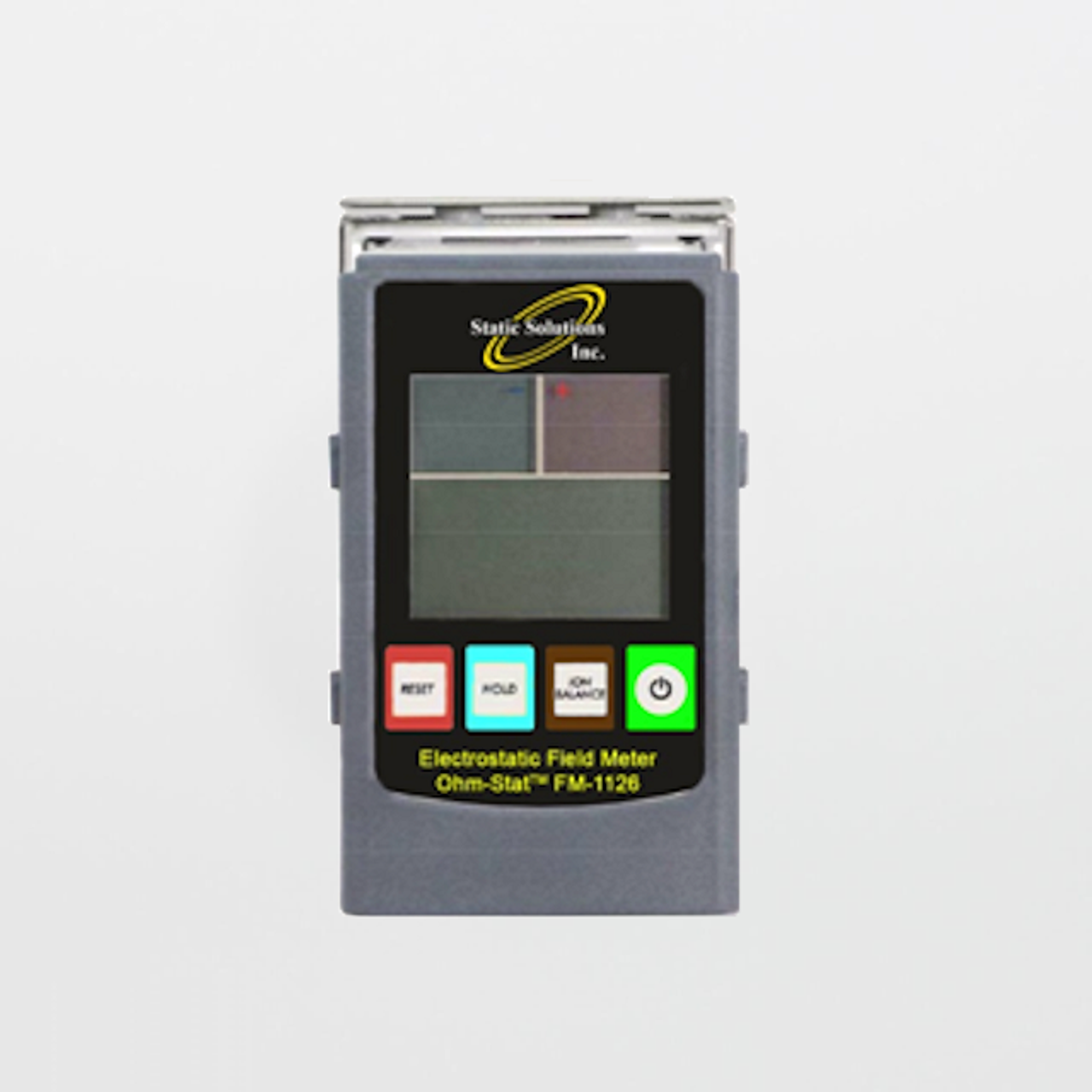
Ohm-Stat FM-1126 Digital ESD Field Meter — Non-Contact Static Voltage & Polarity Measurement, Ionizer Balance Mode (with Plate), NIST Certificate Included
Non-Contact Static Survey Polarity + Voltage Range: 1–80,000 V Ionizer Balance Mode (to 200 V w/ plate) NIST Certificate Included Made in USA

Overview

The Ohm-Stat FM-1126 Digital ESD Field Meter is a palm-sized, non-contact instrument used to identify and quantify electrostatic charge on work surfaces, materials, tools, and packaging — and to support ionizer verification when the ion balance plate is installed. In ESD-controlled operations, static risk is often invisible; this meter helps you find charge sources before they create device damage, yield loss, rework, or unexplained failures.

SOSCleanroom focuses on proven, best-in-class static control brands because ESD control is a system — not a single product. The FM-1126 is a practical tool for supervisors, process engineers, and EHS teams who need repeatable surveys, documentation support, and actionable results on the shop floor.


Why this meter matters (electronics + non-cleanroom users)
  • ESD risk is often not felt by people: harmful charge can exist even when no one notices it. A field meter provides objective visibility into static conditions.
  • Prevents “mystery” failures: static events can create immediate failures or latent defects that show up later during test, shipping, or customer use.
  • Confirms controls are working: validate that ionizers, materials, and housekeeping practices are reducing charge accumulation in real workflows.
  • Improves training and compliance: turn static control into measurable behavior by showing operators what actions create charge (packaging movement, wiping, garment friction, tape removal, etc.).
  • Useful beyond cleanrooms: electronics assembly, repair benches, QA labs, plastics/printing areas, and packaging lines all benefit from static surveys.

Typical applications
  • Static surveys of worksurfaces, carts, totes, packaging, and insulators
  • Audit support for ESD Protected Areas (EPA) and process stations
  • Verification of ionizer performance (ion balance / polarity) using the ion balance plate
  • Troubleshooting: “why is this product attracting dust?” or “why do we see intermittent test failures?”
  • Confirming process changes (new tape, new packaging, new cleaning method, new garment) did not increase static charge

Key specifications (published)
Measurement type Non-contact electrostatic field / surface voltage indication
Voltage range 1–80,000 volts
Ionizer balance mode Measures low voltages up to 200 V (requires ion balance plate installed)
Display Digital value + LCD bar graph; easy-to-read 3.5" LCD
Update rate Display updates every ~3 seconds
Distance control Includes 1" spacer bar for consistent measurements
Power 9-volt battery
Included items Leather case; NIST certificate; includes ionizer probe attachment (as listed)
Conformance / origin Listed as conforming to ESD S20.20; Made in USA

Practical note: field meter readings become more meaningful when you standardize distance (use the spacer), define “action levels” for your process, and trend results over time (before/after cleaning, maintenance, or material changes).


How to use it (quick-start)
  1. Set a consistent distance: use the included spacer bar where possible.
  2. Scan the “usual suspects” first: tape rolls, poly bags, tote liners, cart wheels, chair seats, garments, and work-surface mats.
  3. Record polarity + magnitude: note where charge is highest and what activity created it (peeling tape, wiping, unpacking, moving trays).
  4. Correct the cause, then re-test: introduce dissipative packaging, add ionization, improve grounding, change process motions, or adjust cleaning method.
  5. Ionizer balance checks: install the ion balance plate and use the meter’s ion balance mode per your internal procedure and audit schedule.

ESD program references (education)

If you have any questions please email us at Sales@SOSsupply.com or give us a call at (214)340-8574. OR check out the AI ChatBot powered by SOSCleanroom data libraries - give it a try! THIS IS NEW FOR 2026! © 2026 SOSCleanroom. All rights reserved.
The Technical Vault By SOSCleanroom
ESD Education Static Surveys Ionizer Verification Audit-Ready Documentation Mindset

Why electrostatic fields matter (even in cleanrooms)

Static electricity is not just an annoyance — it is an imbalance of charge that creates an electric field. In electronics operations, a discharge can degrade or destroy sensitive devices, and it can also disrupt equipment behavior. In contamination-controlled environments, charged surfaces can attract and hold particles, increasing the likelihood of contamination transfer when materials move through a process.

The practical challenge is that static can build up and persist on insulators (common plastics, films, tapes, garments, and packaging). If you cannot measure it, you are forced to guess. A field meter turns static control into data.


Where the FM-1126 fits in an ESD control program

ESD control programs (often structured around ANSI/ESD program principles) rely on three themes: prevent charge generation, provide a controlled path to ground, and neutralize charge where grounding is not possible (ionization). The FM-1126 supports the “verify” step — helping you confirm that those controls are actually effective at the point of use.

What the FM-1126 helps you answer
  • Are my packaging materials (bags, films, liners) carrying charge into the work area?
  • Is tape removal or wiping generating charge that could hit sensitive assemblies?
  • Do carts, chairs, garment surfaces, or floor interfaces accumulate charge during routine motion?
  • Are ionizers balanced and behaving the way we believe they are?
  • After we cleaned/maintained/changed a material, did our static risk get better or worse?

How to run a useful static survey (repeatable method)
  1. Define the survey map: list your stations and include common insulators (poly bags, tote liners, tapes, labels), plus people interfaces (chairs, smocks, gloves, heel grounders).
  2. Standardize distance: use the FM-1126 spacer bar where feasible. Distance consistency makes your before/after results meaningful.
  3. Capture polarity and magnitude: polarity matters for troubleshooting (e.g., why a film keeps re-attracting dust or why parts cling).
  4. Force “real life” motion: measure after typical actions (unbagging, peeling tape, wiping, stacking trays, pushing carts).
  5. Correct and re-test: change materials to dissipative options, improve grounding, add ionization, adjust operator technique, and then measure again.
  6. Trend results: keep a simple log. When failures spike, your history often points to what changed.

Ionizer balance checks (what teams forget)

Ionizers are often installed and then “assumed good.” In reality, ionizer performance can drift due to emitter wear, contamination, airflow changes, or maintenance activity. The FM-1126 is listed as supporting ion balance checks (low voltage measurement up to 200 V) when the ion balance plate is installed.

  • Make checks routine: verify at startup, after maintenance, and on a schedule appropriate to risk.
  • Measure where the work happens: balance at the actual point-of-use location, not “somewhere nearby.”
  • Document outcomes: keep calibration and verification evidence aligned with your quality expectations.
  • Trigger corrective actions: cleaning, adjustment, or replacement should be tied to thresholds you define internally.

FM-1126 — what you receive (SOSCleanroom listing)
Core capability Non-contact field measurement; indicates voltage and polarity
Voltage range 1–80,000 volts
Ion balance mode Up to 200 V with ion balance plate installed
Display & behavior 3.5" LCD; bar graph + numeric; updates every ~3 seconds
Included Leather case; 1" spacer bar; 9V battery power; NIST certificate; ionizer probe attachment (as listed)
Program alignment Listed as conforming to ESD S20.20; supports “class zero conformance” checks (as listed)

Why buy ESD test equipment from SOSCleanroom
  • Curated for real programs: we don’t sell “random static gadgets.” We stock the building blocks used in ESD Protected Areas — testers/monitors, wrist straps, heel grounders, and the supporting consumables.
  • Program continuity: consistent SKUs make audits and training easier. When you standardize, your process becomes repeatable.
  • Operational efficiency: Auto-Ship options support recurring needs and reduce purchasing churn for maintenance and EHS teams.
  • Support mindset: the Technical Vault is written to help customers implement products correctly — because “installed” is not the same as “controlled.”

If you have any questions please email us at Sales@SOSsupply.com or give us a call at (214)340-8574. OR check out the AI ChatBot powered by SOSCleanroom data libraries - give it a try! THIS IS NEW FOR 2026! © 2026 SOSCleanroom. All rights reserved.