RT-1000 Megohmmeter Resistivity Meter Tester Kit

$1,365.27
(No reviews yet)
SKU:
RT-1000
Availability:
7 - 10 Business Days
Shipping:
Calculated at Checkout

Expected release date is 1st May 2026

Static Solutions Ohm-Stat® RT-1000 Megohmmeter Resistivity Tester Kit — Surface/Volume Resistivity + RTG/RTT Resistance Testing with RH/Temperature Measurement, Dual 10V/100V Test Voltages, NIST Certificate Included
ESD Verification Megohmmeter / Resistivity Tester 10^3–10^12 Ohms RH + Temperature Dual Test Voltage (10V/100V) NIST Certificate Case Unit: 1 Kit

Overview

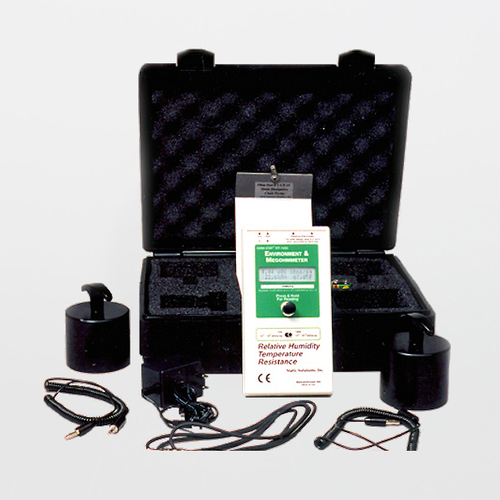
The Ohm-Stat® RT-1000 is a portable megohmmeter / resistivity tester kit used to verify whether ESD-control materials and surfaces (conductive, antistatic, and static dissipative) still perform as intended. It is commonly used for ESD Protected Area (EPA) audits of worksurfaces, floors, chairs, garments, carts, and grounding paths — plus troubleshooting when yield loss, latent failures, or unexplained static events occur.

The RT-1000 also measures relative humidity and temperature during testing because environmental conditions can materially influence resistivity results. This is critical for cleanrooms that handle electronics (static can attract particles and create handling risk), and it is just as important for non-cleanroom electronics operations such as assembly, rework benches, labs, and maintenance stations.


Why this tester matters
  • Prevents ESD “process drift”: mats, floors, garments, and seating can degrade over time — periodic verification helps detect issues before defects appear.
  • Makes audits defensible: documented measurements support QA expectations and help teams standardize corrective actions.
  • Captures real conditions: RH and temperature readings provide context that prevents misleading pass/fail decisions.
  • Cleanrooms + electronics: static control supports product integrity and can reduce particle attraction to charged surfaces during electronics handling.

RT-1000 kit includes (Case Unit)
  • Two 5 lb, 2.5" probes with handles
  • Two 3" parallel surface resistivity probes
  • Dissipative chair test probe (meets ANSI/EOS/ESD Standard 12.1)
  • Earth ground probe
  • Garment clamps (conforms to EOS/ESD 2.1 standard)
  • Foam lined carrying case

Typical applications
  • Worksurface and mat verification (incoming inspection + periodic checks)
  • Flooring and footwear system audits (ground path validation)
  • Chair, garment, and wrist strap program support testing
  • Cleanroom electronics handling: troubleshooting particle attraction tied to static charge
  • Change-control validation (new materials, new tapes, new packaging, new cleaning methods)

Key specifications (published)
Measurement range Resistivity / resistance to 10^3–10^12 ohms
Relative humidity 10%–90% RH
Temperature 32°F–100°F or 0°C–37°C
Test voltage Dual 10V / 100V test voltage ranges
Operational features Easy-to-read digital display; automatic zeroing and power off
Power 120V or 220V AC; 9V DC alkaline or nickel cadmium (as listed)
Standards & certificates Meets ANSI/EOS/ESD 11.11; CE Approved; NIST certificate included (as listed)

Note: ESD compliance is a program outcome — instruments support verification, but results depend on test method, probes used, environment, and the facility’s compliance verification plan.


Why businesses buy ESD test equipment from SOSCleanroom
  • System sourcing: testers, monitors, wrist straps, heel grounders, tapes, mats, and ESD consumables in one place supports standardization.
  • Cleaner procurement: consistent SKUs simplify training, internal SOPs, and audit documentation.
  • Auto-Ship option: useful when you standardize verification schedules and want predictable replenishment of related supplies.
  • Electronics + cleanrooms: we support both contamination-control and static-control needs where electronics are present.

Documentation

Use manufacturer documentation and your ESD Control Plan to define test points, test frequency, and pass/fail criteria.


If you have any questions please email us at Sales@SOSsupply.com or give us a call at (214)340-8574. OR check out the AI ChatBot powered by SOSCleanroom data libraries - give it a try! THIS IS NEW FOR 2026! © 2026 SOSCleanroom. All rights reserved.
The Technical Vault By SOSCleanroom
ESD Fundamentals S20.20 Program Thinking TR53 Verification Mindset RT-1000 Megohmmeter

ESD is a “silent” failure mode — verification turns it into a controlled risk

Electrostatic charge can accumulate on people, tools, garments, floors, packaging, and process materials. In many cases, the charge is present long before anyone feels a shock. The problem is that ESD events can damage components immediately or create latent defects that only show up later. That is why professional ESD programs treat verification as routine: controls must be installed, and then controls must be measured on a schedule so performance does not drift.

The RT-1000 is built for that verification work. It measures resistance/resistivity over a wide range and captures relative humidity and temperature to keep test results defensible.


What the RT-1000 helps you answer (real-world questions)
  • Is our work surface still static-dissipative? New mats may pass on day one, but contamination, wear, and cleaning chemistry can change performance over time.
  • Are floors and seating still contributing to a safe ground path? Chair casters, floor finishes, and humidity shifts can change charging behavior.
  • Do garments and sleeves still provide continuity? Garments can drift due to laundering methods, age, and damage.
  • Are we auditing under the right conditions? RH and temperature are not “nice-to-have” — they often explain why the same surface can behave differently week to week.

Cleanrooms + electronics: why ESD control supports contamination control

In cleanrooms that handle electronics, static charge is more than an electronics reliability risk. Charged surfaces can attract particles and increase handling variability. ESD verification supports stable processes — and stable processes are easier to keep clean.


A practical audit workflow (repeatable, training-friendly)
  1. Map the EPA: list benches, floors, chairs, carts, garments, and grounding points that define each work area.
  2. Record RH and temperature: log them at the time of measurement so results can be compared across seasons and shifts.
  3. Verify the surfaces: use the correct probes for worksurfaces and floors; follow your ESD Control Plan for test points and frequency.
  4. Verify the “people system”: chairs and garments matter because people are the most common moving charge generator in a process.
  5. Correct and re-test: clean/replace, adjust grounding, update materials, retrain technique, then document the new baseline.

Standards context (why verification exists)

ESD programs typically reference a formal control-plan framework and a verification discipline. ANSI/ESD S20.20 is widely used to define the program structure, while TR53 provides periodic verification test methods and troubleshooting guidance that support compliance verification plans. Globally, IEC 61340-5-1 defines requirements for an ESD control program. The RT-1000 supports the measurement side of that reality: if you do not measure, you do not control.


Why source ESD verification tools from SOSCleanroom
  • Program standardization: consistent SKUs reduce ambiguity in SOPs and training.
  • System coverage: pair measurement tools with wrist straps, heel grounders, grounding cords, and ESD tapes to close the loop.
  • Education included: the Technical Vault is designed to help teams implement products correctly — because “purchased” is not the same as “controlled.”

If you have any questions please email us at Sales@SOSsupply.com or give us a call at (214)340-8574. OR check out the AI ChatBot powered by SOSCleanroom data libraries - give it a try! THIS IS NEW FOR 2026! © 2026 SOSCleanroom. All rights reserved.