
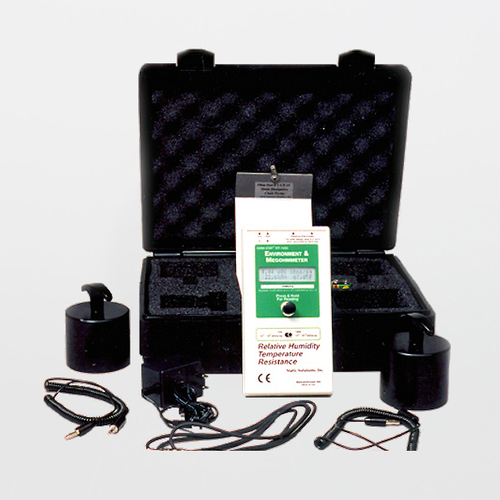
RT-500 Megohmmeter Resistivity Tester

$510.93
(No reviews yet)
SKU:
RT-500
Availability:
7 - 10 Business Days
Shipping:
Calculated at Checkout
Static Solutions Ohm-Stat® RT-500 Megohmmeter Resistivity Tester — Surface Resistivity + RTG/RTT Resistance Testing, 103–1012 Ω, Dual 10V/100V Test Voltage, NIST Certificate Included (Optional 5 lb Probes + Hard Case)
ESD Verification Megohmmeter / Resistivity Tester 103–1012 Ω Range Dual 10V / 100V NIST Certificate Automatic Zeroing / Auto Shutoff Optional 5 lb Probes

Overview

The Ohm-Stat® RT-500 is a compact, audit-friendly ESD megohmmeter / resistivity tester used to confirm whether ESD control materials and grounding paths still perform within your facility’s expectations. It measures surface resistivity using built-in electrodes (parallel bars / concentric ring style), and it supports common verification tests including Resistance to Ground (RTG) and Resistance Between Two Points (RTT).

This instrument is frequently used for incoming inspection, periodic verification, and troubleshooting of benches, mats, flooring systems, packaging, footwear, wrist straps, garments, and ESD chairs in electronics environments — including cleanrooms where electronics handling is involved.


Why this tester matters
  • Stops ESD “process drift”: mats, floors, garments, and seating degrade over time — periodic verification finds problems before they become defects.
  • Makes audits defensible: documented measurements support internal QA expectations and supplier/customer requirements.
  • Built for field checks: small, lightweight design with automatic range selection and clear range indication helps technicians work quickly.
  • Cleanrooms + electronics: ESD control supports stable handling and can reduce static-related attraction of lightweight particles during sensitive assembly.

What you receive (Each)
  • 1 RT-500 megohmmeter with leather case, battery, and internal probes
  • Grounding hardware and instructions
  • NIST Certificate
  • One-year limited warranty
  • Optional configuration: two 5 lb (2.5") disk probes + hard carrying case for volume resistance testing

Typical applications
  • Worksurface and mat verification (incoming inspection + periodic checks)
  • Flooring and footwear system audits (ground path validation)
  • Garment sleeve continuity checks and ESD chair testing
  • Packaging material verification for ESD-controlled areas
  • Troubleshooting: identifying “hot spots” where materials are out of spec or grounding is intermittent

Key specifications (published)
SKU RT-500
Resistance / resistivity range 103 to 1012 Ω (listed as 100% accuracy)
Supported tests Surface resistivity; RTG; RTT; volume resistance (with accessories)
Test voltage 10V and 100V; automatic voltage range selector
User features Automatic zeroing & power shutoff; LED display color indicates range; low battery warning
Size / weight 2.6 x 5 x 1.2 in; 8.4 oz (233 g)
Standards (listed) ANSI/EOS/ESD (S4.1, S7.1, S12.1, S2.1), EN 61340-5-1, ASTM F150, NFPA 99A, ASTM D257, and others (as listed)

Why buy RT-500 from SOSCleanroom
  • Program sourcing: testers, monitors, wrist straps, heel grounders, and ESD consumables in one place supports standardization.
  • Auto-Ship options: helpful for repeatable verification schedules and planned replenishment of related supplies.
  • Support that understands critical environments: we serve both cleanroom and non-cleanroom electronics users with practical ESD guidance.

Documentation

Use manufacturer documentation and your ESD Control Plan to define test points, test frequency, and pass/fail criteria.


If you have any questions please email us at Sales@SOSsupply.com or give us a call at (214)340-8574. OR check out the AI ChatBot powered by SOSCleanroom data libraries - give it a try! THIS IS NEW FOR 2026! © 2026 SOSCleanroom. All rights reserved.
The Technical Vault By SOSCleanroom
ESD Fundamentals Compliance Verification RT-500 Megohmmeter Cleanroom + Electronics

Why ESD verification exists: static risk grows as devices get smaller

ESD is often a “silent” reliability risk. You may never feel a shock, yet sensitive devices can still be damaged or weakened (latent defects). Industry guidance has repeatedly highlighted that as devices become more sensitive, facilities must scrutinize the ESD capabilities of handling processes. The practical takeaway is simple: install controls, then verify controls on a schedule.

The RT-500 is purpose-built for the verification portion of an ESD control program: quick checks of worksurfaces, floors, packaging, garments, chairs, and grounding paths. It’s compact enough for routine audits, yet supports the core test categories ESD teams rely on to prevent process drift.


What the RT-500 measures (and why it matters)
  • Surface resistivity: confirms whether mats and surfaces behave as intended (conductive / dissipative / insulative behavior is a program-level decision).
  • RTG (Resistance to Ground): validates the work surface or system can reliably bleed charge to ground.
  • RTT (Resistance between points): identifies weak continuity, seams, damaged zones, or intermittent connections.
  • Volume resistance (optional probes): supports deeper investigation when material thickness and bulk properties matter.

Cleanrooms + electronics: ESD control supports stable contamination control

In electronics cleanrooms, ESD isn’t only a reliability concern. Charge can build on people, garments, tools, and packaging; charged surfaces can attract lightweight particles, complicating handling and process stability. Verifying ESD controls helps keep both yield and cleanliness more predictable.


A repeatable verification workflow (training-friendly)
  1. Define your test map: worksurfaces, mats, floors, chairs, garments, carts, and common point grounds.
  2. Standardize your method: same test points, same probes, same sequence — so results are comparable over time.
  3. Document baseline values: record the starting “known good” state after installation or corrective action.
  4. Trend, don’t just pass/fail: small changes can signal wear, contamination, or cleaning chemistry impacts.
  5. Correct and re-verify: clean/replace, repair grounding, retrain technique, then re-test and log the new baseline.

Standards context (why “periodic verification” is called out)

Formal ESD programs typically reference a control-plan framework and a compliance verification discipline. ANSI/ESD S20.20 is widely used to define program structure, and ESD TR53 is specifically intended to provide periodic verification methods and troubleshooting guidance. Globally, IEC 61340-5-1 defines requirements for an ESD control program.


Why source ESD verification tools from SOSCleanroom
  • One-vendor standardization: build a consistent EPA with testers, wrist straps, heel grounders, and ESD consumables under controlled SKUs.
  • Configuration choices: choose RT-500 as a compact meter, or add the optional 5 lb probes + hard case for expanded testing.
  • Upgrade path: for broader audit capability, pair the RT-500 with an ESD field meter, or step up to a full audit kit (like RT-1000 + FM-1126) for multi-parameter programs.

If you have any questions please email us at Sales@SOSsupply.com or give us a call at (214)340-8574. OR check out the AI ChatBot powered by SOSCleanroom data libraries - give it a try! THIS IS NEW FOR 2026! © 2026 SOSCleanroom. All rights reserved.