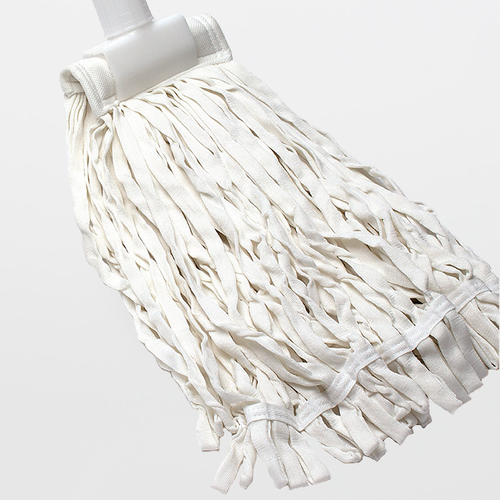
Texwipe STX7070 Sterile BetaMop® Microdenier String Mop Head Refills — Tubular Microdenier, Gamma Irradiated (Case of 6)
STX7070 is a sterile, microdenier polyester tubular string mop head refill designed for the BetaMop® cleaning system when technicians need stronger particle capture, controlled solution delivery, and streak-minimizing floor cleaning in critical environments. The microdenier knit is intended to increase lifting/capturing power for fine contamination while supporting routine application/removal of cleaning solutions and disinfectants.
Important supply note: This item is shown as Discontinued by Texwipe on the SOSCleanroom product listing. If your program is standardized to STX7070, treat any substitution (including non-sterile alternatives) as a formal change-control event. SOSCleanroom can help you identify the closest current-production options and align documentation for QA/QC review.
For over 35 years, SOS and Texwipe have been close partners, and SOSCleanroom is the authorized Master Distributor of ITW Texwipe for the United States market. That relationship matters for cleanroom mopping programs: it supports continuity of supply, consistent product lineage, and fast access to manufacturer documentation when investigations, audits, or cleaning validation questions come up.
Published configuration (STX7070)
- Part number: STX7070
- Product type: Sterile tubular microdenier string mop head refill (replacement heads)
- System compatibility: Used with BetaMop® hardware / BetaMop II cleaning system (mop handle + clamp frame)
- Case quantity: 6 sterile microdenier string mop heads per case
- Material: Microdenier 100% polyester knit (as published for BetaMop® microdenier refills)
- Solution capacity (typical): 1.8 liters per head (as published for microdenier string refills)
- Autoclave compatibility: Autoclave safe (as published for BetaMop® head refills)
- Rewash potential: Can be rewashed up to 10x (published guidance for BetaMop® string refills; qualify per site laundry controls)
- Recommended cleanroom environment: ISO Class 3–7; EU Grade A–D (sterile recommended for EU Grade A–B programs)
- Sterility approach: Gamma irradiated to a Sterility Assurance Level (SAL) of 10-6 (as published for sterile BetaMop® refills)
- Traceability (as published): Lot code and expiration date marked on each package; case-level certificates available for irradiation/compliance
Low-linting performance — and the reality check
This microdenier mop refill is built for contamination-controlled cleaning with low-linting textiles and controlled residue behavior. Even so, mop performance is still process-dependent: solution control, wringing discipline, change-out frequency, and zone segregation are what keep particles, residues, and microbes from being redistributed.
Discontinued item — protect your program
STX7070 is listed as Discontinued by Texwipe on SOSCleanroom. If you must maintain equivalency, document the cleaning objective (particle capture, streak control, disinfectant compatibility, sterility/packaging) and run a controlled side-by-side qualification before changing to a substitute SKU.
Practical cleanroom use guidance (technicians and engineers)
- Pre-wet intentionally: Add solution slowly and uniformly to avoid dry zones (skipping) or over-saturation (drips and residue). Microdenier will hold more solution than standard polyester, so dose deliberately.
- Two-bucket discipline: Use a defined dirty/clean separation and a wringing step that is consistent every time. In critical environments, inconsistency is what turns a mop into a redistribution tool.
- Stroke geometry: Use overlapping strokes with a consistent edge lead (do not scrub randomly). Treat each pass as a controlled wipe, not a sweeping motion.
- Zone segregation: Assign mops by room/zone (or even by side of a line) and label buckets/handles. Cross-zone use is a common root cause in excursions.
- Change-out trigger: Replace the head at defined square footage/time/soil-load limits, not when it “looks dirty.” Microdenier can hide soil while still redepositing fines.
- Dry time control: After application, allow the programmed wet-contact and dry time for your disinfectant. Avoid re-mopping too soon, which can lift partially dried residues and spread them.
Compatibility and solution management
Published guidance indicates compatibility with most disinfectants (including Texwipe’s TexQ). Always qualify chemical compatibility under your site concentrations, dwell times, and temperature.
| Control point |
What to do on the floor |
Why it matters |
| Solution loading |
Dose evenly; avoid pouring onto one spot of the head |
Prevents streaking, drip trails, and uneven contact time |
| Wringing consistency |
Standardize number of compressions/turns per cycle |
Controls residue and prevents chemical over-application |
| Disinfectant dwell time |
Respect the label/SOP wet-contact time before rework |
Prevents reduced kill efficacy and residue smearing |
| Rinse / neutralization step |
Use a defined rinse/wipe step if your SOP requires it |
Reduces film formation and ionic residue carryover |
Sterility, documentation, and traceability controls
- SAL target (published): Gamma irradiated to SAL 10-6 (commonly used for sterile consumables in controlled environments).
- Label discipline: Verify lot code and expiration date before staging into Grade A/B zones; do not “borrow” from unlabeled overwraps.
- Certificate retention: Keep Certificates of Irradiation/Compliance with the batch record or cleaning log packet when required by QA.
- Introduction into sterile areas: Open outer packaging outside the critical zone per your gowning/material transfer SOP; avoid tearing that can shed fibers/films into the room.
Typical performance characteristics
These are published characteristics to support selection and qualification planning (verify against your site cleaning validation strategy).
| Characteristic |
Published value / guidance |
Practical implication |
| Solution capacity |
1.8 liters/head (microdenier string refill) |
Fewer reloads; higher risk of over-application if wringing is inconsistent |
| Environment suitability |
ISO Class 3–7; EU Grade A–D (sterile recommended for A–B) |
Appropriate for critical cleaning zones when process controls are enforced |
| Rewash capability |
Up to 10x (published guidance for string refills) |
Requires validated laundering controls; sterile programs often treat heads as single-use |
| Disinfectant compatibility |
Compatible with most disinfectants (including TexQ) |
Still qualify per concentration/dwell time; residue control is process-dependent |
Common failure modes
- Streaking / visible film: Typically from over-application, inconsistent wringing, or re-mopping before full dry time. Prevent with measured dosing, consistent wring cycles, and dwell-time discipline.
- Residue carryover (cross-contamination): Usually from using the same head across zones or re-dipping into “clean” solution after dirty contact. Prevent with two-bucket segregation and zone-dedicated tools.
- Particle re-deposition: Caused by extended use past change-out limits or aggressive scrubbing that lifts embedded soil. Prevent with defined square footage/time triggers and controlled stroke patterns.
- Microbial spread risk: When a head is overloaded and not changed appropriately during disinfectant rotation. Prevent with frequency controls, correct dwell time, and program-defined head replacement intervals.
Storage and handling best practices
- Keep sterile refills in original packaging until point-of-use; do not stage opened packs in uncontrolled areas.
- Protect packaging from puncture/tears that compromise sterility and shed films into the room.
- Store away from direct sunlight and chemical vapors; avoid compressing heads under heavy loads (deformation affects contact pattern).
- If laundering is used at your site, qualify wash chemistry, water quality, drying, and re-bagging to prevent residue and bioburden carryover.
Documentation
SOS-hosted BetaMop® Technical Data Sheet (includes STX7070 listing):
Click HereTexwipe BetaMop™ Series TDS (updated, 11/21):
Click Here
If you have any questions please email us at Sales@SOSsupply.com
or give us a call at (214)340-8574.
Check our the AI ChatBot powered by SOSCleanroom data libraries - give it a try!
THIS IS NEW FOR 2026!
Last updated: January 9, 2026.
© 2026 SOS Supply. All rights reserved.