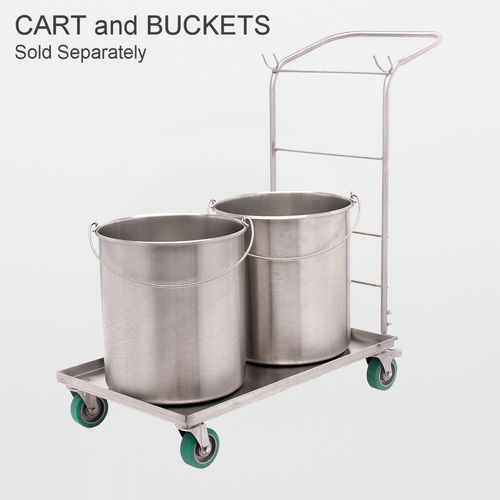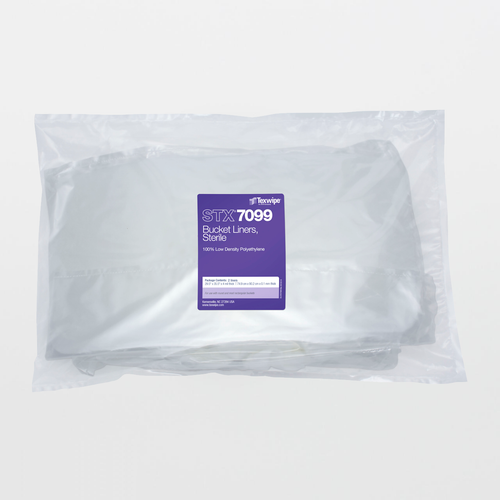
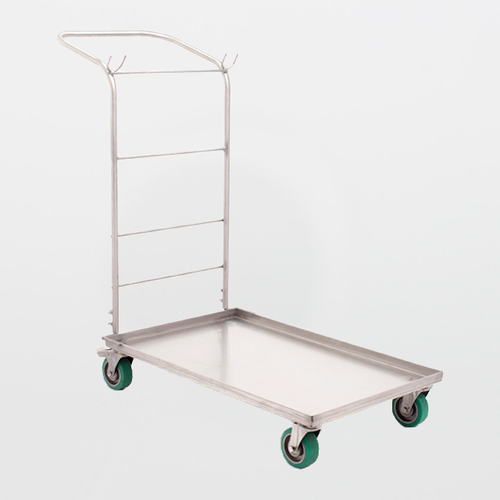
Texwipe STX7099 Sterile Bucket Liners for Texwipe Mop Buckets

Discontinued by Texwipe

(No reviews yet)
SKU:
STX7099
Availability:
7 - 10 Business Days
Quantity Option (Case):
25 Bags Per Case (2 Liners Per Bag)
Type:
Dry Mop
Sterile:
Yes
Texwipe STX7099 Sterile Bucket Liners — 4 mil, Irradiated Liners for Texwipe Round Mop Buckets
STX7099 is a sterile (irradiated) bucket-liner system used to segregate cleaning solutions and help reduce cross-contamination risk when using Texwipe mop buckets in critical environments. Liner discipline is a simple control that prevents residue carryover between chemical families (e.g., detergent vs. disinfectant vs. sporicide programs) and reduces the time and validation burden tied to bucket cleaning between changeovers.

Discontinued by Texwipe: This item is listed as discontinued on SOSCleanroom. If your program is standardizing around liners as a process control, consider building a qualification plan that includes an alternate or a last-time-buy strategy.

For over 35 years, SOS and Texwipe have been close partners, and SOSCleanroom is the authorized Master Distributor of ITW Texwipe for the United States market. That relationship matters when you are standardizing critical cleaning tools: it supports continuity of supply, stable product lineage, and fast access to the manufacturer documentation your QA/QC team expects.

Published configuration (STX7099)
  • Part number: STX7099
  • Type: Bucket liner (sterile / irradiated)
  • Thickness: 4 mil
  • Packaging: 2 liners per bag; 25 bags per case (50 liners per case)
  • Intended bucket style: Round buckets
  • Fit limitation (published): Not recommended for TX7054 or TX7063
  • Status: Discontinued by Texwipe (availability may be limited)
Published size note — verify before standardizing
The SOSCleanroom product page lists 29.5" x 35.5" (74.9 cm x 90.2 cm) and 4 mil thick. The Texwipe manufacturer page lists 29.5" x 45" (74.9 cm x 114.2 cm) and 4 mil thick. If size is critical for your wringer geometry, lid clearance, or validated fill volumes, confirm the liner dimensions on the case label / COA package set and qualify fit on the exact bucket models in your program before final release.

Quick-reference tables (for SOPs, training, and procurement)
Attribute Published value Why it matters in critical environments
Thickness 4 mil Helps resist punctures/tears during wringing and transport; supports consistent handling in repetitive cleaning cycles.
Packaging 2 liners/bag; 25 bags/case Supports staged introduction and controlled changeover frequency without exposing the full case.
Bucket compatibility Round buckets; not recommended for TX7054/TX7063 Fit drives wringer function and prevents liner pinch points that can tear and create leak paths.
Sterile status Sterile / irradiated (as published) Enables cleaner introduction into controlled areas when your program requires sterile accessories or controlled bioburden.
Use / fit rule Pass criteria Fail signals to train on
Bucket fit Liner seats fully with uniform slack; no tension points at rim/wringer Overstretching at rim, wringer contact tearing, liner twist that restricts wringer travel
Wringing Wring action does not pinch liner; no visible abrasion Liner pinched between wringer and bucket wall; whitening/stress marks; micro-tears
Leak control No seepage at base during agitation/transport Drips at base seam, liner puncture from debris in bucket, wet trail during cart movement

Practical cleanroom use guidance (technicians and engineers)
  • Use liners as a change-control tool: Assign liners by chemistry family (detergent, disinfectant, sporicide) or by area (Grade A/B vs. C/D) to reduce residue carryover and cross-contamination risk.
  • Bucket prep before liner install: Ensure the bucket interior is free of burrs, dried residues, or trapped fasteners that can puncture a liner under agitation or wringing.
  • Controlled filling: Fill gradually and confirm liner is not tensioned at the rim. Tension points are the primary precursor to tearing during wringing.
  • Glove and gowning discipline: Treat liner handling as a controlled component introduction. Avoid touching liner exterior after it contacts floors/carts; replace if exterior contamination is suspected.
  • Wring awareness: Verify the wringer does not pinch or shear the liner. Pinch points create micro-tears that become leak paths under repeated cycles.

Compatibility and wipe-down notes
  • Bucket model compatibility: Published for round buckets; not recommended for TX7054 and TX7063 due to fit limitations.
  • Solution compatibility: Intended for use with cleaning agents, disinfectants, and other solutions in cleanroom environments (as published in mop/bucket documentation). If your process includes aggressive oxidizers or long soak times, qualify the liner under your exact chemistry, concentration, and dwell time.
  • External wipe-down: Liners are typically an internal barrier; external wipe-down practices generally apply to the bucket exterior and cart surfaces. Keep liner edges dry and avoid wicking at the rim.
  • Sterile handling: Introduce liners using your site’s sterile transfer practice (double-bag transfer where applicable). Do not stage opened bags on uncontrolled carts or shelves.

Common failure modes 
  • Tearing at the rim / wringer pinch: Typically caused by liner tension, wringer misalignment, or using a non-recommended bucket geometry. Prevent with fit checks, controlled fill, and a pre-use wringer dry-run.
  • Puncture leaks: Usually from dried residues, burrs, or debris in the bucket; also from sharp tools stored in the same cart. Prevent with bucket inspection and dedicated storage away from clips/scrapers.
  • Residue carryover: Happens when liners are reused across chemistries/areas, or when the exterior of the liner becomes contaminated during handling. Prevent with one-liner/one-chemistry rules and clear labeling practices.
  • Static cling and handling errors: In low humidity, liners can cling and fold, increasing the chance of mis-seating. Prevent by installing slowly and confirming uniform slack before filling.

Storage and handling best practices
  • Keep liners in original packaging until point-of-use; stage in a clean drawer or enclosed cart rather than open shelving.
  • Segregate by area/chemistry (color-coded bin, labeled tote, or dedicated shelf position) to prevent mix-ups during shift changes.
  • Avoid stacking liners with sharp accessories (clips, scrapers, wringer parts) that can damage packaging or the liner film.
  • If a bag is torn, wet, or shows compromised seals, treat the contents as nonconforming and replace per site deviation practice.
Documentation 
SOS-hosted Texwipe datasheet (BetaMop® Buckets, Wringers & Carts — includes Sterile Liners TX7099; BetaMop TDS ALL 2014): Click Here
Texwipe manufacturer page (STX7099): Click Here
Texwipe manufacturer technical data sheet (AlphaMop™ TDS — mop/bucket system documentation): Click Here
If you have any questions please email us at Sales@SOSsupply.com or give us a call at (214)340-8574.

Check out the AI ChatBot powered by SOSCleanroom data libraries - give it a try!
 
THIS IS NEW FOR 2026!

Last updated: January 9, 2026
© 2026 SOS Supply. All rights reserved.
The Technical Vault Sterile Wet-Cleaning Reservoir Control (Applied Use Case: Texwipe™ STX7099 Sterile Bucket Liners for Texwipe Mop Buckets)

Purpose & Scope

STX7099 sterile bucket liners are designed to help control the wet-cleaning reservoir in aseptic and sterile housekeeping workflows. In ISO-classified and USP-regulated environments, the bucket is a high-leverage control point because it influences solution integrity, bioburden/soil accumulation risk, and cross-contamination pathways. Sterile liners help reduce risk—but only when paired with disciplined entry, setup, and change-out behavior.

Visual Aids (Technique, Zoning, Lifecycle)

Use this graphic to reinforce zone discipline and lifecycle control. Sterile liners are part of the same contamination-control chain as mop covers and sterile wipes.

Cleanroom mopping technique, zoning control, and mop tool lifecycle diagram

Implementation note: Liners reduce bucket interior exposure—but they do not eliminate the need to control solution change-out and bucket hardware hygiene.

What Sterile Bucket Liners Really Control (and What They Don’t)

  • They help: reduce direct contact between solution and bucket interior surfaces, limiting residue carryover from prior use.
  • They help: simplify turnaround (dump, remove liner, reset), which supports more frequent change-out compliance.
  • They do not: make casters, exteriors, handles, and rims “sterile.” Those remain transfer surfaces.
  • They do not: fix overextended solution usage. Dirty solution still redeposits contamination—even in a clean liner.

Sterile Setup & Entry Discipline (Where Programs Typically Drift)

The most common way sterile liners get compromised is not during use—it’s during setup. Liners are often handled with gloves that have already touched non-sterile cart rails, door hardware, or bucket exteriors. If your program treats the bucket interior as part of the sterile wet-cleaning process, define a repeatable setup method.

  • Stage at point-of-use: avoid opening sterile packaging early “to save time.”
  • Define glove protocol: if gloves contact bucket exterior/handles, do not use those gloves to seat the sterile liner.
  • Control rim contact: treat bucket rims as high-transfer points; minimize contact while placing the liner.
  • Prevent liner tears: a torn liner defeats the purpose—inspect before filling.

Solution Integrity (Liners Support Change-Out, Not “Longer Use”)

A liner can make bucket cleaning easier, but it should never become permission to stretch solution longer. The reservoir should still follow objective change-out rules based on zone boundaries, time, and area cleaned. Loaded solution will still redeposit—liner or not.

  • Change by zone: do not take solution from a dirtier zone into a cleaner zone.
  • Change by phase: perimeter/entry work should not share solution with critical areas.
  • Time/area caps: define maximum use windows even if solution looks “clear.”

Bucket Hardware Still Matters (Exterior, Handles, Casters, Undercarriage)

Liners only address the interior reservoir surface. The outside of the bucket, the handles, and (if present) casters remain frequent-touch and floor-contact transfer points. Strong programs define cleaning frequency for these surfaces separately from liner change-out.

  • Exterior wipe-down: after use and before storage, especially around handles and rims.
  • Wheel control (if applicable): zone dedicate and clean wheel forks/housings regularly.
  • Under-bucket risk: underside surfaces collect splash residue that later transfers to carts or floors.

Objective Liner Change-Out Triggers

  • Every solution batch: liner change aligned to solution dump/refill is the most defensible control.
  • Any tear/puncture: immediate replacement.
  • Any cross-zone movement event: if the bucket moves outside its assigned zone, replace liner per SOP.
  • After spills: if chemistry leaks between liner and bucket wall, replace liner and clean the bucket interior.

Details Most Sites Skip (But Auditors Notice)

  • Rim-touch logic: define what happens if gloves touch the rim during liner placement (glove change or wipe-down step).
  • Liner seating: poorly seated liners can fold and trap residues at the base—inspect seating before filling.
  • “Sterile interior” assumption: liners don’t make the bucket system sterile unless the entire workflow is controlled.
  • Documentation: tie liner changes to solution batch changes so records are simple and defensible.

SOP & Audit Readiness Checklist (Sterile Bucket Liners)

  • Define sterile entry/staging steps for liners (when opened, where staged, how presented).
  • Define glove management for liner placement (avoid transfer from bucket/cart exteriors).
  • Define solution change-out rules (zone/time/area) and align liner changes to solution batches.
  • Define liner replacement triggers (tear, leakage, cross-zone movement event).
  • Define separate cleaning frequency for bucket exterior, rims, handles, and wheels/undercarriage (if applicable).

Disclaimer: This Technical Vault content is provided for educational purposes only. Manufacturer instructions, facility SOPs, disinfectant label directions, and site-specific risk assessments must always take precedence. Sterile housekeeping programs must follow validated procedures for entry, handling, contact times, and documentation.

© SOSCleanroom. All rights reserved.