Texwipe TX7026 AlphaSat 8" x 15" Replacement Mop Covers Pre-Wetted 6% IPA (Refills)

$463.39
(No reviews yet)
SKU:
TX7026
Availability:
Stock Item
Shipping:
Calculated at Checkout
Quantity Option (Case):
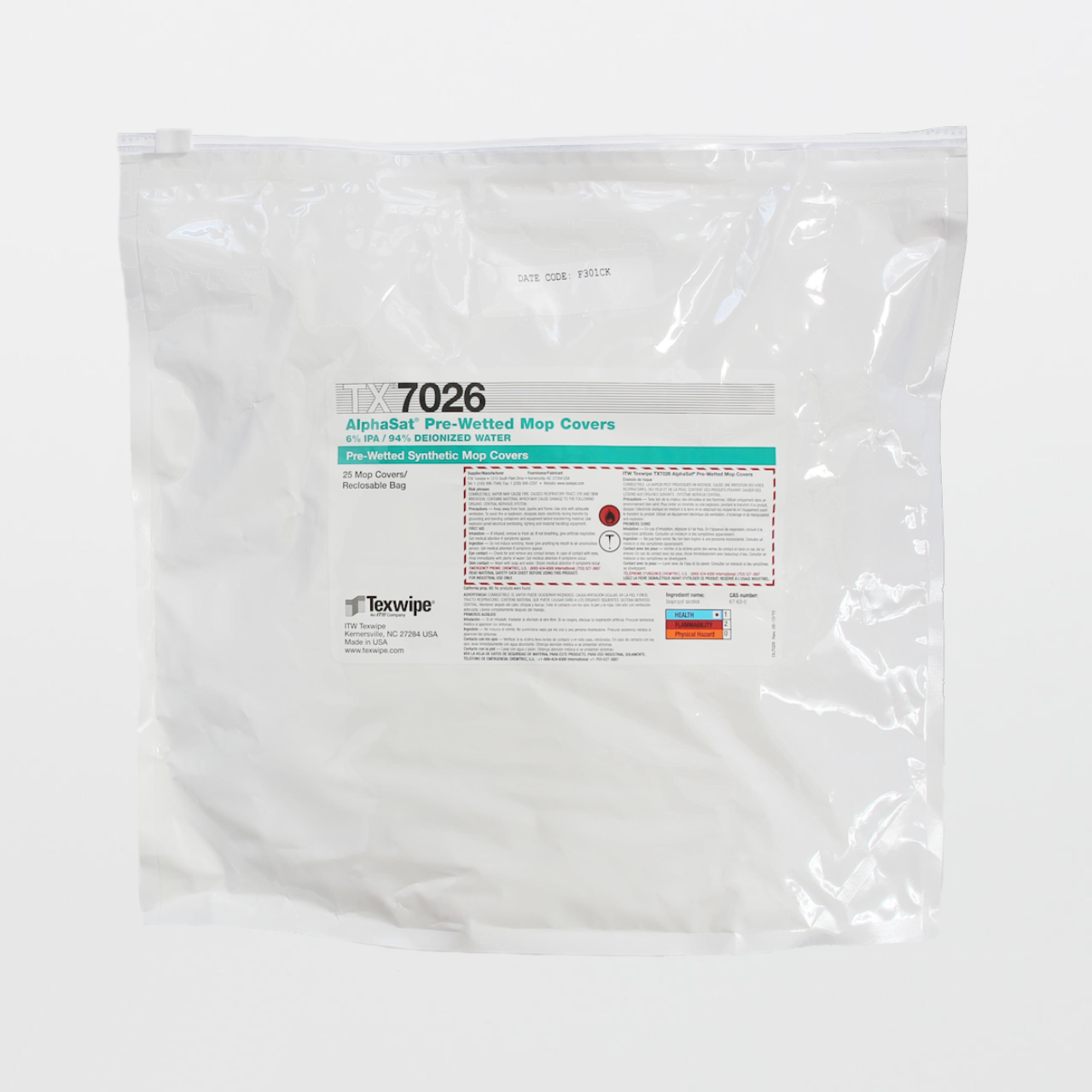
100 Mop Covers and 4 Foam Pads Per Case (4 Bags of 25 Mop Covers)
Type:
Pre-Wet Mop
Texwipe TX7026 AlphaSat® Pre-Wetted Replacement Mop Covers — 8" x 15", 6% IPA / 94% DIW (Refills)
TX7026 is a pre-wetted replacement mop cover set built for critical-environment floor, wall, and ceiling cleaning where you need a controlled liquid load and a low particle-generating polyester substrate. These AlphaSat® covers use Texwipe’s AlphaWipe® continuous-filament knitted polyester and arrive pre-wetted with a 0.2 µm filtered, semiconductor-grade 6% isopropyl alcohol (IPA) / 94% deionized water solution to help reduce mixing errors, cut VOC burden versus open buckets, and support repeatable surface wetting in production cleaning.

For over 35 years, SOS and Texwipe have been close partners, and SOSCleanroom is the authorized Master Distributor of ITW Texwipe for the United States market. That relationship matters when you are standardizing mopping systems: it supports continuity of supply, stable product lineage, and fast access to the manufacturer documentation your QA/QC team expects.

Published configuration (TX7026)
  • Cover size: 8" x 15" (20 cm x 38 cm)
  • Dry/Pre-Wet: Pre-wet
  • Substrate: AlphaWipe® continuous-filament knitted polyester (low-linting, low particle-generating by design)
  • Pre-wet solution: 6% IPA / 94% DIW (0.2 µm filtered; IPA described as semiconductor grade)
  • Packaging (inner): 25 covers per bag with foam pad(s) included; recloseable pouch feature to help prevent solvent evaporation
  • Packaging (case): Total 100 covers per case (4 bags of 25). Foam pads: listed as 4 pads/case on current product listings; older DS-7026 sheet lists 2 pads/case.
  • Compatible systems: Replacement covers for Texwipe AlphaMop™ flat mop kits including TX7108 and TX7108A
  • Cleanroom environment: Published as ISO Class 3–7 (also described as recommended for ISO Class 3 in some legacy documentation)
  • Non-sterile: Yes (sterile version not published for this part number)
  • Hazmat shipping: Ground shipping only; commercial address only; hazmat surcharge required per case (as configured at checkout)
Low-linting, low particle-generating — and the reality check
These covers are engineered for low particle generation and low extractables in critical cleaning. Even so, no textile system is truly “lint-free.” Treat mop covers as contamination-controlled components: control pouch wipe-down, glove discipline, change frequency, and the dry-time/evaporation window so the cleaning process stays repeatable shift to shift.

Practical cleanroom use guidance (technicians and engineers)
  • Pouch wipe-down before entry: Wipe the closed pouch per your site SOP (directional strokes; fresh wipe faces; do not re-deposit). Allow the pouch to dry before opening to reduce solvent transfer to gloves and work surfaces.
  • Control the liquid load: TX7026 is pre-wetted to a measured dilution. Do not add extra IPA/DI water in the pouch. Over-wetting increases streaking risk and can push solvent into seams, corners, and under equipment.
  • Pad alignment matters: Install the foam pad flat and centered, then fit the cover with even tension. Wrinkles and pad drift create “pressure ridges” that leave streaks and miss microtexture.
  • Stroke discipline: Use overlapping strokes with consistent pressure (avoid “scrubbing”). For walls/ceilings, work top-to-bottom and maintain a wet edge to avoid drying lines.
  • Change frequency: Replace covers based on area cleaned, bioburden/soil load, and your validation limits. In high-risk programs, change at every room transition or defined square-foot threshold.
  • Segregate by chemical and zone: Dedicate covers to a single chemical family and room/area where required. Cross-use is a common route for residue carryover and unintended chemical interaction.

Compatibility and wipe-down notes
  • Pre-wet chemistry: Published as 6% IPA / 94% DIW (0.2 µm filtered). This is intended to support controlled wetting for routine cleaning and solution application/removal.
  • Evaporation control: Reseal the pouch immediately after removing a cover. Leaving the pouch open drives concentration shift and dry-out, which changes cleaning behavior and can increase streaking.
  • Surface compatibility: IPA/DI water is commonly used on stainless, epoxy, vinyl, and many coated surfaces, but material tolerance is site-specific. If you have sensitive polymers or optical coatings, qualify under your conditions before standardizing.
  • Flammability / EHS: IPA-containing products require compliant storage and ground-only shipping. Follow site controls for flammables, ventilation, ignition sources, and waste handling.

Typical performance characteristics 
These are published as typical descriptions (not specifications) to support qualification planning and contamination-risk reviews.
Property Typical / published value Test method (as published)
Pre-wet chemistry 6% IPA / 94% DIW Not stated
Solution filtration 0.2 µm filtered (IPA described as semiconductor grade) Not stated
Substrate construction Continuous-filament knitted polyester (AlphaWipe®) Not stated
Packaging integrity Recloseable / zip-style pouch to help prevent solvent evaporation; package designed to be wiped down Not stated
VOC burden vs open buckets Pre-wetted format described as helping reduce VOC emissions Not stated
Cleanroom use range ISO Class 3–7 (also referenced as recommended for ISO Class 3 in legacy documentation) Not stated

Typical contamination characteristics 
Property Typical / published value Test method (as published)
Particle generation Described as ultra-low particle-generating Not stated
Extractables Described as low extractable levels Not stated
Ionic contamination Described as suitable for low ionic contamination requirements Not stated

Common failure modes 
  • Streaking / haze: Most often from uneven pad contact, wrinkled covers, or over-wetting. Prevent with flat pad installation, even tension, and controlled overlapping strokes.
  • Residue carryover: Caused by running one cover too long, crossing zones, or picking up bench oils/adhesives. Prevent with defined change frequency and zone/chemical segregation.
  • Evaporation dry-out: Leaving the pouch open shifts the liquid load and can increase drag and redeposition. Prevent with immediate reseal and minimizing time between removal and use.
  • Re-deposition of captured soil: Excessive scrubbing or back-and-forth strokes re-release particles. Prevent with directional technique and cover changes before saturation.
  • Safety / compliance misses: IPA-containing products require proper flammable handling and ground shipment controls. Prevent with EHS-compliant storage, labeling, and waste practices.

Storage and handling best practices
  • Keep pouches sealed until use; store per your flammable liquid controls and site policy.
  • Use FIFO and track lot/date codes where required. Non-sterile shelf life is published as 5 years from date of manufacture in the AlphaMop™ technical data sheet.
  • Transport pouches in closed totes; avoid crushing or pin-holing packaging that can accelerate evaporation.
  • After opening, do not leave covers exposed on carts or benches. Remove, install, and begin cleaning promptly to keep the intended wet load consistent.
Documentation 
SOS-hosted Texwipe datasheet (DS-7026, Effective: December 2010): Click Here
Texwipe manufacturer page (TX7026): Click Here
Texwipe technical data sheet (AlphaMop™ Series): Click Here
Texwipe Safety Data Sheet (SDS — English, US/Canada): Click Here
If you have any questions please email us at Sales@SOSsupply.com or give us a call at (214)340-8574.

Check out our AI ChatBot powered by SOSCleanroom data libraries - give it a try!
 
THIS IS NEW FOR 2026!

© 2026 SOS Supply. All rights reserved.