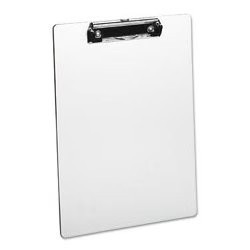
The cleanroom clipboard problem no one budgets for: preventing paper dust, residue transfer, and cross-zone drift with Unitek CRP0930
The Technical Vault | By SOSCleanroom
Documentation tools are high-touch and high-traffic: they move between gloves, paper, carts, drawers, and benches. That makes them a quiet contamination vector — not because a clipboard is “dirty,” but because paper dusting, solvent-wet gloves, clip wear, and cross-zone movement create residue transfer and debris pathways that show up as intermittent “mystery” findings.
The Unitek CRP0930 Clean-Write Cleanroom Clipboard is built for controlled-environment documentation: a stable 9.5" x 12" polypropylene writing surface with a top-mount, nickel-coated, non-particulating clip intended to reduce common office-clipboard failure modes in clean work areas.
The Operational Problem It Solves
In cleanrooms and controlled environments, clipboards fail in predictable ways:
- Paper dust and edge abrasion: dragging sheets under the clip or aggressive page changes can shed paper fibers near product.
- Residue transfer: solvent-wet gloves, disinfectant films, or pooled chemistry around the clip can transfer to page edges and back to surfaces downstream.
- Cross-zone drift: moving documentation tools between rooms (or between core and support areas) is a common root cause of “unexpected” debris or residue on paperwork.
- Wear debris over time: repeated snapping, over-extension, or overloading can degrade clip performance and create avoidable wear.
CRP0930 is designed to give technicians a controlled writing platform while supporting more disciplined handling: durable polypropylene, beveled edges, and a clip design positioned as non-particulating to reduce the “office tool in a clean area” problem.
What It’s For
CRP0930 is intended for controlled-environment documentation where operators need a stable writing surface for logs, travelers, batch notes, equipment checks, and material-status paperwork without introducing conventional office clipboards into the area.
Operationally, it is most useful at benches, carts, gowning/support stations, and line-side documentation points where paper handling and tool staging happen near controlled work.
Decision Drivers (What Buyers Should Care About First)
- Substrate choice: 1/4" polypropylene provides a durable, wipeable writing surface and reduces “fragile board” failure modes.
- Clip design intent: nickel-coated, non-particulating clip with stainless steel springs supports repeatable paper retention without rough clip edges or uncontrolled corrosion behavior.
- Edge behavior: beveled edges reduce sharp-corner scraping and incidental debris from corner impacts or bench dragging.
- Paper handling control: sized to hold standard 8 1/2" x 11" paper and adjust to fit a single sheet — useful for limiting overstuffing and “clip abuse.”
- Packaging and program discipline: cleanroom packaged; manufacturer packaging is listed as 10/case, while SOSCleanroom sells CRP0930 as an each unit (1 clipboard) for staged deployment.
Materials and Construction: Practical Implications
Board: 1/4" polypropylene is a practical material choice for controlled environments because it is durable and easier to keep visually clean than porous boards. The frosted-clear finish supports quick inspection for smears and residue films.
Clip assembly: the top-mounted, nickel-coated clip is described as non-particulating, with stainless steel springs. The operational goal is stable clamping without corrosion-driven roughness or flaking. The clip is also where residue pooling and wear show up first, so handling and wipe-down technique matter as much as materials.
Reality check: a cleanroom clipboard is not a particle-free object. Paper itself is a shedding risk. The control plan is minimizing abrasion events, minimizing solvent pooling, and enforcing storage/zone discipline so the clipboard does not become a “traveling contamination carrier.”
Identification control: clipboards are often untracked “miscellaneous” items. If your program is investigation-driven, treat clipboards like other clean tools: assign by zone, label where appropriate, and keep them in dedicated storage.
Specifications in Context
Published configuration (CRP0930):
| SOSCleanroom SKU |
CRP0930 |
| Quantity option |
Each (1 clipboard) |
| Size |
9.5" x 12" |
| Color |
Frosted clear |
| Substrate |
1/4" polypropylene |
| Clip specification |
Top-mounted, nickel-coated, non-particulating clip; stainless steel springs |
| Paper compatibility |
Holds 8 1/2" x 11" paper; adjusts to fit a single sheet |
| Packaging (manufacturer) |
10/case |
Practical interpretation: these are product characteristics (not performance specifications). If your SOP requires wipe-down prior to use, or if the clipboard is exposed to disinfectants, qualify in your conditions to confirm there is no residue transfer, embrittlement, whitening, tackiness, or clip-function change.
Cleanliness and Performance: What Matters Operationally
Clipboard contamination characteristics (particle shedding, ionic extractables, NVR) are not published as quantified values for CRP0930. In practice, cleanroom teams control risk through mechanics and procedure:
- Paper-dust control: insert and remove sheets deliberately. Avoid scraping paper under the clip near open product.
- Residue transfer control: do not load paper onto a solvent-wet surface. If wipe-down is required, use controlled wetness and allow full dry time before loading paperwork.
- Wear control: keep the clip closed when not in use. Avoid over-extension and avoid forcing thick stacks.
- Static attraction: polypropylene can tribocharge in low humidity and attract fines. Minimize rubbing against garments and follow site ESD/humidity controls where applicable.
Why Packaging and Handling Discipline Matter
Clipboards are often treated as “office supplies,” but in controlled environments they function like process tools. Keep CRP0930 in its clean packaging until introduced, and stage it in dedicated clean storage (drawer, cabinet, or bag) reserved for documentation tools.
Avoid storing clipboards loose with tools, metal clips, or abrasive items that can scratch polypropylene and generate debris. If you assign clipboards by zone (core vs. support) and keep them in that zone, you reduce cross-zone drift and shorten investigations when paperwork picks up unexpected debris or films.
Best-Practice Use: Operator Controls That Prevent Real Failures
- Zone discipline: assign clipboards by room/zone and keep them there.
- Clip discipline: keep the clip closed when not actively inserting/removing pages; avoid snapping and over-extension.
- Paper-change discipline: do page changes away from open product when possible; avoid sliding paper edges over benches.
- Wipe-down discipline: if wipe-down is required, avoid saturating seams; allow full dry time before loading paper.
- Dedicated storage: store in a clean drawer/cabinet or dedicated bag; do not stack with abrasive items.
Common Failure Modes—and How to Prevent Them
- Residue transfer to paperwork: prevent with dry-time control after wipe-down and avoiding solvent-wet gloves on the clipboard face.
- Paper edge abrasion and dusting: prevent by inserting/removing sheets deliberately and avoiding aggressive page changes near product.
- Clip wear and reduced clamping: prevent by avoiding thick stacks and over-extension; use for intended sheet count.
- Static attraction: prevent by minimizing rubbing against garments and following site ESD/humidity controls.
Where This Clipboard Fits in a Controlled Cleaning Program
CRP0930 sits in the documentation-control layer of a cleanroom program. It reduces the need to improvise with office supplies, but it does not replace handling discipline. If your area is residue-sensitive, treat wipe-down compatibility as a qualification item (your IPA concentration, contact time, and wipe type), and standardize storage and zone assignment so the clipboard does not become an uncontrolled variable during inspections and investigations.
Source basis
- SOSCleanroom product page: Unitek Cleanroom Clipboard (CRP0930) (dimensions, materials, clip description, packaging configuration, and published feature/benefit statements).
- Operational contamination-control practice basis applied: zone discipline, wipe-down dry-time control, paper-handling dust control, and storage segregation for high-touch documentation tools.