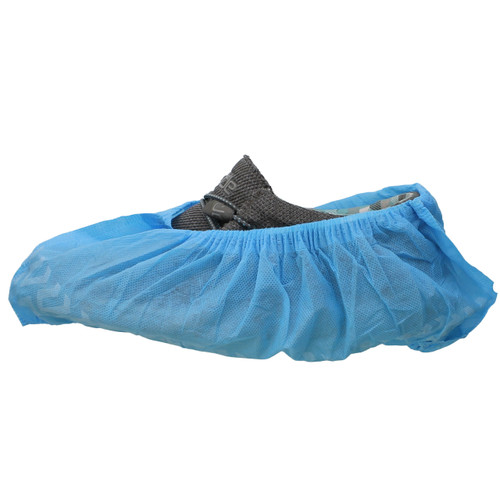
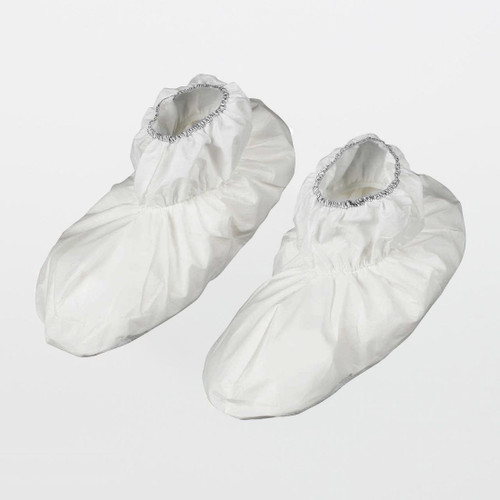
The Technical Vault: SCR200 Spunbonded Polypropylene Shoe Cover
Vault purpose: Technical analysis of spunbond polypropylene footwear covers, contamination transfer pathways, nonwoven material behavior, and controlled-environment deployment considerations.
1) Why Footwear Is a Major Contamination Source
Footwear is one of the highest-risk contamination vectors in controlled environments because shoe soles continuously interact with floor surfaces, collecting and redistributing particles during movement.
- Walking motion generates particle turbulence near the floor
- Shoe tread traps debris and transports contamination between zones
- Friction between soles and flooring can aerosolize particulates
- Personnel movement creates continuous contamination redistribution
In controlled environments, floor contamination can become airborne through mechanical disturbance, making footwear protocols an important component of contamination-control strategy.
2) Spunbond Polypropylene Material Structure
SCR200 shoe covers are manufactured from spunbond polypropylene nonwoven fabric. In spunbond production, thermoplastic polypropylene is extruded into continuous filaments that are thermally bonded into a lightweight sheet structure.
- Continuous filament structure reduces loose fiber generation
- Nonwoven construction improves breathability
- Low basis weight supports economical disposable use
- Hydrophobic polypropylene resists light moisture absorption
Compared to woven fabrics, spunbond materials provide lower manufacturing cost and reduced laundering complexity while maintaining acceptable particulate-control characteristics for many controlled environments.
3) Particle Generation and Shedding Characteristics
All apparel materials generate some level of particles during movement. Spunbond polypropylene is widely used because it generally produces lower lint levels than conventional textile fabrics.
- Continuous filaments reduce fiber breakage
- Thermal bonding minimizes loose particulate release
- No woven yarn intersections that can fray during flexing
- Disposable use eliminates contamination accumulation from laundering
Actual particle performance depends on material weight, manufacturing quality, walking conditions, and floor interaction.
4) Breathability vs Barrier Performance
Spunbond polypropylene is frequently selected because it balances wearer comfort and contamination-control functionality.
| Property |
Spunbond PP Behavior |
| Air permeability |
High |
| Liquid resistance |
Moderate to low |
| Heat retention |
Low |
| Wear comfort |
Good |
Because spunbond polypropylene prioritizes breathability, it is generally used in dry environments rather than high-liquid-exposure applications.
5) Elastic Retention and Fit Stability
Shoe-cover effectiveness depends heavily on maintaining position during movement. Improper fit can expose shoe surfaces or create tripping hazards.
- Elastic openings help maintain ankle retention
- Larger sizing accommodates bulkier footwear
- Movement-induced shifting increases contamination risk
- Oversized covers may increase drag and tearing potential
Proper sizing selection improves both contamination-control effectiveness and worker mobility.
6) Disposable vs Reusable Footwear Systems
| System |
Advantage |
Tradeoff |
| Disposable PP covers |
Low cost, no laundering |
Lower durability |
| Reusable cleanroom boots |
Higher durability |
Requires laundering validation |
Disposable systems are frequently preferred for visitor access, intermittent use, and environments where garment reprocessing infrastructure is unavailable.
7) Controlled Environment Deployment Considerations
- Use alongside tacky mats to reduce sole contamination load
- Replace immediately if torn or heavily soiled
- Match apparel protocols to room classification requirements
- Validate compatibility with flooring and slip-resistance requirements
Footwear control is most effective when integrated into a broader contamination-control program including garments, gloves, airflow management, and cleaning SOPs.
8) Typical Use Environments
- Cleanroom gowning and transition areas
- Pharmaceutical and biotech support spaces
- Electronics and semiconductor manufacturing
- Laboratories and controlled manufacturing
- Visitor and contractor contamination-control programs
9) Source Basis
- Nonwoven spunbond polypropylene manufacturing principles
- Controlled-environment contamination-control practices
- Cleanroom apparel deployment standards and SOP methodologies
- SOSCleanroom technical analysis and application guidance