1) What this garment is designed to do
Cleanroom garments do not "make" a cleanroom clean—your HVAC, filtration, cleaning program, and behavior controls do.
What apparel does is reduce one of the biggest contamination sources in any controlled environment: people.
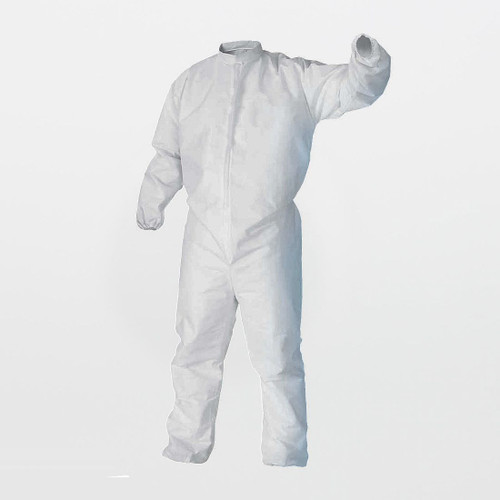
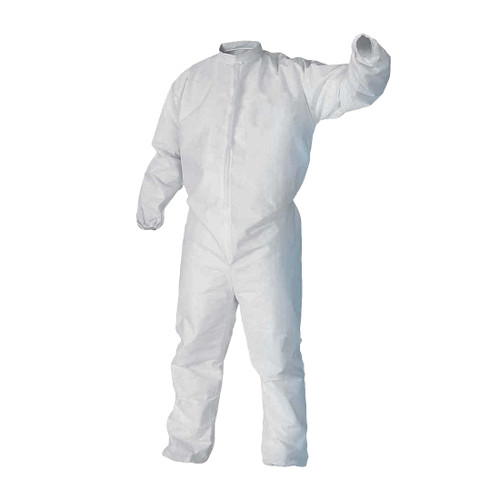
Disposable coveralls like Kimtech™ A5 are positioned to help reduce shedding and transfer risk during routine operations in controlled environments when paired with a disciplined gowning program.
2) Where the manufacturer positions non-sterile A5 apparel
Manufacturer catalogs commonly position non-sterile A5 cleanroom apparel for ISO Class 6–8 controlled environments and bioburden-control areas supporting non-sterile pharmaceutical manufacturing, biomedical research, compounding support, and biotechnology workflows (program- and equipment-dependent).
- Non-sterile cleanroom environments where sterility is not required by SOP.
- Operations that benefit from breathable disposable apparel to support compliance and comfort.
- Gowning rooms where throughput favors bulk case formats (25/Case).
3) Construction and design notes
The A5 platform is built around breathable SMS construction and a cleanroom-focused layout intended to support consistent coverage during movement.
Design features that typically matter most are: how sleeves stay in place (thumb loops), how closures are protected (zipper coverage), and how seams hold up across repeated bending, reaching, and material handling.
The manufacturer also publishes a sizing/design comparison for A5 coveralls (Reflex* design concept) positioned to reduce tear risk at typical stress points and improve fit through the torso and seat — important because poor fit drives operator "adjustments," which increases touch risk.
4) Ordering guide (bulk-packed A5 coveralls)
| Size option |
Manufacturer bulk code |
Case pack |
| Small | 49831 | 25/Case |
| Medium | 49832 | 25/Case |
| Large | 49833 | 25/Case |
| XL | 49834 | 25/Case |
| 2XL | 49835 | 25/Case |
| 3XL | 49836 | 25/Case |
| 4XL | 49837 | 25/Case |
| 5XL | 49838 | 25/Case |
| 6XL–8XL | 49841 | 25/Case |
5) ISO-first gowning (donning) discipline
Practical donning sequence (general template — follow your SOP)
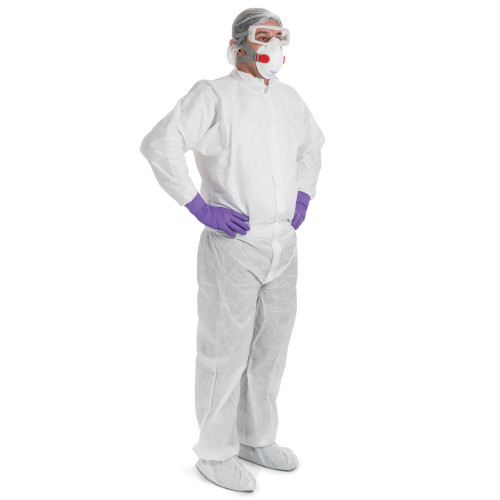
- Prep: remove jewelry; secure personal items; verify correct size; inspect package integrity; sanitize hands per SOP.
- Hair/face control first: don bouffant/hood, beard cover, and mask as required.
- Coverall handling rule: touch the inside only; avoid "shaking" garments; keep sleeves/legs controlled to prevent floor contact.
- Legs then torso: step in one leg at a time while seated/controlled; bring garment up without dragging; then insert arms.
- Secure closures: close zipper fully; ensure zipper flap is positioned; use thumb loops if your SOP specifies.
- Final checks: confirm full coverage; correct fit; no tears; then proceed to glove/boot integration steps per SOP.
The most common contamination failures during gowning are (a) touching the outside of the coverall with bare hands, (b) allowing legs/sleeves to contact the floor, and (c) re-adjusting fit repeatedly after entry.
6) EU GMP Annex 1 overlay
- Qualification and requalification: Annex 1 expects gowning qualification with regular reassessment and ongoing evaluation of adherence.
- Garment integrity and visual checks: garments should be visually checked for integrity and replaced when damaged.
- Higher-grade (A/B) reality: sterile programs are typically required for Grade A/B work.
- Bottom line: non-sterile bulk apparel may be appropriate for Grade C/D support areas (SOP-dependent), but sterile programs are typically required for Grade A/B work.
7) Common failure modes (and how to prevent them)
- Floor-contact events: seated donning and keeping cuffs lifted prevents dragging contamination upward.
- Touching the outside surface: handle from the inside; don slowly and deliberately.
- Fit-driven re-adjustment: correct sizing reduces post-entry adjustments that increase touch events.
- Tears at stress points: follow manufacturer sizing guidance; replace damaged garments immediately.
8) Closest alternatives (selection logic)
- A5 individually packed (non-sterile): tighter point-of-use handling control where SOP requires it.
- A5 sterile coveralls: when sterile garment presentation/documentation is required (aseptic programs).
- A8 non-sterile coveralls: when a different apparel tier aligns better to your cleanliness target.
9) SOSCleanroom note about SOPs
The Technical Vault is written to help customers make informed contamination-control decisions and improve day-to-day handling technique.
It is not your facility's Standard Operating Procedure (SOP), batch record, or validation protocol.
Customers are responsible for establishing, training, and enforcing SOPs that fit their specific risks, products, equipment, cleanroom classification, and regulatory obligations.
If you adapt any technique guidance from this entry, treat it as a starting template. Your team should review and approve the final method, then qualify it for your specific processes and risk profile.
10) Source basis (manufacturer datasheets + standards)
SOSCleanroom is the source for this Technical Vault entry.
Briefed and approved by the SOSCleanroom (SOS) staff.
If you have any questions please email us at Sales@SOSsupply.com
If you need additional information please try our SOSCleanroom specific AI ChatBot which draws from our extensive cleanroom specific libraries.
Last reviewed: April 29, 2026
© 2026 SOSCleanroom