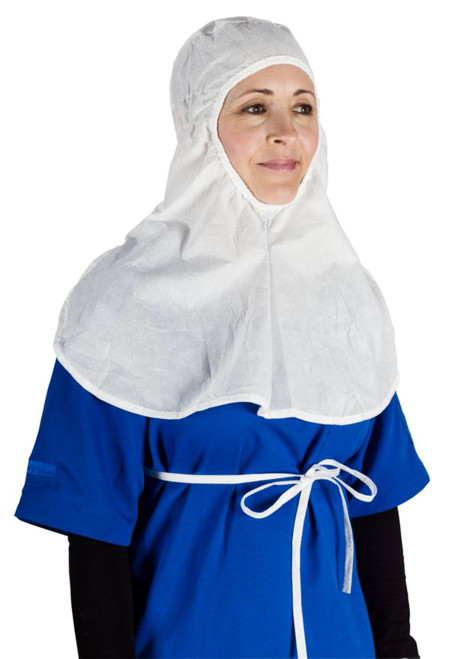
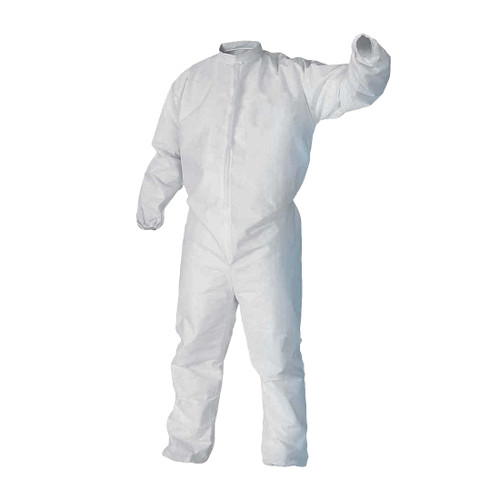
Shown: Kimtech A5 Hood with Ties (non-sterile), manufacturer code 25796.
Why cleanroom hoods matter (the “people” problem)
In most controlled environments, people are the dominant contamination source: hair, skin flakes, clothing fibers, and micro-droplets generated by movement and talking.
A cleanroom hood is a simple control that helps limit head/neck shedding — but only when it is paired with correct donning technique, compatible mask/eye protection (as required),
and a complete gowning program aligned to your cleanroom classification.
What this product is used for
- Head coverage in ISO Class 5–8 cleanroom gowning systems (environment and equipment dependent).
- Support areas and bioburden-controlled workflows where non-sterile headgear is permitted by SOP.
- Compounding, mixing, filling, and cleaning tasks where consistent gowning reduces variation across operators.
Why customers consider this hood
- Simple fit control: ties allow operators to secure head coverage without improvised adjustments.
- System compatibility: designed to be one component in a complete head-to-toe gowning set.
- A5 platform positioning: manufacturer selection charts place A5 apparel within ISO Class 5–8 cleanroom use context (site dependent).
- Operational efficiency: 100/case supports gowning-area replenishment and stocking discipline.
Materials and construction (manufacturer context)
Kimtech literature describes the A5 apparel platform as SMS (spunbond/meltblown/spunbond) fabric, with outer spunbond polypropylene layers and a microfiber middle layer intended to help filter particulates and resist many water-based liquids (application dependent).
For contamination control programs, material selection matters — but technique and behavior matter just as much.
Specifications in context
The table below consolidates the published manufacturer identifiers that matter for ordering, receiving, and SOP alignment.
| Attribute |
Kimtech A5 Hood (Non-Sterile) |
| Manufacturer code |
25796 |
| Description |
Hood with ties |
| Size |
Universal |
| Total per case |
100 |
| Sterility |
Non-sterile (select sterile garments when required by grade/SOP) |
| ISO context (catalog) |
A5 apparel is shown in ISO Class 5–8 selection context; ISO compatibility depends on cleanroom equipment capability and site controls |
Cleanroom standards context (ISO first)
ISO cleanroom programs start with classification (ISO 14644-1) and then require disciplined operations to maintain the target cleanliness level.
ISO 14644-5 describes an operations control programme that includes personnel management and a gowning programme, along with controlled entry/exit and cleaning/monitoring.
The practical takeaway: apparel selection is only “half the control” — the other half is training, behavior, and repeatable donning technique.
Manufacturer gowning guidance (what “minimal gowning” implies)
Kimtech selection charts show that as ISO class becomes more stringent, “minimal gowning requirements” expand to cover head/face, body, and footwear — typically including a hood, face mask, coverall, boots/shoe covers, and gloves.
Use these charts as a starting point, then finalize requirements via your facility SOPs and risk assessment.
Best-practice donning (technique that reduces contamination)
Donning checklist (ISO-aligned principles)
- Start clean: remove jewelry and non-essential items; follow your hand hygiene and gowning-room entry procedure.
- Control contact points: only touch the inside of the hood during donning; avoid contacting the outer surface with bare hands.
- Close the “hair/skin gaps”: fully contain hair and ensure the hood sits correctly around the head and neck; tie securely without leaving loose ends that can contact garments/surfaces.
- Pair correctly: add the approved face mask and eye protection as required by your SOP (this hood does not include a mask).
- Final check: perform a quick integrity/fit check before entering the higher-grade area; replace if torn, wet, or contaminated.
European Annex 1 (GMP) add-on: For aseptic manufacture (Grades A/B), Annex 1 provides explicit gowning expectations (e.g., sterile headgear enclosing all hair, sterile facemask and eye coverings, footwear/over-boots, sleeves tucked into a second pair of sterile gloves, and garments packed/folded to avoid touching the outer surface or the floor).
If your operation is governed by EU GMP Annex 1, treat those Grade A/B provisions as controlling requirements and select sterilized garments where specified.
Common failure modes (what to coach and audit)
- Exposed hairline / ears / neck: adjust the hood fit before crossing the gowning boundary.
- Touching the outer surface while donning: train operators to handle only internal surfaces and ties.
- Mask mismatch: ensure the selected mask seals and sits correctly with the hood to reduce droplet/particle escape.
- Wrong sterility level: non-sterile headgear used where sterilized garments are required by grade/SOP.
Critical environment fit for this product
This hood is a practical fit where your gowning program specifies non-sterile head coverage in ISO Class 5–8 contexts and where head/neck shedding control is part of day-to-day discipline.
For higher criticality aseptic operations, confirm whether your process requires sterilized headgear and additional gowning controls (training, qualification, and periodic reassessment).
SOSCleanroom note about SOPs
The Technical Vault is written to help customers make informed contamination-control decisions and improve handling technique.
It is not your facility’s Standard Operating Procedure (SOP), batch record, or validation protocol.
Customers are responsible for establishing, training, and enforcing SOPs that fit their cleanroom classification, product risk, equipment capability, and regulatory obligations.
Always confirm gowning requirements (including sterility level) using your internal quality system and documented methods.
Use these best-practice suggestions to strengthen your SOPs — not to replace them. Final gowning sequences and acceptance criteria must be reviewed and approved by your quality team.
Source basis
- Manufacturer catalog (Kimtech Scientific Products Catalog, 2018): https://www.soscleanroom.com/content/Kimberly_Clark_PDF/2018%20Scientific%20Catalog.pdf
- SOSCleanroom product page (SKU 25796): https://www.soscleanroom.com/product/kimtech/kimberly-clark-kimtech-a5-non-sterile-cleanroom-hoods/
- ISO 14644-1 (cleanroom classification context): https://www.iso.org/standard/53394.html
- ISO 14644-5 (operations control programme / gowning program context): https://www.iso.org/standard/88599.html
- EU GMP Annex 1 (sterile manufacture; gowning expectations by grade): https://health.ec.europa.eu/document/download/e05af55b-38e9-42bf-8495-194bbf0b9262_en?filename=20220825_gmp-an1_en_0.pdf
SOSCleanroom is the source for this Technical Vault entry.
Briefed and approved by the SOSCleanroom (SOS) staff.
If you have any questions please email us at Sales@SOSsupply.com
Last reviewed: Jan. 14, 2026
© 2026 SOSCleanroom