
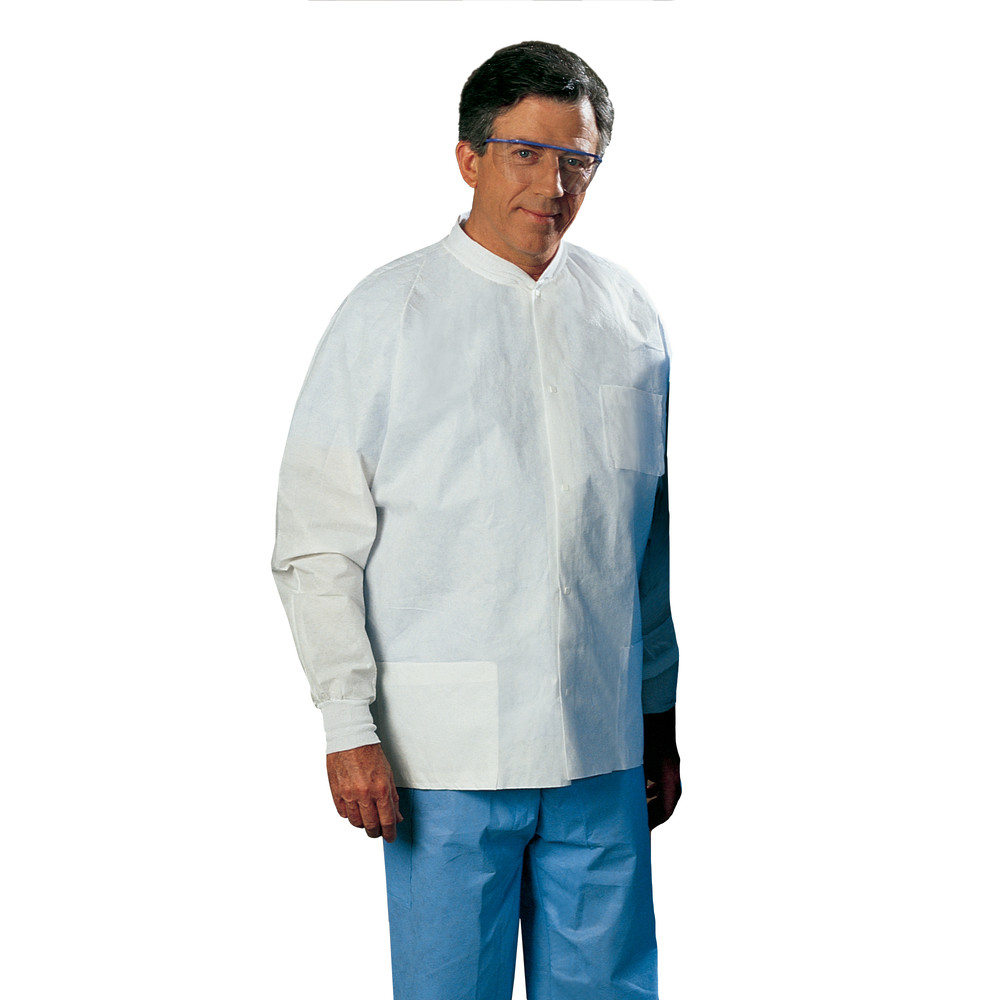
Kimberly-Clark Kimtech A8 Lab Coat

$254.36
(No reviews yet)
SKU:
Kimtech 1007x
Availability:
5 - 7 Business Days
Shipping:
Calculated at Checkout
Kimberly-Clark Kimtech™ A8 Lab Coat — 3-Layer SMS, Knit Cuffs & Knit Collar, Snap Front, Reinforced Pockets (25/Case)
A8 (Lab / Controlled Areas) 3-Layer SMS (Nonwoven) Knit Cuffs Knit Collar 5 Snap Closure 3 Reinforced Pockets Back Vent Neck Loop 25/Case

Overview

Kimtech™ A8 Certified Lab Coats are designed to deliver a balanced blend of comfort and protective coverage for laboratory and controlled workflows where low-to-moderate exposure potential to chemicals or fluids may exist. The coat is constructed from 3-layer SMS nonwoven fabric and includes knit cuffs (wrist interface control), a knit collar (comfort + coverage), a 5-snap front, and a back vent for ventilation.

SOSCleanroom prioritizes best-in-class PPE because contamination control is not the place for “close enough.” Kimtech is now part of the Ansell portfolio, and SOSCleanroom’s long-standing alignment with Ansell supports standardized programs, documentation expectations, and dependable supply for regulated customers.


Why this lab coat matters in controlled environments
  • Barrier + comfort in one garment: SMS construction supports daily wear while maintaining practical protective coverage.
  • Wrist interface control: Knit cuffs help keep sleeves positioned and improve overlap with gloves.
  • Task readiness: Three reinforced pockets support tools, logs, and workflow items where pockets are permitted by SOP.
  • Consistent closure: Five snaps support repeatable donning and closure discipline in high-traffic lab areas.
  • Wearer comfort: Back venting and a knit collar help reduce heat stress during extended use.

Typical tasks supported
  • Research laboratory work and general lab operations
  • Industrial and manufacturing support workflows where protective apparel is required
  • Material handling, receiving, and staging where garment coverage reduces transfer risk
  • Quality, inspection, and documentation tasks where pockets improve workflow efficiency (if permitted)
  • Low-to-moderate splash potential steps (per your risk assessment and SOP)

Key specifications (published)
SKU family Kimtech 1007x (size-dependent)
Fabric 3-layer SMS (nonwoven)
Cuffs / collar Knit cuffs; knit collar
Closure / features 5 snaps; 3 reinforced pockets; back vent; neck loop
Sizes shown (site) Small, Medium, Large, XL, 2XL, 4XL, 6XL
Availability (site) Typically 5–7 business days

Selection note: Garment suitability should be determined by your facility risk assessment, task hazards, and contamination control requirements (SOP/CCS).


Packaging and handling

Available Quantity Option: Case. Case Unit: 25 lab coats. For controlled environments, stage garments per SOP (remove outer shipping materials outside the controlled area; open cases in designated gowning or staging zones).

If your workflow prohibits pockets (particle traps) or snap closures, consider pocketless zipper-front alternatives within the Kimtech A8 family, depending on your contamination control strategy.


EU GMP Annex 1 alignment notes (practical)

Annex 1 programs treat garments as part of the facility Contamination Control Strategy (CCS). Selection is only one control—performance depends on gowning sequence, zoning, change frequency, and operator behavior.

  • Zoning: define where non-sterile lab coats are permitted (and where sterile gown systems are required).
  • Interface control: confirm cuff overlap with gloves; use cuff sealing only if required by SOP and validated for your process.
  • Change triggers: replace on tear/snag, splash event, or when exiting the controlled workflow.

Storage and lifecycle control
  • Store in original packaging in a clean, dry location to maintain packaging integrity.
  • Use FIFO and standardize substitutions through change control.
  • If packaging integrity is compromised, quarantine and replace per your quality system.

Standards and regulatory references (where applicable)

Documentation

Use manufacturer literature for qualification packets, safety reviews, and change-control support.


If you have any questions please email us at Sales@SOSsupply.com or give us a call at (214)340-8574. OR check out the AI ChatBot powered by SOSCleanroom data libraries - give it a try! THIS IS NEW FOR 2026! © 2026 SOSCleanroom. All rights reserved.
The Technical Vault By SOSCleanroom
ISO-First Gowning (Donning) Discipline Pocket & Closure Risk Annex 1 CCS Thinking Kimtech A8 Lab Coat

ISO-first: why lab coats exist in contamination control

In contamination-controlled workflows, people are often the dominant particle source. A lab coat is a practical control that reduces shedding from street clothes, stabilizes coverage during movement, and reduces direct contact transfer to benches, carts, and materials.

Critical point: garments are not “set-and-forget.” Performance depends on donning technique, where the garment is permitted (zoning), and when it is changed (discipline).


Donning (how to minimize contamination transfer)
  1. Stage correctly: remove outer shipping materials outside the controlled area; open the case in the designated gowning/staging zone per SOP.
  2. Hands first: perform hand hygiene per SOP before touching the garment collar, snaps, or pockets.
  3. Control touch points: handle interior surfaces as much as possible; avoid brushing the exterior against benches and door frames.
  4. Close it completely: engage all snaps to prevent gapping at the chest/abdomen during movement.
  5. Wrist interface: keep knit cuffs under the glove cuff; avoid rolling cuffs back (re-exposes skin and increases shedding).
  6. Change triggers: replace after any tear/snag, splash event, or contact with non-controlled surfaces.

Pockets and snaps: practical risk controls
  • Pockets are useful, but they are also traps: if your SOP prohibits pockets in higher-cleanliness zones, keep this coat limited to approved lab/support areas.
  • Snap manipulation is a contamination moment: avoid re-snapping after entry; if re-adjustment is necessary, follow SOP (often re-glove or sanitize).
  • Escalation path: where contamination sensitivity increases, many facilities migrate to pocketless, high-closure garments (e.g., zipper-front, sealed seams, sterile presentation) based on risk assessment and CCS.

EU GMP Annex 1: CCS-style garment control
  • Zoning: define exactly where this non-sterile coat is permitted, and where sterile gown systems are mandatory.
  • Interface management: specify glove overlap rules; train to avoid exposed wrists.
  • Documentation: lock garment SKUs/sizes (Kimtech 1007x family) and substitutions under change control so behavior and risk remain consistent.

Best-in-class programs (Kimtech + Ansell alignment)

SOSCleanroom supports best-in-class contamination-control programs by standardizing proven manufacturers and maintaining close alignment with Ansell (including the Kimtech portfolio). This helps customers reduce “uncontrolled variability” across sites, maintain documentation readiness, and avoid unplanned substitutions.

When audits matter, consistency matters: garment selection, donning steps, glove interface discipline, and change triggers should be documented, trained, and enforced.


Complete the system (recommended companions)


If you have any questions please email us at Sales@SOSsupply.com or give us a call at (214)340-8574. OR check out the AI ChatBot powered by SOSCleanroom data libraries - give it a try! THIS IS NEW FOR 2026! © 2026 SOSCleanroom. All rights reserved.