1) Why gowning discipline matters (more than most teams think)
In cleanrooms and controlled environments, people are one of the largest contamination sources: particles shed from skin, hair, street clothing, and “high-touch” behaviors (adjusting garments, touching the face, leaning on surfaces).
The purpose of protective apparel is to reduce shedding, reduce transfer from street clothing, and make contamination behavior more repeatable.
A lab coat only works as intended when it is donned in the correct order, worn correctly, and handled consistently at the gowning boundary.
2) What this lab coat is used for
- Non-sterile controlled areas where a cleanroom/lab coat is permitted by SOP (e.g., support corridors, staging zones, inspection zones, and certain laboratory workflows).
- Work environments where the manufacturer positions “low to moderate potential exposure” for chemicals or fluids (program dependent).
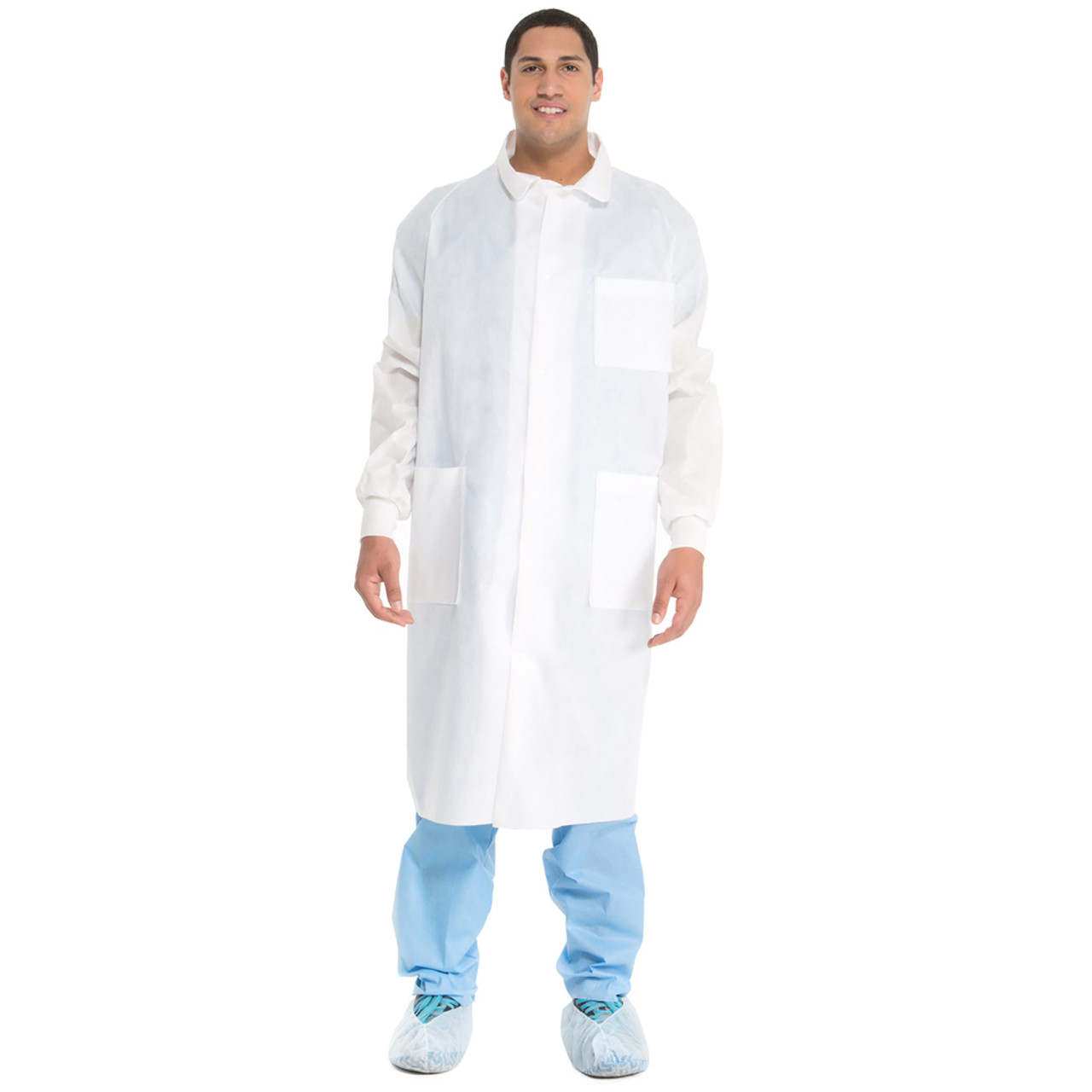
- Situations where knit cuffs, coat length, and consistent closure support coverage discipline and reduce exposed wrist/forearm interfaces.
- Visitor/maintenance apparel where a defined garment layer is required before controlled entry (as allowed by the site contamination control strategy).
3) Why customers consider this model (A8 “Certified Lab Coat + Extra Protection” family)
- SMS barrier structure: manufacturer literature positions protective 3-layer SMS fabric for light fluid protection.
- Coverage features: knit cuffs, traditional collar, and mid-calf coat length support basic controlled-entry expectations when worn correctly.
- Practical build: snap-front closure, reinforced pockets, back vent, and a neck loop are included in the “Extra Protection” lab coat family listing.
- Stocking simplicity: bulk packed case quantities support routine gowning-room replenishment.
4) Materials and build (manufacturer-positioned attributes)
This Kimtech A8 lab coat is positioned in manufacturer literature as a protective 3-layer SMS nonwoven garment for light fluid protection, with versions described as offering blood strike-through resistance (“Extra Protection” positioning, model-family dependent).
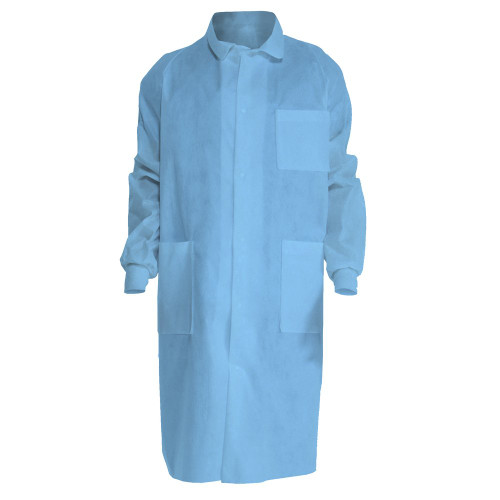
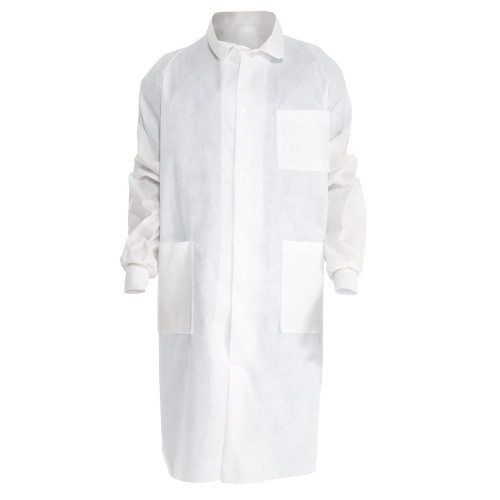
The SOSCleanroom listing for the Long/Tall option includes knit cuffs, a traditional collar, a 6-snap front, 3 reinforced pockets, a back vent, and a neck loop for hanging.
Key cleanroom takeaway: knit cuffs and correct closure reduce the chance of exposed wrists/forearms and reduce “open-front” garment behaviors that increase particle transfer.
The coat’s value is maximized when paired with consistent donning technique and controlled touchpoints at entry.
5) Specifications in context (receiving + SOP alignment)
| Attribute |
What to record / verify |
| SOSCleanroom SKU shown |
Kimtech 1004x (Long/Tall option) |
| Manufacturer family |
Kimtech A8 Certified Lab Coat + Extra Protection (mid-calf length listing in manufacturer catalog) |
| Material |
Protective 3-layer SMS (nonwoven) |
| Cuffs / collar / closure |
Knit cuffs; traditional collar; 6 snaps (per SOS listing) |
| Pockets / vent / hanging loop |
3 reinforced pockets; back vent; neck loop (per SOS listing and manufacturer family description) |
| Case pack |
25/case standard; 2XL = 10/case (as listed) |
| ISO class positioning |
Manufacturer catalog places A8 lab coat grouping in ISO 6–8 context; final suitability is SOP- and risk-based |
| Country of origin |
Not stated in the source basis listed below; treat as a receiving/documentation requirement if your program requires COO |
6) Cleanliness performance (what you should focus on)
For lab coats used in controlled environments, “performance” is usually less about marketing terms and more about repeatability:
(1) coverage integrity (wrists closed, front closed, hem coverage maintained), (2) controlled contact behaviors (don’t touch the outside after donning), and
(3) consistent change/issue criteria (when to replace).
A strong garment becomes a weak control when donning and handling are inconsistent.
7) Packaging, traceability, and receiving checks
- Confirm the exact garment family: A8 lab coat vs. A7 or other material families (match to your SOP).
- Confirm case quantity by size: particularly 2XL packaging differences.
- Control storage and issue: keep cases sealed until use and limit open-case exposure in gowning areas.
- Document what matters for audits: item code, size, lot/batch identifiers (if supplied), receiving date, and approved use area.
8) Best-practice donning (gowning) to minimize contamination
ISO-first guidance (cleanroom operations mindset)
- Don from “clean to cleaner”: follow your site’s gowning order so you do not contaminate clean layers after they are on.
- Treat the outside of the coat as a controlled surface: once donned, keep hands off the exterior except where the SOP requires adjustments.
- Seal wrists every time: knit cuffs must sit correctly. If gloves are used, verify the glove-to-cuff interface matches your SOP (no exposed wrist).
- Close the front fully: snap every snap that your SOP expects. Partial closure creates a “chimney effect” and increases transfer risk.
- Move deliberately: fast movements increase particle generation and resuspension. Slow down at entry and near sensitive work.
European Annex 1 add-on (sterile medicinal product expectations, where applicable)
- Minimize fibre/particle shedding: select and wear garments that reduce shedding, and enforce behaviors that prevent garment disturbance.
- Grade D baseline: hair/beards/moustaches covered; a general protective suit and appropriately disinfected shoes or overshoes worn (then add controls based on CCS and activity risk).
- Gowning in appropriate change rooms: gowning must be performed in change rooms of appropriate cleanliness to maintain gown cleanliness.
- Risk-based upgrades: additional gowning (e.g., gloves/facemask) may be required in Grade C/D when activities are contamination risks per the CCS.
Practical takeaway: the coat is only one layer in a system. If your process risk increases, your CCS/SOP may require integrated head/face/hand/foot controls and stricter garment qualification.
Use ISO as the foundation for cleanroom operations discipline, then apply Annex 1 requirements when your regulated scope demands it.
9) Common failure modes (and how to prevent them)
- Exposed wrists: cuffs not seated; glove interface not controlled.
- Half-closed front: snaps skipped or popped during work.
- Pocket misuse: frequent reaching increases garment disturbance and transfer.
- Re-touching the exterior after entry: adjusting collar/cuffs repeatedly.
- Improper change-out: worn too long, used while wet/soiled, or carried between zones without controls.
10) Closest competitors (how to compare correctly)
Compare other non-sterile SMS lab coat programs by: fabric family, cuff style, closure type, cleanroom positioning, packaging discipline, and documentation support.
For regulated environments, the right comparison is “meets my CCS/SOP and qualification” — not “looks similar.”
11) Critical environment fit (where this coat typically belongs)
Based on manufacturer positioning and typical industry use, Kimtech A8 lab coats are most often used in non-sterile controlled environments and support areas where light fluid protection and particle-control discipline are required by SOP.
If your work is aseptic/sterile manufacturing, validate garment suitability, gowning layers, and operator qualification against Annex 1 expectations and your CCS.
12) SOSCleanroom note about SOPs
The Technical Vault is written to help customers make informed contamination-control decisions and improve day-to-day handling technique.
It is not your facility’s Standard Operating Procedure (SOP), batch record, or validation protocol.
Customers are responsible for establishing, training, and enforcing SOPs that fit their specific risks, products, equipment, cleanroom classification, and regulatory obligations.
Always confirm material suitability, cleanliness requirements, and gowning acceptance criteria using your internal quality system and documented methods.
Use these best-practice suggestions to strengthen your SOPs — not to replace them.
13) Source basis (manufacturer + standards)
- SOSCleanroom product page (Kimtech A8 Lab Coat Long/Tall): https://www.soscleanroom.com/product/kimtech/kimberly-clark-kimtech-a8-lab-coat-long-tall/
- Manufacturer catalog (Kimtech Scientific Products Catalog, hosted by SOSCleanroom): https://www.soscleanroom.com/content/Kimberly_Clark_PDF/2018%20Scientific%20Catalog.pdf
- ISO 14644-1 (cleanroom classification context): https://www.iso.org/standard/53394.html
- ISO 14644-5 (operations / gowning discipline context): https://www.iso.org/standard/88599.html
- EU GMP Annex 1 (European sterile manufacturing gowning expectations): https://health.ec.europa.eu/system/files/2022-08/20220825_gmp-an1_en_0.pdf
SOSCleanroom is the source for this Technical Vault entry.
Briefed and approved by the SOSCleanroom (SOS) staff.
If you have any questions please email us at Sales@SOSsupply.com
Last reviewed: Jan. 14, 2026
© 2026 SOSCleanroom